Thursday, March 20, 2008
An unapologetic apologia for the Iraq war
Contrarian Christopher Hitchens takes stock of the Anglo-American intervention into Iraq, on the occasion of the fifth anniversary of the war, in "How did I get the Iraq war so wrong? I didn't" (The Australian, March 20, 2008).
Hitchens reminds us of some notable successes achieved:
Yet, he does rebut the easy answer of those war critics who think that had we simply not intervened, any bad result would not be our fault. He dubs this position the "Bishop Berkeley theory," to wit, "if a country collapses and succumbs to trauma, and it's not our immediate fault or direct responsibility, then it doesn't count, and we are not involved."
Hitchens points to the potentially shameful and dire consequences of the Bishop Berkeley attitude toward a "war of choice" in Burma, Rwanda and Darfur.
Alas, in a morally ambiguous world, there is no safe refuge from responsibility.
Hitchens reminds us of some notable successes achieved:
A much-wanted war criminal was put on public trial.Hitchens provides no conclusive reason to claim these positive developments outweigh the negative results: the costs of the war in lives and treasure and its undesirable unintended consequences.
The Kurdish and Shi'ite majority was rescued from the ever-present threat of a renewed genocide.
A huge, hideous military and party apparatus, directed at internal repression and external aggression was (perhaps overhastily) dismantled.
The largest wetlands in the region, habitat of the historic Marsh Arabs, have been largely recuperated.
Huge fresh oilfields have been found, including in formerly oil-free Sunni provinces, and some important initial investment in them made. Elections have been held, and the outline of a federal system has been proposed as the only alternative to a) a sectarian despotism and b) a sectarian partition and fragmentation. Not unimportantly, a battlefield defeat has been inflicted on al-Qa'ida and its surrogates, who (not without some Baathist collaboration) had hoped to constitute the successor regime in a failed state and an imploded society.
Further afield, a perfectly defensible case can be made that the Syrian Baathists would not have evacuated Lebanon, nor would the Gaddafi gang have turned over Libya's (much larger than anticipated) stock of WMD, if not for the ripple effect of the removal of the region's keystone dictatorship.
Yet, he does rebut the easy answer of those war critics who think that had we simply not intervened, any bad result would not be our fault. He dubs this position the "Bishop Berkeley theory," to wit, "if a country collapses and succumbs to trauma, and it's not our immediate fault or direct responsibility, then it doesn't count, and we are not involved."
Hitchens points to the potentially shameful and dire consequences of the Bishop Berkeley attitude toward a "war of choice" in Burma, Rwanda and Darfur.
Alas, in a morally ambiguous world, there is no safe refuge from responsibility.
Labels: al Qaeda, Al-Qa'idah, Al-Qaeda, Al-Qaida, Burma, Christopher Hitchens, Darfur, Iraq, Lebanon, Libya, Rwanda, Syria


Thursday, January 31, 2008
Seized records detail al Qaeda foreign recruits in Iraq
Documents captured by coalition forces last fall in Sinjar, near the Syrian-Iraqi border, provide a profile of al Qaeda’s foreign recruits in Iraq. The more than 600 records of individual recruits were made public by the Army's Combating Terrorism Center at West Point, and are discussed on the web by the Inter Press Service News Agency. They were also the subject of a Dubai Al-Arabiya television program, broadcast in Arabic and translated (January 30, 2008) by BBC Worldwide Monitoring.
The documents are dated from August 2006 to August 2007. Here are some details and statistics on the al Qaeda recruits:
The documents are dated from August 2006 to August 2007. Here are some details and statistics on the al Qaeda recruits:
- 56% of the recruits expressed an interest in suicide bombing;
- 43% of the recruits listed an interest in being traditional fighters;
- The youngest recruit was 16 and the oldest was 54;
- More than 40% of the recruits were from Saudi Arabia, and the majority of Saudi recruits came from Riyadh and Mecca;
- 19% of the recruits were from Libya and the majority of the Libyan recruits come from Dirnah;
- 85% of the Libyan recruits were prospective suicide bombers;
- 50% of the Saudi recruits expressed an interest in suicide bombing;
- Syria, Yemen and Algeria each accounted for 8% of the recruits; the majority of Syrians come from Dayr al-Zur, a rural town near the Iraqi border;
- 6.1% of the recruits were Moroccans;
- 42% listed at least one contact in Syria, and several listed multiple contacts;
- The recruitment questionnaire asks recruits for the name of their “coordinator” (smuggler) and how much money they paid to be moved across the border, thereby indicating that al Qaeda is relying on a Syrian logistics network run by Syrian “mercenaries, free-lancers, and criminal smuggling networks";
- 82.4% of the Libyans arrived in Iraq through the same pathway through Egypt and then by air to Syria, and the recruiting and logistics network is said to be likely tied to the Libyan Islamic Fighting Group (LIFG);
- The recruiting organization in Algeria is the Salafist-inspired Group for Preaching and Combat (GSPC), now renamed al Qaeda Organization in the Islamic Maghrib.
"Al-Qa'idah cannot do anything in Iraq without assistance from some countries in the region, which might be Syria and the cooperation it extends in this regard. This is in addition to the assistance extended by the followers of the former regime of Saddam Husayn. It seems that there is a network in Syria that helps these elements enter into Iraq."Qambar concludes:
"I believe that the status of Al-Qa'idah in Iraq is increasingly deteriorating. You know well that 600 fighters cannot alter the course of the battle, but the majority of these fighters are suicide attackers who are capable of carrying out the blind suicide attacks that cause harm to the Iraqi people....If these fighters are not killed in Iraq and leave the country, they will be a threat, and I believe that they would become commanders for Al-Qa'idah and Islamic extremist organizations in their countries. Therefore, I believe that there should be a joint international effort in coordination with Iraq to tackle this situation."
Labels: al Qaeda, Al-Qa'idah, Iraq, Libya, Syria
Monday, December 20, 2004
Turkey and the European Union: Cui Bono?
The European Union decided last week to start negotiations with Turkey over that country's possible accession into the EU. The decision has generated a variety of takes on just whose interests would be served by the success or failure of the talks. Here is a sample:
Morocco's L'Economiste newspaper claimed that if the European Union should eventually refuse membership to Turkey that a chasm between the West and the Muslim world would be created that would mark a victory for Al Qaeda leader Osama bin Laden:
Defense & Foreign Affairs Daily sees the Turkish General Staff as resisting compliance over Cyprus in an effort to keep a separate sovereignty for Turkey. ["The EU and Turkey Reach a Watershed Which May See Cyprus Remain Divided and EU Expansion Halted," Analysis by Gregory R. Copley, Defense & Foreign Affairs Daily, December 20, 2004.]
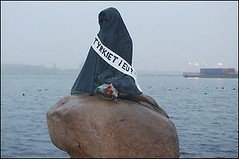 |
| Denmark's national symbol, the Little Mermaid sculpture perched on a rock at a Copenhagen pier, was draped in a burka and a sash reading 'Turkey in the EU?' overnight(AFP/Scanpix/Kristian Linnemann) |
Morocco's L'Economiste newspaper claimed that if the European Union should eventually refuse membership to Turkey that a chasm between the West and the Muslim world would be created that would mark a victory for Al Qaeda leader Osama bin Laden:
"Osama bin Laden and his followers are seeking to provoke this split," wrote the paper, adding: "Rejection of Turkey's candidacy would be seen around the world as a deliberate attempt to rupture ties with the Muslim world.
"It would be a huge victory for bin Laden and other fanatics. It would be as if they had succeeded in force-feeding the entire world the doctrine that religious differences determine political and strategic choices," the paper wrote. [" Rejection of Turkey in EU Would be a Victory for Bin-Laden," Turkish Weekly]
Defense & Foreign Affairs Daily sees the Turkish General Staff as resisting compliance over Cyprus in an effort to keep a separate sovereignty for Turkey. ["The EU and Turkey Reach a Watershed Which May See Cyprus Remain Divided and EU Expansion Halted," Analysis by Gregory R. Copley, Defense & Foreign Affairs Daily, December 20, 2004.]
Turkey and the EU will inevitably continue the facade of ongoing negotiations, and the EU-Turkey relationship will, of necessity, become in some important respects closer and more efficient than in the past, but many Turkish officials in the General Staff will start the process of breathing a collective sigh of relief that Turkey and its pan-Turkist dream have not been swallowed into the essentially hostile and homogenizing maw of Western Europe.Libya's leader Moammar Gadhafi maintained that Osama bin Laden would welcome an accession by Turkey into the EU. [Turkish Weekly: Gadhafi Agrees with ‘EU's Turkey-Sceptics’]
The Government of the Republic of Cyprus no doubt also drew breath with the knowledge that it did not have to confront Turkey directly, nor need to threaten use of a veto on Turkish accession; the EU process itself clearly demanded that Turkey abide by EU rulings on the mutual recognition by all member states of the sovereignty of all other member states. However, if the watershed does indeed see Turkey move to re-focus on its own sovereign destiny, outside the EU, then it will also become clear that the lure of EU membership was not sufficient to force Turkey to withdraw its 40,000 troops from their northern Cyprus occupation.
The result will now most likely be that Turkey does not move ahead with EU entry, does not recognize the Republic of Cyprus, and continues to occupy northern Cyprus.
Gadhafi: "Turkey will be a Trojan Horse for the EU"Meanwhile, in Denmark, pranksters responded to the news of the EU's planned initiation of talks with Turkey by draping a burka over the Little Mermaid statue.
Libyan leader Moammar Gadhafi has said it would be dangerous for the European Union to admit Turkey as a member state, calling the accession bid a "Trojan horse" for Islamic militants like Osama bin Laden.
"As far as the Islamic world is concerned -- including the Islamic extremists, even bin Laden -- they're rejoicing over the entry of Turkey in the European Union. This is their Trojan horse," he was quoted as saying by the Italian media. "I'm saying only what will happen with the entry of the horse into Troy," Gadhafi added in comments published on the day EU leaders met in Brussels to discuss whether to begin accession talks with the secular but overwhelmingly Muslim Turkey.
Gadhafi made his comments in an interview with RAI television, which is due to be aired on Friday. A transcript was printed on Thursday in Italy's La Repubblica daily.
Libya is in the US List of State Sponsors of Terrorism, and Libyan leader accepted Libya’s role in many terrorist attacks in the past.
Labels: al Qaeda, Al-Qa'idah, Al-Qaeda, Al-Qaida, Cyprus, European Union, Libya, Moammar Gadhafi, Osama bin Laden, Turkey
main page
most recent entries
- The sting of 'cling'
- Finding Iran's long-range missile site in Google E...
- Southern Iraqi Shiite tribal leader claims Iran be...
- Rice for the Vice?
- A stash of FARC's uranium found in Columbia
- Is Condi Rice signaling an interest in being McCai...
- Saddam Hussein's regime plotted with Gaza terroris...
- An unapologetic apologia for the Iraq war
- Romanian rendezvous; Terrorists and arms dealers i...
- Saddam's support for terror: the Pentagon report's...
archives
blogs
feeds




searches
statistics
buttons
Blogroll Me!


