Tuesday, April 08, 2008
Southern Iraqi Shiite tribal leader claims Iran behind Basra fighting (and al-Qaida!)
Sheikh Unayzan and Sheikh Sabah Muhsin al-Maliki, head of the Bani Malik tribes, were interviewed in Arabic, but an English account of the interview can be found on Radio Free Europe and on BBC Worldwide Monitoring (subscription).
Al-Maliki claims that it was the Arab tribes of southern Iraq that brokered a truce between the Al-Mahdi Army and the government:
Tribes in southern Iraq played a large role in extinguishing the fire of sedition. They mediated between the Al-Mahdi Army and government. The tribes reached a truce in some areas so that security could prevail. Praised be God, things went on normally there."More significantly, the tribal leaders remarked on the intervention of Iran in Iraq:
[Unayzan]"Iranian interference is no secret to anyone. America itself wants the Iranians to interfere in Iraq although it found Iranian explosive devices, Grad missiles, and Katyushas. The Iranians have agendas. Some political forces are now working for the Iranian intelligence and they receive funds from them. The Iranians are seriously thinking of creating an unbalanced Iraq that advocates a theory that is not pan-Arab. This means they want to keep Iraq away from its pan-Arab affiliation. These forces worked from Karbala and even Baghdad up to the farthest part of Iraq. Iran supports Al-Qa'idah, militias, and death squads. Iran buys the smuggled and stolen oil." He then says he "warned" the Arab countries that if Basra falls in Iranian hands, the Iranians will try to expand in the direction of the Gulf States, where "Iran has a large community estimated at 5 million people."The two southern Iraqi tribal leaders are currently on a tour of Arab countries to mobilize Arab support for the Southern Arab Tribal Council.On whether he is concerned about the Arab identity of Iraq, Al-Maliki says: "There is a large concern and this is the feeling of every patriotic citizen who wants security and all that is good for his country. We are all concerned because there are foreign interferences by Iran and its agents." Asked if the Arab tribes will establish a force to fight the militias, he says the tribes will not fight the "patriotic militias which have a genuine Arab history." He adds: "But there are militias which want to wreak havoc in Iraq, hand southern Iraq to another country, and destroy some leaders in Iraq. These should be fought. A force should be formed from the tribes to deter them."
Asked if a force similar to the Awakening Councils will be established, Unayzan says: "We will not establish Awakening Councils to serve the occupation. This is the first point. We will establish a force to strike at the militias collaborating with Iran. This is certain. The Iranians killed only in Basra 31 heads of tribes and clans, 37 doctors carrying the doctorate and master's degree including a professor, 400 women, and a large number of pilots and ordinary people who belonged to the Ba'th Party and the former security and intelligence services. We want to stop this."
...Asked what the tribal council will do if it participates in and wins in the local elections, Unayzan says: "We will first prevent the establishment of federalism, block the Oil Law, and prevent absolute subservience to Iran. We will demand protection for our areas in the south to prevent all neighbouring countries and not only Iran from infiltrating them."...On the reasons for "lack of security and poor services in Basra," Unayzan says "personal gains, ambitions, and Iran's blatant interference in Iraq are the reasons. He adds that the recent Basra fighting began and ended "with Iranian motives."
...On the way he views merger of religion with politics in Iraq, Unayzan says political Islam does not serve the interests of any country." Asked if Basra can be ruled by religious parties, he says: "There is no doubt that Basra is now ruled by the religious parties. Had it not been for the tribes, they would have made people suffer bitterly." He adds this is so although killings, abductions, and seizure of state resources continue, noting that the government's campaign in Basra was not successful because more than 900 people were killed in it.
Asked about national reconciliation...Unayzan says: "Reconciliation with whom? The Shi'is totally reject reconciliation with the Ba'thists. They want to uproot the Ba'th ideology and the Ba'th Party in general. There are more than 3 million Ba'thists in Iraq, and the Shi'is, including me, refuse to pardon the Ba'thists. But those whose hands were not stained with the blood of the Iraqis and who have good intentions should be accepted and rehabilitated." He then says reconciliation can be achieved when the Iraqi officials listen to the ordinary people and prevent foreign interference.
UPDATE: Those quick to pounce on John McCain's slip, in which he momentarily implied that al-Qaida in Iraq was a "Shiite sect" before correcting himself, would do well to consider that to keep track of the complex and shifting political coalitions in the Middle East one must not presume that such affiliations do not cut across Islamic sectarian lines. That point will be lost, however, to those who appear to think that one need only have the Sunni and Shiite teams on their Middle East scorecard. MSNBC wasted no time suggesting McCain had made another gaffe. Here is the exchange:
McCain: There are numerous threats to security in Iraq and the future of Iraq. Do you still view Al Qaeda in Iraq as a major threat?Meanwhile, Jason Linkins, on Huffington Post, praised Senator Evan Bayh's questioning as the "highlight of the hearing," but neglected to notice Bayh's own momentary lapse of taking Pakistan to be an Arab country, in this exchange with Ambassador Ryan Crocker:
Petraeus: It is still a major threat, though it is certainly not as major a threat as it was say 15 months ago.
McCain: Certainly not an obscure sect of the Shiites overall?
Petraeus: No, no sir.
McCain: Or Sunnis or anybody else then? Al Qaeda continues to try to assert themselves in Mosul, is that correct?
BAYH: The Afghanistan and Pakistan are subjects for another day but since this is all tied up in the global effort against extremism and terror, as you know, things have not been going as well as we would hope in Afghanistan. And it is true we're not going to have troops in Pakistan. Still, our resources are finite and they do have an impact. Some might look at this and say why are we devoting five times the amount of resources to a place that at this time is not the principal threat?CROCKER: In part, Senator, to be sure that it doesn't become that. I noted in my testimony that Osama bin Laden fairly recently referred to Iraq as the perfect base for al Qaeda and it is a reminder that for al Qaeda, having a safe base on Arab soil is extremely important today. They got close to that in '06.
BAYH: They apparently have one now in the tribal areas of Pakistan.
Labels: al Qaeda, Al-Qa'idah, Al-Qaeda, Al-Qaida, Basra, Iran, Iraq, Kazim Unayzan, Sabah Muhsin al-Maliki, Southern Arab Tribal Council


Thursday, March 20, 2008
An unapologetic apologia for the Iraq war
Hitchens reminds us of some notable successes achieved:
A much-wanted war criminal was put on public trial.Hitchens provides no conclusive reason to claim these positive developments outweigh the negative results: the costs of the war in lives and treasure and its undesirable unintended consequences.
The Kurdish and Shi'ite majority was rescued from the ever-present threat of a renewed genocide.
A huge, hideous military and party apparatus, directed at internal repression and external aggression was (perhaps overhastily) dismantled.
The largest wetlands in the region, habitat of the historic Marsh Arabs, have been largely recuperated.
Huge fresh oilfields have been found, including in formerly oil-free Sunni provinces, and some important initial investment in them made. Elections have been held, and the outline of a federal system has been proposed as the only alternative to a) a sectarian despotism and b) a sectarian partition and fragmentation. Not unimportantly, a battlefield defeat has been inflicted on al-Qa'ida and its surrogates, who (not without some Baathist collaboration) had hoped to constitute the successor regime in a failed state and an imploded society.
Further afield, a perfectly defensible case can be made that the Syrian Baathists would not have evacuated Lebanon, nor would the Gaddafi gang have turned over Libya's (much larger than anticipated) stock of WMD, if not for the ripple effect of the removal of the region's keystone dictatorship.
Yet, he does rebut the easy answer of those war critics who think that had we simply not intervened, any bad result would not be our fault. He dubs this position the "Bishop Berkeley theory," to wit, "if a country collapses and succumbs to trauma, and it's not our immediate fault or direct responsibility, then it doesn't count, and we are not involved."
Hitchens points to the potentially shameful and dire consequences of the Bishop Berkeley attitude toward a "war of choice" in Burma, Rwanda and Darfur.
Alas, in a morally ambiguous world, there is no safe refuge from responsibility.
Labels: al Qaeda, Al-Qa'idah, Al-Qaeda, Al-Qaida, Burma, Christopher Hitchens, Darfur, Iraq, Lebanon, Libya, Rwanda, Syria
Wednesday, March 19, 2008
Romanian rendezvous; Terrorists and arms dealers in Bucharest
Raul Reyes (real name: Luis Edgar Devia Silva), who was killed in Ecuador earlier this month by the Columbian army during a bomb attack against FARC [Revolutionary Armed Forces of Columbia], had come to Bucharest, just weeks before his death, to negotiate the purchase of uranium from an agent of the Ukrainian crime syndicate of Semyon Yukovich Mogilevich.
The website of the Romanian newspaper Ziua ( "Romania Swarms With Terrorists," by Bogdan Galca, translated by BBC Monitoring, subscription) cites Colombia's El Espectador as reporting Reyes visit to Romania on a fake Venezuelan passport in mid-January. The Irish journalist Gordon Thomas is quoted in the piece and is said to have had access to reports of the British intelligence service MI6.
The United States issued a warrant for Mogilevich's arrest on charges of fraud, racketeering and money laundering. Russia arrested Mogilevich outside Moscow's World Trade Center last month, along with Arbat Prestige owner Vladimir Nekrasov. (On Monday, a Moscow court refused to grant Mogilevich bail, despite his plea to be dying of diabetes related ailments. See Moscow Times.)
The MI6 report is said to allege that Mogilevich has:
"a working relationship with Al-Qa'idah....It is a known fact that the organization led by Usamah Bin-Ladin is present in Venezuela and in South American countries governed by populist left-wing representatives who oppose the United States."Columbian Vice President Francisco Santos is quoted by the Spanish television network Antena 3 during the UN Conference on Disarmament as claiming that documents discovered on Reyes' computers revealed that FARC was attempting to purchase fissile material to construct a radiological ("dirty") bomb.
MI6 contends that the Ukrainians stole the enriched uranium from an insufficiently guarded storage site in Cheyabinsk, in the Ural Mountains.
Mogilevich's organization was not the only group attempting to negotiate with FARC in Bucharest.
The notorious Russian-born arms trafficker Viktor Bout, known as the "Merchant of Death" (and the model for the main character of the movie "Lord of War," played by Nicholas Cage), was arrested last month in Thailand on the basis of information provided by the Romanian authorities. Bout's associate, Andrew Smulian, had also been in Bucharest to negotiate an arms delivery to FARC.
The U.S. released an indictment of Bout and Smulian that accused them of "plotting in view of procuring material support for a terrorist organization." That material included 100 air-to-ground missiles and missile launchers. The indictment was based on the fact that Smulian had been negotiating with phony FARC leaders who in fact were agents of the Drug Enforcement Administration of the U.S.
Ziua's description of the sting that led to the arrest of Viktor Bout makes for fascinating reading:
Copenhagen, Curacao, and BucharestBout's arrest operation, as described by the documents of the US authorities, sounds like a spy novel. The informers had meetings in Copenhagen, Curacao, and Bucharest during an operation that first trapped Smulian, one of Bout's associates, the middle man of the arms transaction. According to the official document drawn up by a DEA special agent, undercover American agents succeeded in gaining the trust of the "Merchant of Death" and his associates several months before Smulian was arrested in Thailand. The meetings were held in several countries, including Denmark, Netherland Antilles, and Romania. In 1997, a DEA source (CS-1) contacted Smulian. Under DEA coordination, CS-1 sent an email to Smulian asking him to tell Bout that he had a business proposal. After a short while, Smulian told the agent that Bout was interested in the proposal and that they should meet. Under DEA coordination, CS-1 organized a meeting in Curacao, Netherlands Antilles. On 7 January 2008, CS-1 met Smulian in Curacao. CS-1 introduced two other DEA sources (CS-2 and CS-3). The two agents claimed to be FARC representatives. They told Smulian that they were interested in purchasing weapons, particularly missiles. On 22 January 2008, CS-1 met Smulian in Copenhagen, Denmark, to discuss Smulian and Bout's meeting in Russia about the weapons deal. Bout told Smulian to schedule a meeting with CS-2 and one of his representatives to discuss the transaction. The Russian warned his associate to be extremely careful and instructed him to get rid of cell phones, SIM cards, and other devices that might indicate where he had been and whom he had met. According to Smulian, Bout had said that he could provide the FARC with the weapons, because "any communist is our friend." On 23 January 2008, CS-1 and CS-2 met Smulian in Copenhagen. The three discussed the locations where they could meet Bout. Smulian told the DEA collaborators that "100 pieces were immediately available."
Missiles Photos Shown on Laptop
On 26 January 2008, CS-1 and Smulian came to Bucharest, where they met CS-2 and CS-3. Once they arrived, the latter told Smulian that they wanted to meet Bout in person to finalize the arms deal and deliver the money.
Smulian told them that Bout might have been arrested if he had come to Romania. At a certain point, CS-3 talked with Bout on the telephone about potential meeting locations, among which Cuba, Nicaragua, or Armenia. After the discssion with the "Merchant of Death," Smulian showed the three CS on his laptop photos of the missiles that were going to be delivered, pointing out that Bout could also supply helicopters that could be equipped with double-range missiles. Smulian also said that the weapons were in Bulgaria and that their "transport" would cost $5 million. Several days later, Smulian told CS-2 that "the weapons were ready in Bulgaria." On 5 February 2008, the Romanian authorities intercepted a conversation between Bout and CC-2, one of his associates, who operates an air company in our country [Romania]. On 7 February, CS-2 gave Smulian an e-mail address (bogotazo32@yahoo.com) that could be used by Smulian and Bout. On 12 February, CS-2 received an e-mail: "Buenos Dias! this is the e-mail we can use for commjnications. Best regards. Friend of Andrew." The address of the sender was created on 12 February under the name Victor But [name as published]. The DEA believes that the message was sent by the "Merchant of Death." The next meeting was held in Thailand, where Bout was captured.
Bout remains under detention in a maximum-security prison on the outskirts of Bangkok. Today, a Thai court extended by 12 days his detention, pending formal charges in Thailand. (See Russian Arms Dealer Jail Stay Lengthened," Guardian, March 19, 2008).
The DEA used a similar sting of a phony deal with FARC to capture Syrian arms trafficker Monzer al-Kassar, the "Prince of Marbella." (See Syrian arms dealer stung in DEA pseudo-deal with Colombian guerillas.) Kassar was arrested on June 7, 2007 in Madrid, following a tip from the Romanians, one day after two of his accomplices, a Chilean and a Palestinian suspected of terrorist activities in the United States, were arrested in Bucharest. Kassar had ties with Uday Hussein, son of Saddam Hussein. Michael J. Garcia, U.S. federal prosecutor in New York, alleges that Kassar has "supported terrorists and insurgents by providing state-of-art weapons that fuelled most of the conflicts started in the past 30 years." Kassar's customers include groups from Nicaragua, Brazil, Cyprus, Bosnia, Croatia, Somalia, the Palestinian territories, Iran and Iraq.
As Bucharest prepares to host the 20th NATO summit on April 2-4, security preparations have been understandably extensive.
Labels: al Qaeda, Al-Qa'idah, Al-Qaeda, Al-Qaida, Bucharest, Columbia, FARC, MI6, Monzer al-Kassar, NATO, Osama bin Laden, Raul Reyes, Romania, Semyon Yukovich Mogilevich, Ukraine, Venezuela, Viktor Bout
Tuesday, March 18, 2008
Saddam's support for terror: the Pentagon report's unreported findings
Based on a review of some 600,000 documents captured in post-war Iraq, the 59-page Pentagon report, with over 1500 pages of appendices, details a 'de facto' link between Saddam's security organizations and Osama bin Laden's terror network. Yet, that was not the story reported in the U.S. press.
Instead, a headline in the New York Times and stories in the Washington Post, NPR and ABC reported that the study showed no links between al Qaeda and Saddam Hussein.
What accounts for the difference? Stephen F. Hayes in this week's The Weekly Standard ("Saddam's Dangerous Friends; What a Pentagon review of 600,000 Iraqi documents tells us, March 24, 2008, subscription) asks and answers the key question:
How can a study offering an unprecedented look into the closed regime of a brutal dictator, with over 1,600 pages of "strong evidence that links the regime of Saddam Hussein to regional and global terrorism," in the words of its authors, receive a wave-of-the-hand dismissal from America's most prestigious news outlets? All it took was a leak to a gullible reporter, one misleading line in the study's executive summary, a boneheaded Pentagon press office, an incompetent White House, and widespread journalistic negligence.
The storyline that drove the coverage by the mainstream press was based upon a leaked -- and "highly misleading" -- phrase taken from the executive summary: "This study found no 'smoking gun' (i.e. direct connection between Saddam's Iraq and al Qaeda."
Contrast that dismissive summation with the study's actual findings, detailed by Hayes:
In 1993, as Osama bin Laden's fighters battled Americans in Somalia, Saddam Hussein personally ordered the formation of an Iraqi terrorist group to join the battle there.IIS documents included in the Pentagon report reveal two terorist organizations relying on Iraqi financial support were the Afghani Islamic Party of Gulbuddin Hekmatyar and the Egyptian Islamic Jihad of Ayman al Zawahiri.For more than two decades, the Iraqi regime trained non-Iraqi jihadists in training camps throughout Iraq.
According to a 1993 internal Iraqi intelligence memo, the regime was supporting a secret Islamic Palestinian organization dedicated to "armed jihad against the Americans and Western interests."
In the 1990s, Iraq's military intelligence directorate trained and equipped "Sudanese fighters."
In 1998, the Iraqi regime offered "financial and moral support" to a new group of jihadists in Kurdish-controlled northern Iraq.
In 2002, the year before the war began, the Iraqi regime hosted in Iraq a series of 13 conferences for non-Iraqi jihadists groups.
That same year, a branch of the Iraqi Intelligence Service (IIS) issued hundreds of Iraqi passports for known terrorists.
Hayes concludes:
What's happening here is obvious. Military historians and terrorism analysts are engaged in a good faith effort to review the captured documents from the Iraqi regime and provide a dispassionate, fact-based examination of Saddam Hussein's long support of jihadist terrorism. Most reporters don't care. They are trapped in a world where the Bush administration lied to the country about an Iraq-al Qaeda connection, and no amount of evidence to the contrary -- not even the words of the fallen Iraqi regime itself -- can convince them to reexamine their mistaken assumptions.The most curious and puzzling aspect of the misreporting of the Pentagon report is the apathy and silence of the Bush administration. Hayes surmises that they were "too busy or too tired or too lazy" to correct the record.
Labels: al Qaeda, Al-Qa'idah, Al-Qaeda, Al-Qaida, Ayman al-Zawahri, Gulbuddin Hekmatyar, Institute for Defense Analyses, Islamic Jihad, jihadists, Pentagon, Saddam Hussein, Stephen F. Hayes
Saturday, March 01, 2008
Mahmud Abbas: Hamas brought Al-Qaida into Gaza
[Shirbil] You said on a previous occasion that there are indicators of an Al-Qa'idah presence in Gaza. Hamas has denied such a presence. What do you say today?
[Abbas] I believe that Al-Qa'idah is present in the Palestinian territories.
[Shirbil] Where?
[Abbas] In Gaza. And it is Hamas who brought in Al-Qa'idah and who facilitates its coming in and going out in ways that are known to the Hamas Movement.
[Shirbil] This is a serious accusation. Hamas says it is the barrier to the possibility of Al-Qa'idah infiltration into the Palestinian Territories.
[Abbas] Al-Qa'idah is present in Gaza, and I think they are allies.
[Shirbil] Are you saying that Hamas is an ally of Al-Qa'idah?
[Abbas] Yes, I believe that is the case. I firmly believe that Al-Qa'idah has a presence in the Palestinian territories and that presence has been facilitated by Hamas in Gaza in particular.
Back in November 2004, this space reported on Yossef Bodansky's allegation that Richard Reid's shoe bomb was the result of a network of cooperation between Iran, al-Qaeda and Hamas in Gaza ("An Axis of Terror: Chechen Rebels, Hamas and Al Qaeda"):
Reid's shoe bombs were based on Iranian-origin technology and were made of new type of high-explosives. Reid -- then an acknowledged bin Laden operative -- received his shoe-bombs in the Palestinian Jebalya camp in the Gaza Strip. At the time, he was a trainee-guest of Nabil Aqal, a senior commander of the Hamas' Izz al-Deen al-Qassim Brigades and a protege of Hamas leader Sheikh Yassin. The key components of the bombs had been smuggled to Gaza from Lebanon via Egypt by then-Palestinian Authority (PA) Chairman Yasir Arafat's ally and confidante, Jamal Sema Dana. The Hamas support for Reid a major deviation from Yassin's long-standing insistence that the Hamas cadres limit their operations to the Palestinian theater in order to contribute to international operations under the banner of a global jihadist entity. However, by the late 1990s, the Hamas needed foreign support from the global Islamist-jihadist movement and Yassin was willing to "pay" by increasing its direct involvement in the international jihad.
UPDATE: Intelligence Online (subscription) reported on May 12, 2006 of Al Qaeda's Infiltration into the Gaza Strip:
Even more worrisome, however, the Egyptian investigation and inquiries by Jordanian intelligence have revealed that Al Qaeda has begun to infiltrate Palestinian territory in the Gaza Strip, crossing over from the Sinai desert. According to the Jordanians, an extremist wing of the Ezedeen al Qassam Brigades, the military arm of Hamas that rejects the truce with Israel, has set up a new group linked to Al Qaeda. It is reportedly led by the boss of the Brigades, Mohammed Deif, while his right hand man is Jamal Abu Samhadan, chief of the Salaheddin Brigades cell in the Jabalia camp. An outpost of Al Qaeda is said to have also established itself at Nablus on the West Bank, with Diaeddin al Qodsi, an Afghanistan veteran, at its head.
UPDATE: More recent news of Mohammed Deif and Al Qaeda in Gaza from Intelligence Online, "How Hamas Organizes its Defenses," January 4, 2008:
Another sign that Hamas is girding itself for an Israeli attack was the return of Muhammad Daif, chief of the al Qassam Brigades, the military wing of Hamas. Wounded in an Israeli assault on July 11, 2006 against the residence of Nabil Abu Silmiyya, Hamas chief in Gaza, Diaf spent 14 months under medical treatment in Cairo. However, he remains half paralysed. Immediately on his return he appointed a new commander of the al Qassam Brigades. He is Ahmed Nimr, the Hamas leader in the town of Khan Younes, where Daif himself was born.Traditionally suspicious of international Jihadist movements of the Al Qaida type, Hamas has ended up by closing ranks with them in order to find militants willing to commit suicide bomb attacks against Israeli tanks.
Indeed, Hamas has given its blessings to the formation of the Army of Islam, a cell affiliated to Al Qaida and headed by Mumtaz Dormush. He is a former member of the Peoples' Resistance Committee, a small armed Palestinian group founded in 2000.
The Army of Islam was responsible for the kidnapping of BBC newsman Alan Johnston who was held for 114 days, and took part in capturing Israeli corporal Gilad Shalit. With a large stock of chlorine it acquired from Egyptian and Iraqi smugglers, Hamas and its affiliated organizations are reportedly now in a position to carry out toxic gas attacks.
Labels: Abu-Mazin, Ahmed Nimr, al Qaeda, Al-Hayat, Al-Qa'idah, Al-Qaeda, Al-Qaida, Gaza, Hamas, Izz al-Deen al-Qassim Brigades, Mahmud Abbas, Muhammad Daif, Mumtaz Dormush, Nabil Aqal, Richard Reid
Friday, February 29, 2008
McCain's supposed "100 year war" in Iraq
But Hillary Rodham Clinton and especially Barack Obama have distilled McCain's position into sound bite oversimplifications, suggesting he foresees a war without end in anyone's lifetime.
THE SPIN:
Obama: "We are bogged down in a war that John McCain now suggests might go on for another 100 years."
Clinton: "I've also been a leader in trying to prevent President Bush from getting us committed to staying in Iraq regardless, for as long as Senator McCain and others have said it might be — 50 to 100 years."
THE FACTS:
The Democrats leave out a vital caveat.
When McCain was asked about Bush's theory that U.S. troops could be in Iraq for 50 years, the senator said: "Maybe 100. As long as Americans are not being injured or harmed or wounded or killed, it's fine with me, and I hope it would be fine with you, if we maintain a presence in a very volatile part of the world where al-Qaida is training, recruiting, equipping and motivating people every single day."
A troop presence that does not involve Americans being harmed is, by definition, not a war.
Labels: al Qaeda, Al-Qa'idah, Al-Qaeda, Al-Qaida, Barack Obama, Calvin Woodward, Hillary Clinton, Iraq, John McCain
Friday, February 22, 2008
A rocket factory for Hezbollah?
The Ukrayinska Pravda website in Kiev published the following report on February 20 entitled "Arabs want to buy a plant working for rocket production. For Al-Qa'idah?" (BBC English translation by subscription).
The state-owned Nikopol pipe plant, a producer of unique stainless thin-walled seamless pipes and titanium-and-nickel alloys, which currently undergoes bankruptcy procedures, can change hands to Junet, a Lebanese company willing to invest 35m dollars in the plant.The director-general of the National Space Agency of Ukraine, Yuriy Alyekseyev, said this in a letter to the plant's financial readjustment manager.
The output of the plant, which entered a state of financial readjustment in June 2007, is used in rocket production, aviation and in the nuclear sector. It is worth noting that Junet was never before involved in this business. It sells frozen vegetables, fruit, juice and grain.
Labels: al Qaeda, Al-Qa'idah, Al-Qaeda, Al-Qaida, Hezbollah, Lebanon, Ukraine
Friday, February 01, 2008
Jihadists retreating from Iraq expected in Europe
The exodus from Iraq is the result of a loss of trust in al Qaeda by the Iraqis, who no longer regard “the foreign jihadists to be mujahidins, but takfiris, that is to say, extremists and assassins of their Islamic brothers.” The initial destination for this retreat is said to be Mosul.
Many of the jihadists originally found their way to the insurgency in Iraq by journeying through Spain. Return to their country of origin, to Saudi Arabia, Libya, Syria, Yemen, Algeria or Morocco, would place them under strict surveillance of the intelligence service of their home country, where their identities and recent absence are known. This leaves Europe as the likely destination for the retreating jihadists, with Spain as one of the entrance gates.
Labels: al Qaeda, Al-Qa'idah, Al-Qaeda, Al-Qaida, Iraq, jihadists, Spain
Thursday, January 31, 2008
Seized records detail al Qaeda foreign recruits in Iraq
The documents are dated from August 2006 to August 2007. Here are some details and statistics on the al Qaeda recruits:
- 56% of the recruits expressed an interest in suicide bombing;
- 43% of the recruits listed an interest in being traditional fighters;
- The youngest recruit was 16 and the oldest was 54;
- More than 40% of the recruits were from Saudi Arabia, and the majority of Saudi recruits came from Riyadh and Mecca;
- 19% of the recruits were from Libya and the majority of the Libyan recruits come from Dirnah;
- 85% of the Libyan recruits were prospective suicide bombers;
- 50% of the Saudi recruits expressed an interest in suicide bombing;
- Syria, Yemen and Algeria each accounted for 8% of the recruits; the majority of Syrians come from Dayr al-Zur, a rural town near the Iraqi border;
- 6.1% of the recruits were Moroccans;
- 42% listed at least one contact in Syria, and several listed multiple contacts;
- The recruitment questionnaire asks recruits for the name of their “coordinator” (smuggler) and how much money they paid to be moved across the border, thereby indicating that al Qaeda is relying on a Syrian logistics network run by Syrian “mercenaries, free-lancers, and criminal smuggling networks";
- 82.4% of the Libyans arrived in Iraq through the same pathway through Egypt and then by air to Syria, and the recruiting and logistics network is said to be likely tied to the Libyan Islamic Fighting Group (LIFG);
- The recruiting organization in Algeria is the Salafist-inspired Group for Preaching and Combat (GSPC), now renamed al Qaeda Organization in the Islamic Maghrib.
"Al-Qa'idah cannot do anything in Iraq without assistance from some countries in the region, which might be Syria and the cooperation it extends in this regard. This is in addition to the assistance extended by the followers of the former regime of Saddam Husayn. It seems that there is a network in Syria that helps these elements enter into Iraq."Qambar concludes:
"I believe that the status of Al-Qa'idah in Iraq is increasingly deteriorating. You know well that 600 fighters cannot alter the course of the battle, but the majority of these fighters are suicide attackers who are capable of carrying out the blind suicide attacks that cause harm to the Iraqi people....If these fighters are not killed in Iraq and leave the country, they will be a threat, and I believe that they would become commanders for Al-Qa'idah and Islamic extremist organizations in their countries. Therefore, I believe that there should be a joint international effort in coordination with Iraq to tackle this situation."
Labels: al Qaeda, Al-Qa'idah, Iraq, Libya, Syria
Monday, December 20, 2004
Turkey and the European Union: Cui Bono?
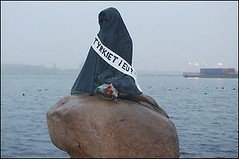 |
| Denmark's national symbol, the Little Mermaid sculpture perched on a rock at a Copenhagen pier, was draped in a burka and a sash reading 'Turkey in the EU?' overnight(AFP/Scanpix/Kristian Linnemann) |
Morocco's L'Economiste newspaper claimed that if the European Union should eventually refuse membership to Turkey that a chasm between the West and the Muslim world would be created that would mark a victory for Al Qaeda leader Osama bin Laden:
"Osama bin Laden and his followers are seeking to provoke this split," wrote the paper, adding: "Rejection of Turkey's candidacy would be seen around the world as a deliberate attempt to rupture ties with the Muslim world.
"It would be a huge victory for bin Laden and other fanatics. It would be as if they had succeeded in force-feeding the entire world the doctrine that religious differences determine political and strategic choices," the paper wrote. [" Rejection of Turkey in EU Would be a Victory for Bin-Laden," Turkish Weekly]
Defense & Foreign Affairs Daily sees the Turkish General Staff as resisting compliance over Cyprus in an effort to keep a separate sovereignty for Turkey. ["The EU and Turkey Reach a Watershed Which May See Cyprus Remain Divided and EU Expansion Halted," Analysis by Gregory R. Copley, Defense & Foreign Affairs Daily, December 20, 2004.]
Turkey and the EU will inevitably continue the facade of ongoing negotiations, and the EU-Turkey relationship will, of necessity, become in some important respects closer and more efficient than in the past, but many Turkish officials in the General Staff will start the process of breathing a collective sigh of relief that Turkey and its pan-Turkist dream have not been swallowed into the essentially hostile and homogenizing maw of Western Europe.Libya's leader Moammar Gadhafi maintained that Osama bin Laden would welcome an accession by Turkey into the EU. [Turkish Weekly: Gadhafi Agrees with ‘EU's Turkey-Sceptics’]
The Government of the Republic of Cyprus no doubt also drew breath with the knowledge that it did not have to confront Turkey directly, nor need to threaten use of a veto on Turkish accession; the EU process itself clearly demanded that Turkey abide by EU rulings on the mutual recognition by all member states of the sovereignty of all other member states. However, if the watershed does indeed see Turkey move to re-focus on its own sovereign destiny, outside the EU, then it will also become clear that the lure of EU membership was not sufficient to force Turkey to withdraw its 40,000 troops from their northern Cyprus occupation.
The result will now most likely be that Turkey does not move ahead with EU entry, does not recognize the Republic of Cyprus, and continues to occupy northern Cyprus.
Gadhafi: "Turkey will be a Trojan Horse for the EU"Meanwhile, in Denmark, pranksters responded to the news of the EU's planned initiation of talks with Turkey by draping a burka over the Little Mermaid statue.
Libyan leader Moammar Gadhafi has said it would be dangerous for the European Union to admit Turkey as a member state, calling the accession bid a "Trojan horse" for Islamic militants like Osama bin Laden.
"As far as the Islamic world is concerned -- including the Islamic extremists, even bin Laden -- they're rejoicing over the entry of Turkey in the European Union. This is their Trojan horse," he was quoted as saying by the Italian media. "I'm saying only what will happen with the entry of the horse into Troy," Gadhafi added in comments published on the day EU leaders met in Brussels to discuss whether to begin accession talks with the secular but overwhelmingly Muslim Turkey.
Gadhafi made his comments in an interview with RAI television, which is due to be aired on Friday. A transcript was printed on Thursday in Italy's La Repubblica daily.
Libya is in the US List of State Sponsors of Terrorism, and Libyan leader accepted Libya’s role in many terrorist attacks in the past.
Labels: al Qaeda, Al-Qa'idah, Al-Qaeda, Al-Qaida, Cyprus, European Union, Libya, Moammar Gadhafi, Osama bin Laden, Turkey
Wednesday, December 08, 2004
Islamists Try to Recruit Suicide Attackers from German Mental Hospitals
The report of these activities appeared in the December 6 issue of the German news magazine Focus, in an article entitled "Attackers from the hospital?" by J. Hufelschulte and C. Sturm (Dateline: Munich, p. 49, original in German and translated into English by BBC Monitoring International Reports on December 7, 2004).
The group of recruiters are said to be activists of Jamaat al-Tabligh, a Muslim organization based in Pakistan that poses as a missionary group but that helps al-Qaeda terrorists secure travel arrangements (see Neil A. Lewis, "Hearings, yes, but not in court," New York Times).
One foothold of the group's presence in Germany is the Abu-Baqr Mosque in Bremen. One of the young converts in Bremen kidnapped a bus with 16 passengers in April 2003. Another member of the so-called "Taleban of Bremen" was captured and interned in Camp X-Ray in Guantanamo Bay, Cuba.
Labels: al Qaeda, Al-Qa'idah, Al-Qaeda, Al-Qaida, Germany, Jamaat al-Tabligh, Syria
Wednesday, December 01, 2004
Jihad in the Caucasus
All sides agree that the hostage-takers were a multinational team. Russian intelligence claimed, soon after the attack, that the strike force was composed of 35 terrorists, including "Chechens, Insushes, Kazakhs, [ten] Arabs, Uzbeks and Slavs." Arab Islamist sources tend to agree with this original Russian claim of the large number of Arabs among the hostage-takers.
According to Bodansky, in mid-August 2003, Zawahiri and his aides were in Tehran to coordinate anti-American resistance in Iraq. "Then, on August 17 or 18, 2003, the eve of the first spectacular strikes in Baghdad, Ali Younessi, the chief of Iranian intelligence, personally instructed a special team of Iranian senior intelligence operatives to organize Zawahiri's clandestine trip back to Pakistan." The mullahs allegedly wanted Zawahiri to leave Iran because they did not want to be directly associated with a marked escalation in Islamist terrorism. Iranian intelligence gave Zawahiri the disguise and documents that helped him travel across the Turkish border, to stay in a safe house in eastern Turkey. Using a route upon which Islamists volunteers may travel to Chechnya, with the tacit approval of Ankara and Baku, Iranian intelligence escorted Zawahiri to al-Qaida's bases in the Pankisi Gorge in northern Georgia on the border of Russia. Zawahiri is then said to have traveled to the Fergana Valley, through northern Afghanistan, to Pakistan.
On the way to Pakistan, Zawahiri inspected command cells of jihadists that were under a command center of senior al-Qaida commanders in Tehran. Bodansky identifies the key members of this command group as: Saad bin Osama bin Laden (son of Osama bin Laden), Seif-al-Adl, Muhammad Shawqi al-Islambuli (a.k.a. Abu-Khalid) and the Mauritanian Mahfuz Ould Waleed (a.k.a. Abu-Hafts).
On the eve of his departure from Tehran, Zawahiri organized a new command cell for the Caucasus. Among the commanders of this cell were the Saudi, Muhammad Abu-Omar al-Seif, nominated by Zawahiri as "al-Qaida's emissary" in Chechnya and the northern Caucasus. Though he was deployed in summer 2003, he assumed the formal title "Commander of the Eastern Province and the Mujahedin and Al-Ansar in Chechnya" in September 2004. Bodansky mentions, but has no information about, another key commander in Chechnya, the Saudi Abu Hajr.
The first claim of responsibility for the strikes against Russia was issued via authoritative Islamist-jihadist channels that are associated with bin Laden's elite command. The claims were written in Arabic and explained that the anti-Russia jihad was an integral part of the global anti-Western jihad. The first such communique was issued from "Kataeb al-Islambuli" [The al-Islambuli Brigades] and claimed responsibility for the downing of the two aircraft. The Al-Islambuli Brigades are associated with the Iran-based Muhammad Shawqi al-Islambuli.
Next came a claim of responsibility for the Beslan massacre from "Ansar al-Zawahiri" [The Supporters/Devotees of al-Zawahiri] on September 5, 2004. The al-Zawahiri group tried to link their grievances against Russia with those they hold against all whom they regard as enemies of Islam.
The last communique in Arabic regarding the anti-Russian jihad and its connection to the global jihad was issued by "The Chechnya al-Khattab Group" on September 18, 2004. It declared:
"In consideration of the Russian and US parties exceeding the limits of their aggression against the honor and dignity of Islam and Muslims in Chechnya, Palestine, Iraq, Indonesia, Afghanistan, and other Muslim countries, within sight of the international community and without awakening the conscience of any Arab leader ... the commanders of the Chechen mujahedin and al-Ansar in Chechnya declare the beginning of simultaneous attacks against Russian and US interests."
Bodansky sardonically notes that the goal of an independent or Islamic Chechnya was not even mentioned in these statements. He also notes that the Chechen leader Shamil Basayev did not acknowledge responsibility for the strikes until after the Islamist-jihadist leadership had already done so. Basayev's first message was posted on September 19, 2004, though it was dated September 17. In an interview published on November 1, 2004, and prepared by the Kavkaz-Tsentr, Basayev acknowledge he had only "a degree of responsibility for the strikes" and did not think he was "guilty of that outcome." Yet his threats of future escalation became more bold, and he even gave a veiled warning of the use of weapons of mass destruction: "I would like to note," he said, "that the Russians had many times used chemical and bacteriological weapons against us as well as various poisons, and we feel free to retaliate."
Bodansky does not doubt any of these claims of responsibility. He sees a tight integration of the al-Qaeda high command with the Chechen resistance, not only operationally but ideologically. He cites the mentor of Basayev, Magomed [Muhammad] Tagayev, as calling for an anti-Russian jihad not in the context of an independent or even an Islamist Chechnya. According to Tagayev, "[The] Chechen state is ... the forward springboard for the liberation of the entire Caucasus."
Thus, the strikes against Russia in Autumn 2004 reveal how the international Islamist-jihad cause is closely integrated with the regional Islamist jihad in Chechnya.
Labels: Abu-Hafts, al Qaeda, Al-Qa'idah, Al-Qaeda, Al-Qaida, Ayman al-Zawahri, Beslan, Chechnya, Defense and Foreign Affairs Daily, Iran, Iraq, Russia, Saudi Arabia, Shamil Basayev, Yossef Bodansky
Monday, November 29, 2004
An Axis of Terror: Chechen Rebels, Hamas and Al Qaeda
The spectacular assaults on Russia in August 2004 displayed a "mix and match" of local and imported contributions. The two Chechen women who served as martyr-bombers were identified as members of the "regional Shakhid unit of Moscow of the battalion of Shakhid, Riyad us-Salihin" by Shamil Basayev, the Chechen rebel leader (whose top aide, Akhmed "White Arab" Sambiyev was just killed late Thursday by Russian security forces). Forensic evidence reveals that the bombs used on the two Russian planes were similar to the bomb that was seized from the shoes of Richard Reid, after he attempted to bomb an American Airlines flight on December 22, 2001.
Remarkably, Bodansky also claims that the bombs used on the Russian planes were also similar to the "bomb used by Abderraouf Jdey, a Canadian citizen also known as Farouk the Tunisian, who, on November 12, 2001, brought down an American Airlines aircraft soon after taking off from JFK to the Dominican Republic." The U.S. National Transportation Safety Board has maintained that the crash of AA 587 was accidental, and argues that the detachment of the vertical fin could not been the result of an event within the cabin. Suspicion that the crash was the result of sabotage has persisted, however, and just last August, Daniel Pipes reported in FrontPage Magazine the information (which Pipes called "not exactly rock-hard") that AA 587 was the result of an Al-Qaida operation with "Farouk the Tunisian" as the bomber.
Bodansky also reveals the source of Richard Reid's shoe bomb. The details illustrate the close cooperation between Iranian and Palestinian jihadist forces and Osama bin Laden's Al Qaeda network.
Reid's shoe bombs were based on Iranian-origin technology and were made of new type of high-explosives. Reid -- then an acknowledged bin Laden operative -- received his shoe-bombs in the Palestinian Jebalya camp in the Gaz Strip. At the time, he was a trainee-guest of Nabil Aqal, a senior commander of the Hamas' Izz al-Deen al-Qassim Brigades and a protege of Hamas leader Sheikh Yassin. The key components of the bombs had been smuggled to Gaza from Lebanon via Egypt by then-Palestinian Authority (PA) Chairman Yasir Arafat's ally and confidante, Jamal Sema Dana. The Hamas support for Reid a major deviation from Yassin's long-standing insistence that the Hamas cadres limit their operations to the Palestinian theater in order to contribute to international operations under the banner of a global jihadist entity. However, by the late 1990s, the Hamas needed foreign support from the global Islamist-jihadist movement and Yassin was willing to "pay" by increasing its direct involvement in the international jihad.Some of this foreign support Hamas received from international Islamist-jihadists was from Chechnya. Just after the outbreak of the intifada in September 2000, Shamil Basayev and Hattab, the "Black Arab" (who was later poisoned by the Russian secret service in 2002), sent 150 Chechen and Arab-Chechen "expert bomb-makers, snipers and fortification-builders" to Gaza and the West Bank. The extremely powerful bombs that Palestinians used to destroy several Israeli tanks were provided by the Chechens. Muhammad Dahlan, now head of Palestinian security services in Gaza, ran a program of smuggling into the Gaza Strip al-Qaida fighters and Chechens from Afghanistan-Pakistan. Each of the al-Qaida transplants received a $5,000 cash bonus, contributed from Saudi Arabia. A few of the Arab-Chechens had even been members of the Hamas Iss al-Din al-Qassim Brigades before they left Gaza and Nablus for advanced training in Afghanistan/Pakistan.
The ideological solidarity between the Palestinians and the Islamists in Chechnya became more public in 2004 when Hamas recruitment posters and videos featured portraits of bin Laden, Yassin and Hattab as the key leaders of the Islamist movement. The Hamas video also contained a fatwa by the Chechen Mufti Muhammad Abdullah Al-Seif sanctioning martyrdom-terrorism and even authorizing the recruitment of female martyr-bombers.
Labels: al Qaeda, Al-Qa'idah, Al-Qaeda, Al-Qaida, Chechnya, Defense and Foreign Affairs Daily, Gaza, Hamas, Osama bin Laden, Richard Reid, Russia, Shamil Basayev, Yassir Arafat, Yossef Bodansky
Saturday, November 27, 2004
Allegation Saddam Guard Was Al-Zarqawi Aide Spurs Dispute
On November 19, Al-Sharq al-Awsat published a report from Baghdad with the lengthy title: "Al-Zarqawi's aide a former guard of Saddam, brother of 'Al-Jazeera' office's director in Baghdad. Umar Hadid led Al-Fallujah battle, received training in Afghanistan." A translated paraphrase of the article was made by BBC Monitoring International Reports (not, so far as I know, publicly accessible on the web), though a rough translation of a portion of the article is available on FrontPage Magazine.
Al-Sharq al-Awsat quoted informed sources in Iraq as saying that Hamid Hadid, the director of Al-Jazeera's Baghdad bureau had a brother who had been Abu-Mus'ab al-Zarqawi's foremost aide. This brother, Umar Hadid, was also said to have once been in the special guard of Saddam Hussein. (The translation on FrontPage says he was in Saddam Hussein's "personal body-guards unit"; the BBC Monitoring International Report says Umar was in "Saddam's Special Republican Guard.") About ten years ago, according to the report, Umar left the guard service to associate with radical Islamic fundamentalist groups. With one accomplice, he is alleged to have carried out a bombing of an al-Fallujah cinema that killed a person. He then is thought to have fled to Pakistan, and, from there, to have entered Afghanistan, where he received training in the base camps of al-Qa'idah, under the leadership of Osama bin Laden.
Sources for the report thought that Umar Hadid may have left Afghanistan to return to Pakistan, after the overthrow of the Taleban regime in 2001. There is no doubt among the sources, however, that he returned to Iraq just before the beginning of the war, when Saddam Hussein provided a general amnesty for prisoners, wanted men and runaways.
According to intelligence sources, Umar Hadid led the battle against U.S. forces in al-Fallujah. Iraqi sources privy to information from western intelligence services also claimed that Umar Hadid was still in the al-Fallujah region after al-Zarqawi escaped.
The report of Al-Sharq al-Awsat also alleged that the Hadids had a third brother, who was killed, along with his family, when his house was shelled by U.S. forces just two hours after a visit from Umar.
Al Jazeera responded promptly, on November 20, with an interview of Umar Hadid in their Doha studio. Here are his denials, in a translation provided by BBC Worldwide Monitoring, November 20 (again, so far as I know, not available in any publicly accessible website):
Hadid: I am Umar Ahmad Muhammad al-Jumayli, a brother of Hamid Ahmad Muhammad al-Jumayli, director of Al-Jazeera bureau. The Saudi newspaper Al-Sharq al-Awsat published a report claiming that I have a connection with or that I am an aide to Al-Zarqawi in Al-Fallujah. I deny this because I am 24 years old. The report claims that I was in Afghanistan 10 years ago and went to Pakistan. Ten years ago, I was a little boy. Therefore, this is untrue.On November 23, Al-Sharq al-Awsat responded with a published interview of Iraqi interim Defense Minister Hazim Sha'lan. Al-Sha'lan attacked Al-Jazeera satellite television as a "terrorist channel. He also claimed that Umar Hadid was indeed "a terrorist and is wanted by the Iraqi government for his terrorist activities in Fallujah." (quotation from "Analysis: Al-Jazeera's Row with Saudi Paper Al-Sharq Al-Awsat," BBC Monitoring International Reports, November 26, 2004).
Lina Zahr-al-Din, Al-Jazeera: You do not know Al-Zarqawi at all and you have not met him before?
Hadid: I do not know Al-Zarqawi or anybody linked to him. I hear about him from satellite channels only.
Zahr-al-Din: You said that 10 years ago you were a young boy, but the newspaper accused you that then you worked in Saddam Husayn's special guard. What did you exactly do then?
Hadid: I was a student. I was 14 years old. I left school then and began to drive a lorry to support my family. Afterward, I was enrolled in the Iraqi Army for three months. This is the military service document and the driving licence, which prove that I served in the Iraqi Army for three months. I was discharged later after paying cash for my discharge.
On the same day, the new editor of Al-Sharq Al-Awsat, Tariq al-Humayd, appeared on the Lebanese channel Future TV to defend his paper's feature story on Umar Hadid. Appointed by Prince Faysal bin Salman in October 2004, al-Humayd has given the London-based newspaper an editorial stance that is firmly in support of the war on terror. (In one piece, entitled "For Saudis only," for example, he took to task those Saudis who sympathized with the jihadists in Afghanistan, Iraq, and particularly, those fighting in Fallujah. He also called for Islamic clerics to stop inciting the youth of Saudi Arabia to jihad.) By the account of the interview in the BBC Monitoring International Report, it appears that al-Humayd took a moderately conciliatory stance toward al-Jazeera, and emphasized that the story's focus had been Umar Hamid, not al-Jazeera. Al-Humayd also expressed concern that the incident should not become "politicized" and lead to a rift between Saudi Arabia and Qatar.
Whatever the resolution of this dispute over the Hadids, the fast-approaching trial of Saddam Hussein promises to teach us much, much more about the nexus connecting Saddam's regime to global networks of terror.
Labels: Abu Musab al-Zarqawi, al Qaeda, Al-Jazeera, Al-Qa'idah, Al-Qaeda, Al-Qaida, Hamid Hadid, Iraq, Osama bin Laden, Saddam Hussein
Friday, November 26, 2004
9 Bosnian Officials Indicted for Letting Mujahideen Become Citizens
Robert Cvrtak, spokesperson for the Federation Police Administration, signaled that more indictments are in the offing. "The case," Cvrtak declared, "is part of a wider probe into the naturalization of 741 Arabs who obtained Bosnian citizenship illegally." Report of the announcement appeared on the web site of the Bosnian news agency ONASA, and was translated into English by the BBC Monitoring International Reports ("Bosnian Officials Indicted for Granting Citizenship to Foreign Islamic Fighters," November 25, 2004). According to an official source, Bosnian prosecutors are preparing indictments against 100 of the foreigners whose Bosnian citizenships are expected to be revoked. The mujahideen who entered Bosnia during the war against the Serbs and Croats were required to leave the country under the Dayton peace agreement, yet many are known to have remained.
Related headland stories:
- "Khalid Sheikh Mohammed Linked to Bosnian Islamists" (November 24, 2004) [Khalid Sheik Mohammed, the reported "mastermind" of the 9/11 attacks, obtained a Bosnian citizenship certificate in 1994 and a Bosnian passport soon thereafter.]
- "Bodansky: Al-Qaeda-Linked Terrorists Active in Bosnia" (October 28, 2004) [Yossef Bodansky, a noted terrorism expert, told the Serbian daily Glas Srpske that a terrorist network, answering to Osama bin Laden, is active in Bosnia-Hercegovina.]
Labels: al Qaeda, Al-Qa'idah, Al-Qaeda, Al-Qaida, Bosnia, Croatia, Khalid Sheikh Mohammed, Serbia, Yossef Bodansky
Thursday, November 25, 2004
Fiancée of 9-11 Hijacker Sat in Cockpit of Simulator As He Learned to Fly
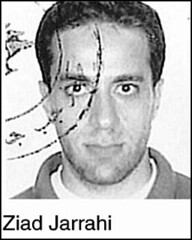 |
Jarrah's former fiancée described how he had changed after moving from provincial Greifswald
| "Ziad didn't want me to tell anyone that he was learning to fly." |
Motassedeq was sentenced in 2003 to fifteen years imprisonment for his role within the al-Qaeda group and for helping to plot the 3,000 murders of September 11, 2001. The verdict was quashed by an appeals court, which then directed a retrial.
Labels: al Qaeda, Al-Qa'idah, Al-Qaeda, Al-Qaida, Mounir al-Motassedeq, September 11, Ziad Jarrah
Wednesday, November 24, 2004
Khalid Sheikh Mohammed Linked to Bosnian Islamists
Specifically, GIS sources reveal that Khalid Sheik Mohammed, born in Kuwait on October 22, 1966, was in Bosnia as a first member of the El-Mudzahid unit, and then, since 1996, he was a member of the Egyptian Islamist radical operations. He obtained a Bosnian citizenship certificate in 1994 (Sarajevo Police No. 09/2-204-108 dated April 30, 1994) and a Bosnian passport soon thereafter.
In 2003, Defense & Foreign Affairs/GIS reported several additional links between Bosnian officials and the Islamist terrorist network ("Bosnian Official Links With Terrorism, Including 9/11, Become Increasingly Apparent as Clinton, Clark Attempt to Justify Support of Bosnian Militants," Gregory R. Copley, Editor, GIS, September 17, 2003).
A key link between radical Islamists in the government of Bosnia-Herzogovina (B-H) and Islamist terrorists was Huso (later Hussein) Zivalj, B-H Ambassador to the U.N. during the September 11, 2001 attacks. Zivalj arrived in New York just before the attacks and left the U.N. post shortly thereafter. During his stay as B-H Ambassador to Vienna between 1992 and 1995, Zivalj approved a significant number of visas and passports to radical islamists of non-Bosnian origin. In 1995, a B-H passport was issued to Safet Catovic [Passport No. BH-46600], who has had many links to Islamist "charity" front groups funding terrorist organizations. Earlier, Zivalj had issued a Bosnia-Herzogovina passport to Osama bin Laden himself.
Additionally, five of the known 9/11 hijackers had direct links through and with Bosnia, and all were supported by Bosnian-linked Islamist "charities".
Why have these links between Bosnian Islamists and 9/11 not become prominent news? Defense & Foreign Affairs concludes on a troubling note:
It is also significant that, despite the fact that the US Government has had Khalid Sheikh Mohammed in custody for more than a year, there has been no mention of Bosnia's role in the September 11, 2001, attacks, despite the growing volume of evidence linking Bosnia to the attacks. There has been some suggestion that the linkage was an embarrassment to the US Government -- and particularly to the US Dept. of State -- which had been a significant source of support for the Bosnian Islamists during and after the Bosnian civil war.Now that Condoleezza Rice is to be Secretary of State and Porter Goss is at the Central Intelligence Agency, one should be able to hope that any residual support within the U.S. Government for Bosnian Islamists can finally cease.
Labels: al Qaeda, Al-Qa'idah, Al-Qaeda, Al-Qaida, Bosnia, Defense and Foreign Affairs Daily, Global Information System, Khalid Sheikh Mohammed, Kuwait
Monday, November 22, 2004
U.S. Report Links Bin Laden and Chechen Rebels
Osama bin Laden has been actively involved in the terrorist insurgency in Chechnya since 1995, sending al-Qaida agents to the North Caucasus and sponsoring Chechen rebels, according to a declassified U.S. intelligence report released by Judicial Watch, a U.S. public corruption watchdog, late last week. Bin Laden sent Jordanian-born warlord Khattab, who is now dead, and nine instructors to Chechnya in 1995 to set up terrorist training camps, according to the six-page U.S. Defense Intelligence Agency report, which was based on notes from an unspecified person in 1998 and is marked at the top as not "finally evaluated intelligence." It says bin Laden met several times in 1997 with Chechen and Dagestani Wahhabis and "settled the question of cooperation -- agreeing to provide 'financial supplies' to Chechen militants." A senior Chechen rebel, Movladi Udugov, denied Saturday that the rebels had any ties to al-Qaida -- a link that the Kremlin has long maintained exists. He said the document's wording suggests it was designed by Russian special services.
Labels: al Qaeda, Al-Qa'idah, Al-Qaeda, Al-Qaida, Chechnya, Judicial Watch, Khattab, Osama bin Laden, Wahhabis
Tuesday, November 16, 2004
Jihadists Anticipate Imminent Nuclear Strike Against U.S.
Bodansky reports that a communique was disseminated throughout the Islamist-jihadist elite of Western Europe and the Arab world before it was first publicized on November 9 by an "Abu-Hamzah al-Filastini" on an Islamist website. The message was allegedly from the "Al-Shaykhayn Brigade" of the "Al-Qaida Organization," and contained a warning that the U.S. would face the consequences of "Allah's wrath" in the form of a nuclear strike against a U.S. city.
"Let everyone know," the communique warned, "that we shall not hesitate to strike against the Americans and the rest of the Crusaders in their own countries. Their dens, their towers, and their hideouts will not be of use to them. The towers of New York continue to bear witness to that and continue to stand in silence dumbfounded by the intensity of the tragedy and the horror of death."
"We, in the Al-Qaida Organization, are in the process of preparing operations that will be more than painful," read the translation of the communique. The author(s) then proceeded to warn the U.S. and the West that "after they refused the truce offered by our Sheikh and the advice given by our leader Osama bin Laden, may God protect him, in his latest oral message in which he advised the Americans not to elect the reckless Bush and to contemplate the outcome of the enmity against the Muslim world, we say that by this refusal they warrant the wrath of God."
The form of the threatened attack was also identified. "We conclude by bringing the Islamic Nation good news by saying that nuclear and atomic production and enrichment is not a monopoly limited to the Crusaders and the Romans or the tyrants of the world, and that we are moving forward with the production of small but very powerful bombs.... the first target and application will be inside the U.S., which has gone too far with its tyranny and oppression, and [against] the American people who refused the advice of our Sheikh and accepted humiliation and enmity towards us and crushed the bones of our children in Afghanistan, Palestine, Iraq, and Muslim countries as a whole."
Bodansky reports that when the authenticity of this communique was questioned on the forum to which it was posted, a "Liwa al-Shaykhayn" identified the source on November 11 as follows: "the Al-Qaida Organization, Europe and America Branch. [The] Media Official in Charge [is] Abu-Ans al-Maghribi."
One would trust, and should expect, that the leaders of the Mideast states should be no less terrified by these threats.
Labels: al Qaeda, Al-Qa'idah, Al-Qaeda, Al-Qaida, Defense and Foreign Affairs Daily, jihadists, Yossef Bodansky
Tuesday, November 09, 2004
Frustrated Terrorists Threaten Unbearable Hell for U.S.
The statement reads in part: "Despite the fact that criminal Bush sanctioned the spilling of Muslims' blood during the past four years, and despite the massacres he committed and is still committing in Afghanistan, Palestine, and Iraq, we see that his popularity is rising and the clapping of his people is getting louder. This demonstrates the nature of the American people, who support the campaign launched by the criminal America against Islam... The American people, at the end of the road, are the ones who will bear the consequences of the policy of their president during the coming four years.... The coming days will show you [the American people] that the one you preferred will lead you to an unbearable hell and that rallying behind that criminal will not bring you the security you are looking for and will not prevent the mujahedin from reaching your strongholds. And days will prove this to you." [Translation from Yossef Bodansky, "Osama bin Laden's Real Message: The Trends Following the U.S. Elections," Defense & Foreign Affairs Daily, November 9, 2004.]
Nonetheless, the BBC reports that even some fundamentalists have raised doubts about the credibility of this group's threats. One was quoted as asking: "How would you believe those who claimed responsibility for the power blackout in New York and Canada last year, while later on it transpired that it had nothing to do with any terrorist operations?"
Labels: Abu-Hafs Al-Masri Brigades, al Qaeda, Al-Qa'idah, Al-Qaeda, Al-Qaida, Defense and Foreign Affairs Daily, George W. Bush, Yossef Bodansky
main page
most recent entries
- The sting of 'cling'
- Finding Iran's long-range missile site in Google E...
- Southern Iraqi Shiite tribal leader claims Iran be...
- Rice for the Vice?
- A stash of FARC's uranium found in Columbia
- Is Condi Rice signaling an interest in being McCai...
- Saddam Hussein's regime plotted with Gaza terroris...
- An unapologetic apologia for the Iraq war
- Romanian rendezvous; Terrorists and arms dealers i...
- Saddam's support for terror: the Pentagon report's...
archives
blogs
feeds




searches
statistics
buttons
Blogroll Me!


