Wednesday, March 19, 2008
Romanian rendezvous; Terrorists and arms dealers in Bucharest
Raul Reyes (real name: Luis Edgar Devia Silva), who was killed in Ecuador earlier this month by the Columbian army during a bomb attack against FARC [Revolutionary Armed Forces of Columbia], had come to Bucharest, just weeks before his death, to negotiate the purchase of uranium from an agent of the Ukrainian crime syndicate of Semyon Yukovich Mogilevich.
The website of the Romanian newspaper Ziua ( "Romania Swarms With Terrorists," by Bogdan Galca, translated by BBC Monitoring, subscription) cites Colombia's El Espectador as reporting Reyes visit to Romania on a fake Venezuelan passport in mid-January. The Irish journalist Gordon Thomas is quoted in the piece and is said to have had access to reports of the British intelligence service MI6.
The United States issued a warrant for Mogilevich's arrest on charges of fraud, racketeering and money laundering. Russia arrested Mogilevich outside Moscow's World Trade Center last month, along with Arbat Prestige owner Vladimir Nekrasov. (On Monday, a Moscow court refused to grant Mogilevich bail, despite his plea to be dying of diabetes related ailments. See Moscow Times.)
The MI6 report is said to allege that Mogilevich has:
"a working relationship with Al-Qa'idah....It is a known fact that the organization led by Usamah Bin-Ladin is present in Venezuela and in South American countries governed by populist left-wing representatives who oppose the United States."Columbian Vice President Francisco Santos is quoted by the Spanish television network Antena 3 during the UN Conference on Disarmament as claiming that documents discovered on Reyes' computers revealed that FARC was attempting to purchase fissile material to construct a radiological ("dirty") bomb.
MI6 contends that the Ukrainians stole the enriched uranium from an insufficiently guarded storage site in Cheyabinsk, in the Ural Mountains.
Mogilevich's organization was not the only group attempting to negotiate with FARC in Bucharest.
The notorious Russian-born arms trafficker Viktor Bout, known as the "Merchant of Death" (and the model for the main character of the movie "Lord of War," played by Nicholas Cage), was arrested last month in Thailand on the basis of information provided by the Romanian authorities. Bout's associate, Andrew Smulian, had also been in Bucharest to negotiate an arms delivery to FARC.
The U.S. released an indictment of Bout and Smulian that accused them of "plotting in view of procuring material support for a terrorist organization." That material included 100 air-to-ground missiles and missile launchers. The indictment was based on the fact that Smulian had been negotiating with phony FARC leaders who in fact were agents of the Drug Enforcement Administration of the U.S.
Ziua's description of the sting that led to the arrest of Viktor Bout makes for fascinating reading:
Copenhagen, Curacao, and BucharestBout's arrest operation, as described by the documents of the US authorities, sounds like a spy novel. The informers had meetings in Copenhagen, Curacao, and Bucharest during an operation that first trapped Smulian, one of Bout's associates, the middle man of the arms transaction. According to the official document drawn up by a DEA special agent, undercover American agents succeeded in gaining the trust of the "Merchant of Death" and his associates several months before Smulian was arrested in Thailand. The meetings were held in several countries, including Denmark, Netherland Antilles, and Romania. In 1997, a DEA source (CS-1) contacted Smulian. Under DEA coordination, CS-1 sent an email to Smulian asking him to tell Bout that he had a business proposal. After a short while, Smulian told the agent that Bout was interested in the proposal and that they should meet. Under DEA coordination, CS-1 organized a meeting in Curacao, Netherlands Antilles. On 7 January 2008, CS-1 met Smulian in Curacao. CS-1 introduced two other DEA sources (CS-2 and CS-3). The two agents claimed to be FARC representatives. They told Smulian that they were interested in purchasing weapons, particularly missiles. On 22 January 2008, CS-1 met Smulian in Copenhagen, Denmark, to discuss Smulian and Bout's meeting in Russia about the weapons deal. Bout told Smulian to schedule a meeting with CS-2 and one of his representatives to discuss the transaction. The Russian warned his associate to be extremely careful and instructed him to get rid of cell phones, SIM cards, and other devices that might indicate where he had been and whom he had met. According to Smulian, Bout had said that he could provide the FARC with the weapons, because "any communist is our friend." On 23 January 2008, CS-1 and CS-2 met Smulian in Copenhagen. The three discussed the locations where they could meet Bout. Smulian told the DEA collaborators that "100 pieces were immediately available."
Missiles Photos Shown on Laptop
On 26 January 2008, CS-1 and Smulian came to Bucharest, where they met CS-2 and CS-3. Once they arrived, the latter told Smulian that they wanted to meet Bout in person to finalize the arms deal and deliver the money.
Smulian told them that Bout might have been arrested if he had come to Romania. At a certain point, CS-3 talked with Bout on the telephone about potential meeting locations, among which Cuba, Nicaragua, or Armenia. After the discssion with the "Merchant of Death," Smulian showed the three CS on his laptop photos of the missiles that were going to be delivered, pointing out that Bout could also supply helicopters that could be equipped with double-range missiles. Smulian also said that the weapons were in Bulgaria and that their "transport" would cost $5 million. Several days later, Smulian told CS-2 that "the weapons were ready in Bulgaria." On 5 February 2008, the Romanian authorities intercepted a conversation between Bout and CC-2, one of his associates, who operates an air company in our country [Romania]. On 7 February, CS-2 gave Smulian an e-mail address (bogotazo32@yahoo.com) that could be used by Smulian and Bout. On 12 February, CS-2 received an e-mail: "Buenos Dias! this is the e-mail we can use for commjnications. Best regards. Friend of Andrew." The address of the sender was created on 12 February under the name Victor But [name as published]. The DEA believes that the message was sent by the "Merchant of Death." The next meeting was held in Thailand, where Bout was captured.
Bout remains under detention in a maximum-security prison on the outskirts of Bangkok. Today, a Thai court extended by 12 days his detention, pending formal charges in Thailand. (See Russian Arms Dealer Jail Stay Lengthened," Guardian, March 19, 2008).
The DEA used a similar sting of a phony deal with FARC to capture Syrian arms trafficker Monzer al-Kassar, the "Prince of Marbella." (See Syrian arms dealer stung in DEA pseudo-deal with Colombian guerillas.) Kassar was arrested on June 7, 2007 in Madrid, following a tip from the Romanians, one day after two of his accomplices, a Chilean and a Palestinian suspected of terrorist activities in the United States, were arrested in Bucharest. Kassar had ties with Uday Hussein, son of Saddam Hussein. Michael J. Garcia, U.S. federal prosecutor in New York, alleges that Kassar has "supported terrorists and insurgents by providing state-of-art weapons that fuelled most of the conflicts started in the past 30 years." Kassar's customers include groups from Nicaragua, Brazil, Cyprus, Bosnia, Croatia, Somalia, the Palestinian territories, Iran and Iraq.
As Bucharest prepares to host the 20th NATO summit on April 2-4, security preparations have been understandably extensive.
Labels: al Qaeda, Al-Qa'idah, Al-Qaeda, Al-Qaida, Bucharest, Columbia, FARC, MI6, Monzer al-Kassar, NATO, Osama bin Laden, Raul Reyes, Romania, Semyon Yukovich Mogilevich, Ukraine, Venezuela, Viktor Bout


Monday, December 20, 2004
Turkey and the European Union: Cui Bono?
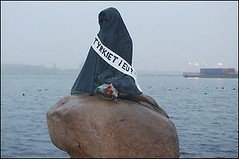 |
| Denmark's national symbol, the Little Mermaid sculpture perched on a rock at a Copenhagen pier, was draped in a burka and a sash reading 'Turkey in the EU?' overnight(AFP/Scanpix/Kristian Linnemann) |
Morocco's L'Economiste newspaper claimed that if the European Union should eventually refuse membership to Turkey that a chasm between the West and the Muslim world would be created that would mark a victory for Al Qaeda leader Osama bin Laden:
"Osama bin Laden and his followers are seeking to provoke this split," wrote the paper, adding: "Rejection of Turkey's candidacy would be seen around the world as a deliberate attempt to rupture ties with the Muslim world.
"It would be a huge victory for bin Laden and other fanatics. It would be as if they had succeeded in force-feeding the entire world the doctrine that religious differences determine political and strategic choices," the paper wrote. [" Rejection of Turkey in EU Would be a Victory for Bin-Laden," Turkish Weekly]
Defense & Foreign Affairs Daily sees the Turkish General Staff as resisting compliance over Cyprus in an effort to keep a separate sovereignty for Turkey. ["The EU and Turkey Reach a Watershed Which May See Cyprus Remain Divided and EU Expansion Halted," Analysis by Gregory R. Copley, Defense & Foreign Affairs Daily, December 20, 2004.]
Turkey and the EU will inevitably continue the facade of ongoing negotiations, and the EU-Turkey relationship will, of necessity, become in some important respects closer and more efficient than in the past, but many Turkish officials in the General Staff will start the process of breathing a collective sigh of relief that Turkey and its pan-Turkist dream have not been swallowed into the essentially hostile and homogenizing maw of Western Europe.Libya's leader Moammar Gadhafi maintained that Osama bin Laden would welcome an accession by Turkey into the EU. [Turkish Weekly: Gadhafi Agrees with ‘EU's Turkey-Sceptics’]
The Government of the Republic of Cyprus no doubt also drew breath with the knowledge that it did not have to confront Turkey directly, nor need to threaten use of a veto on Turkish accession; the EU process itself clearly demanded that Turkey abide by EU rulings on the mutual recognition by all member states of the sovereignty of all other member states. However, if the watershed does indeed see Turkey move to re-focus on its own sovereign destiny, outside the EU, then it will also become clear that the lure of EU membership was not sufficient to force Turkey to withdraw its 40,000 troops from their northern Cyprus occupation.
The result will now most likely be that Turkey does not move ahead with EU entry, does not recognize the Republic of Cyprus, and continues to occupy northern Cyprus.
Gadhafi: "Turkey will be a Trojan Horse for the EU"Meanwhile, in Denmark, pranksters responded to the news of the EU's planned initiation of talks with Turkey by draping a burka over the Little Mermaid statue.
Libyan leader Moammar Gadhafi has said it would be dangerous for the European Union to admit Turkey as a member state, calling the accession bid a "Trojan horse" for Islamic militants like Osama bin Laden.
"As far as the Islamic world is concerned -- including the Islamic extremists, even bin Laden -- they're rejoicing over the entry of Turkey in the European Union. This is their Trojan horse," he was quoted as saying by the Italian media. "I'm saying only what will happen with the entry of the horse into Troy," Gadhafi added in comments published on the day EU leaders met in Brussels to discuss whether to begin accession talks with the secular but overwhelmingly Muslim Turkey.
Gadhafi made his comments in an interview with RAI television, which is due to be aired on Friday. A transcript was printed on Thursday in Italy's La Repubblica daily.
Libya is in the US List of State Sponsors of Terrorism, and Libyan leader accepted Libya’s role in many terrorist attacks in the past.
Labels: al Qaeda, Al-Qa'idah, Al-Qaeda, Al-Qaida, Cyprus, European Union, Libya, Moammar Gadhafi, Osama bin Laden, Turkey
Monday, November 29, 2004
An Axis of Terror: Chechen Rebels, Hamas and Al Qaeda
The spectacular assaults on Russia in August 2004 displayed a "mix and match" of local and imported contributions. The two Chechen women who served as martyr-bombers were identified as members of the "regional Shakhid unit of Moscow of the battalion of Shakhid, Riyad us-Salihin" by Shamil Basayev, the Chechen rebel leader (whose top aide, Akhmed "White Arab" Sambiyev was just killed late Thursday by Russian security forces). Forensic evidence reveals that the bombs used on the two Russian planes were similar to the bomb that was seized from the shoes of Richard Reid, after he attempted to bomb an American Airlines flight on December 22, 2001.
Remarkably, Bodansky also claims that the bombs used on the Russian planes were also similar to the "bomb used by Abderraouf Jdey, a Canadian citizen also known as Farouk the Tunisian, who, on November 12, 2001, brought down an American Airlines aircraft soon after taking off from JFK to the Dominican Republic." The U.S. National Transportation Safety Board has maintained that the crash of AA 587 was accidental, and argues that the detachment of the vertical fin could not been the result of an event within the cabin. Suspicion that the crash was the result of sabotage has persisted, however, and just last August, Daniel Pipes reported in FrontPage Magazine the information (which Pipes called "not exactly rock-hard") that AA 587 was the result of an Al-Qaida operation with "Farouk the Tunisian" as the bomber.
Bodansky also reveals the source of Richard Reid's shoe bomb. The details illustrate the close cooperation between Iranian and Palestinian jihadist forces and Osama bin Laden's Al Qaeda network.
Reid's shoe bombs were based on Iranian-origin technology and were made of new type of high-explosives. Reid -- then an acknowledged bin Laden operative -- received his shoe-bombs in the Palestinian Jebalya camp in the Gaz Strip. At the time, he was a trainee-guest of Nabil Aqal, a senior commander of the Hamas' Izz al-Deen al-Qassim Brigades and a protege of Hamas leader Sheikh Yassin. The key components of the bombs had been smuggled to Gaza from Lebanon via Egypt by then-Palestinian Authority (PA) Chairman Yasir Arafat's ally and confidante, Jamal Sema Dana. The Hamas support for Reid a major deviation from Yassin's long-standing insistence that the Hamas cadres limit their operations to the Palestinian theater in order to contribute to international operations under the banner of a global jihadist entity. However, by the late 1990s, the Hamas needed foreign support from the global Islamist-jihadist movement and Yassin was willing to "pay" by increasing its direct involvement in the international jihad.Some of this foreign support Hamas received from international Islamist-jihadists was from Chechnya. Just after the outbreak of the intifada in September 2000, Shamil Basayev and Hattab, the "Black Arab" (who was later poisoned by the Russian secret service in 2002), sent 150 Chechen and Arab-Chechen "expert bomb-makers, snipers and fortification-builders" to Gaza and the West Bank. The extremely powerful bombs that Palestinians used to destroy several Israeli tanks were provided by the Chechens. Muhammad Dahlan, now head of Palestinian security services in Gaza, ran a program of smuggling into the Gaza Strip al-Qaida fighters and Chechens from Afghanistan-Pakistan. Each of the al-Qaida transplants received a $5,000 cash bonus, contributed from Saudi Arabia. A few of the Arab-Chechens had even been members of the Hamas Iss al-Din al-Qassim Brigades before they left Gaza and Nablus for advanced training in Afghanistan/Pakistan.
The ideological solidarity between the Palestinians and the Islamists in Chechnya became more public in 2004 when Hamas recruitment posters and videos featured portraits of bin Laden, Yassin and Hattab as the key leaders of the Islamist movement. The Hamas video also contained a fatwa by the Chechen Mufti Muhammad Abdullah Al-Seif sanctioning martyrdom-terrorism and even authorizing the recruitment of female martyr-bombers.
Labels: al Qaeda, Al-Qa'idah, Al-Qaeda, Al-Qaida, Chechnya, Defense and Foreign Affairs Daily, Gaza, Hamas, Osama bin Laden, Richard Reid, Russia, Shamil Basayev, Yassir Arafat, Yossef Bodansky
Saturday, November 27, 2004
Allegation Saddam Guard Was Al-Zarqawi Aide Spurs Dispute
On November 19, Al-Sharq al-Awsat published a report from Baghdad with the lengthy title: "Al-Zarqawi's aide a former guard of Saddam, brother of 'Al-Jazeera' office's director in Baghdad. Umar Hadid led Al-Fallujah battle, received training in Afghanistan." A translated paraphrase of the article was made by BBC Monitoring International Reports (not, so far as I know, publicly accessible on the web), though a rough translation of a portion of the article is available on FrontPage Magazine.
Al-Sharq al-Awsat quoted informed sources in Iraq as saying that Hamid Hadid, the director of Al-Jazeera's Baghdad bureau had a brother who had been Abu-Mus'ab al-Zarqawi's foremost aide. This brother, Umar Hadid, was also said to have once been in the special guard of Saddam Hussein. (The translation on FrontPage says he was in Saddam Hussein's "personal body-guards unit"; the BBC Monitoring International Report says Umar was in "Saddam's Special Republican Guard.") About ten years ago, according to the report, Umar left the guard service to associate with radical Islamic fundamentalist groups. With one accomplice, he is alleged to have carried out a bombing of an al-Fallujah cinema that killed a person. He then is thought to have fled to Pakistan, and, from there, to have entered Afghanistan, where he received training in the base camps of al-Qa'idah, under the leadership of Osama bin Laden.
Sources for the report thought that Umar Hadid may have left Afghanistan to return to Pakistan, after the overthrow of the Taleban regime in 2001. There is no doubt among the sources, however, that he returned to Iraq just before the beginning of the war, when Saddam Hussein provided a general amnesty for prisoners, wanted men and runaways.
According to intelligence sources, Umar Hadid led the battle against U.S. forces in al-Fallujah. Iraqi sources privy to information from western intelligence services also claimed that Umar Hadid was still in the al-Fallujah region after al-Zarqawi escaped.
The report of Al-Sharq al-Awsat also alleged that the Hadids had a third brother, who was killed, along with his family, when his house was shelled by U.S. forces just two hours after a visit from Umar.
Al Jazeera responded promptly, on November 20, with an interview of Umar Hadid in their Doha studio. Here are his denials, in a translation provided by BBC Worldwide Monitoring, November 20 (again, so far as I know, not available in any publicly accessible website):
Hadid: I am Umar Ahmad Muhammad al-Jumayli, a brother of Hamid Ahmad Muhammad al-Jumayli, director of Al-Jazeera bureau. The Saudi newspaper Al-Sharq al-Awsat published a report claiming that I have a connection with or that I am an aide to Al-Zarqawi in Al-Fallujah. I deny this because I am 24 years old. The report claims that I was in Afghanistan 10 years ago and went to Pakistan. Ten years ago, I was a little boy. Therefore, this is untrue.On November 23, Al-Sharq al-Awsat responded with a published interview of Iraqi interim Defense Minister Hazim Sha'lan. Al-Sha'lan attacked Al-Jazeera satellite television as a "terrorist channel. He also claimed that Umar Hadid was indeed "a terrorist and is wanted by the Iraqi government for his terrorist activities in Fallujah." (quotation from "Analysis: Al-Jazeera's Row with Saudi Paper Al-Sharq Al-Awsat," BBC Monitoring International Reports, November 26, 2004).
Lina Zahr-al-Din, Al-Jazeera: You do not know Al-Zarqawi at all and you have not met him before?
Hadid: I do not know Al-Zarqawi or anybody linked to him. I hear about him from satellite channels only.
Zahr-al-Din: You said that 10 years ago you were a young boy, but the newspaper accused you that then you worked in Saddam Husayn's special guard. What did you exactly do then?
Hadid: I was a student. I was 14 years old. I left school then and began to drive a lorry to support my family. Afterward, I was enrolled in the Iraqi Army for three months. This is the military service document and the driving licence, which prove that I served in the Iraqi Army for three months. I was discharged later after paying cash for my discharge.
On the same day, the new editor of Al-Sharq Al-Awsat, Tariq al-Humayd, appeared on the Lebanese channel Future TV to defend his paper's feature story on Umar Hadid. Appointed by Prince Faysal bin Salman in October 2004, al-Humayd has given the London-based newspaper an editorial stance that is firmly in support of the war on terror. (In one piece, entitled "For Saudis only," for example, he took to task those Saudis who sympathized with the jihadists in Afghanistan, Iraq, and particularly, those fighting in Fallujah. He also called for Islamic clerics to stop inciting the youth of Saudi Arabia to jihad.) By the account of the interview in the BBC Monitoring International Report, it appears that al-Humayd took a moderately conciliatory stance toward al-Jazeera, and emphasized that the story's focus had been Umar Hamid, not al-Jazeera. Al-Humayd also expressed concern that the incident should not become "politicized" and lead to a rift between Saudi Arabia and Qatar.
Whatever the resolution of this dispute over the Hadids, the fast-approaching trial of Saddam Hussein promises to teach us much, much more about the nexus connecting Saddam's regime to global networks of terror.
Labels: Abu Musab al-Zarqawi, al Qaeda, Al-Jazeera, Al-Qa'idah, Al-Qaeda, Al-Qaida, Hamid Hadid, Iraq, Osama bin Laden, Saddam Hussein
Monday, November 22, 2004
U.S. Report Links Bin Laden and Chechen Rebels
Osama bin Laden has been actively involved in the terrorist insurgency in Chechnya since 1995, sending al-Qaida agents to the North Caucasus and sponsoring Chechen rebels, according to a declassified U.S. intelligence report released by Judicial Watch, a U.S. public corruption watchdog, late last week. Bin Laden sent Jordanian-born warlord Khattab, who is now dead, and nine instructors to Chechnya in 1995 to set up terrorist training camps, according to the six-page U.S. Defense Intelligence Agency report, which was based on notes from an unspecified person in 1998 and is marked at the top as not "finally evaluated intelligence." It says bin Laden met several times in 1997 with Chechen and Dagestani Wahhabis and "settled the question of cooperation -- agreeing to provide 'financial supplies' to Chechen militants." A senior Chechen rebel, Movladi Udugov, denied Saturday that the rebels had any ties to al-Qaida -- a link that the Kremlin has long maintained exists. He said the document's wording suggests it was designed by Russian special services.
Labels: al Qaeda, Al-Qa'idah, Al-Qaeda, Al-Qaida, Chechnya, Judicial Watch, Khattab, Osama bin Laden, Wahhabis
Sunday, November 07, 2004
Radical Saudi Clerics Openly Call for Jihad in Iraq
The letter is quoted as saying: "Fighting the occupiers is a duty for all those who are able. It is a jihad (holy war) to push back the assailants ... Resistance is a legitimate right. A Muslim must not inflict harm on any resistance man or inform about them. Instead, they should be supported and protected.... Those occupiers, there is no doubt they are warring aggressors and it is legitimate to fight them until they leave humiliated. Even earthly laws acknowledge the right of people to resist...."
The close connections to al-Qaeda of some of the clerics cited as signatories of this letter were explored by headland in Cleric With Links to 9-11, Bin Laden and Madrid Made Secret Deal with Saudi Regime. According to Spanish and Italian newspapers, Sheikh Salman al-Awdah funneled money to an Egyptian, Rabei Osman Ahmed, the alleged mastermind behind the March 2004 Madrid train bombings. Moreover, Al-Awdah, Al-Omar, and Al-Hawali were singled out for praise by one of the September 11 hijackers, Sa'id al-Ghamidi, in a video, aired by Al-Jazeera in September 2003, in which he appeared reading his last will and testament. Al-Awdah and Al-Hawali were also praised in a videotape recorded by Osama bin Laden in which he thanked the two clerics for "enlightening Muslim youth."
The article in today's Kuwait Times, "Saudi ulema urge jihad in Iraq" notes that Al-Hawali's name appeared on a list issued last month by a group of Arab intellectuals who seek prosecution of prominent clerics for encouraging terrorism. Needless to say, the continued protection by the Saudi regime of clerics such as Al-Hawali and Al-Awdah, founding members of the Movement for Islamic Resurgence, a front for al-Qaeda in Saudi Arabia, is disturbing.
In Cleric With Links to 9-11, Bin Laden and Madrid Made Secret Deal with Saudi Regime, light on Riyadh's toleration of these radical clerics was provided by a quote from a revealing article published in Intelligence Online in June, 2002. That article pointed to a secret deal between these radical clerics and the Saudi regime:
...since Sept. 11 an informal pact has governed relations between the ruling Saud family and sympathizers of Ben Laden. To avoid tarnishing the country's image even more, Bin Laden's friends agreed to keep a low profile and the regime promised to tolerate their presence. The agreement was reached between the boss of internal security, Nayef Bin Abdel Aziz (presently convalescing in Switzerland) and members of the Movement for Islamic Resurgence, a front for Al Qaeda in Saudi Arabia. Officials from the interior ministry feared - and rightly so - what would happen if the pact were broken. Under the accord, the two leading figures in the movement, Sfar Al Hawli and Salman Al Awdah, promised to abstain from any anti-American acts or rhetoric (which nonetheless continued in dozens of mosques after Sept. 11) in return for the government's leniency and eventual release of group members who were jailed some months ago.Plainly, Sheiks Al-Awdah, Al-Omar and Al-Hawali are abandoning any semblance of a low profile in their continued support of terrorism against the West. How long can the Saudi regime pretend to ignore them?
Labels: al Qaeda, Al-Qa'idah, Al-Qaeda, Al-Qaida, Fallujah, Iraq, Osama bin Laden, Saudi Arabia, Sheikh al-Awdah, Sheikh Awad Al-Qarni, Sheikh Hatem al-Aouni, Sheikh Nasser Al-Omar, Sheikh Safar Al-Hawali
Tuesday, November 02, 2004
Was this OBL's Message: U.S. Deserves Imminent WMD Attack?
Bodansky takes bin Laden's message to be an anticipatory moral defense:
He emphasized that the key to the security of all Americans was in their own hands: "Your security does not lie in the hands of Kerry, Bush, or al-Qaida . Your security is in your own hands." This can be done if Americans, through the electoral process, profoundly changed the policy of the US and ended the war on terrorism. "Each and every state that does not tamper with our security will have automatically assured its own security," bin Laden noted. Left unstated was the most important point: namely, that if US voters chose to support the continuation of the war on terrorism in one form or another they would be held responsible for the inevitable retaliation. This was the logic behind the spectacular strikes of September 11, 2001, and this logic remains valid.In a November 2001 interview by Pakistani journalist Hamid Mir, Bin Laden made the argument that given their participation in the democratic process, no US citizen was actually an innocent civilian.
"This is a major point in jurisprudence," bin Laden explained. "In my view, if an enemy occupies a Muslim territory and uses common people as human shield, then it is permitted to attack that enemy. ... The American people should remember that they pay taxes to their government, they elect their president, their government manufactures arms and gives them to Israel and Israel uses them to massacre Palestinians. The American Congress endorses all government measures and this proves that the entire America is responsible for the atrocities perpetrated against Muslims: the entire America, because they elect the Congress."Bodansky reports that in the summer 2004 there began a crescendo of threatening messages, referring to the forthcoming use of weapons of mass destruction against the West, with a strong hint of the use of a nuclear weapon. He also notes that the threats delivered in American English by Azzam al-Amriki in late October of spectacular strikes against American cities have been echoed in numerous messages delivered in Arabic, Dari and a host of other languages.
A note from the Editor reports that GIS/Defense & Foreign Affairs sources within the Islamist movements in the Balkans all report, on October 31, 2004, an upsurge in the rumors of a planned nuclear strike by Islamists on one or more U.S. targets. The note adds that Bosnian groups linked to the radical Islamist party SDA were active in supporting the terrorists who carried out the attacks on September 11 in the United States and in March 2004 in Madrid.
Bodansky concludes that taken together, these warnings have created great expectations among those faithful to the Islamic jihadist movement and that the leadership is not likely to ignore or fail to fulfill these expectations.
[Ed. In the full text of the speech posted on Aljazeera.Net, there is a grisly attempt by bin Laden to lay the blame for 9/11 on the victims. He claims to discern in their gestures before the collapse of the towers this message: "How mistaken we were to have allowed the White House to implement its aggressive foreign policies against the week..." Bin Laden then sees the victims imploring living Americans to hold their leaders to account, thereby implying that if we do not, we too will be guilty and thus deserving of the attacks of the Islamists.]
Labels: al Qaeda, Al-Qa'idah, Al-Qaeda, Al-Qaida, Defense and Foreign Affairs Daily, George W. Bush, Global Information System, John Kerry, Osama bin Laden, Yossef Bodansky
Monday, November 01, 2004
The Purpose of the Tape (Part 2)
MEMRI quotes the Islamist website Al-Qal'a as explaining the sentence this way:
"This message was a warning to every U.S. state separately. When he [Osama Bin Laden] said, 'Every state will be determining its own security, and will be responsible for its choice,' it means that any U.S. state that will choose to vote for the white thug Bush as president has chosen to fight us, and we will consider it our enemy, and any state that will vote against Bush has chosen to make peace with us, and we will not characterize it as an enemy. By this characterization, Sheikh Osama wants to drive a wedge in the American body, to weaken it, and he wants to divide the American people itself between enemies of Islam and the Muslims, and those who fight for us, so that he doesn't treat all American people as if they're the same. This letter will have great implications inside the American society, part of which are connected to the American elections, and part of which are connected to what will come after the elections."Thus, MEMRI concludes, Osama bin Laden is attempting to influence the American election by offering a deal to each individual state of the union. He is offering a separate truce to each state, similar to the one offered to the Europeans a few months ago.
There can now be no doubt that the enemies of the West would greatly prefer to see Kerry beat Bush, as I argued two weeks ago in "A Question for Those Not Planning to Vote for Bush". Those who have the responsibility to vote on Tuesday should give that fact the utmost consideration.
Labels: al Qaeda, Al-Qa'idah, Al-Qaeda, Al-Qaida, George W. Bush, John Kerry, MEMRI, Middle East Research Institute, Osama bin Laden
Sunday, October 31, 2004
The Purpose of the Tape
The surprise went deeper. For we expected an October Surprise to represent an obvious advantage for one side or the other. On this weekend before the election, however, it is by no means obvious how this October Surprise is likely to sway the electorate. Even putting aside the fact that millions have already cast their ballot, it is hard to anticipate the effect of the tape on those who have yet to vote.
What was Osama bin Laden doing? Obviously, he was giving a message addressed explicitly to the American people. More important than the propositional content of his utterance, however, is what effects he intended to produce in those who heard his words. The philosopher J. L. Austin coined the term "perlocutionary act" to describe that part of a speech act that is directed toward producing an effect in the audience. What was the perlocutionary effect that bin Laden was seeking? One effect, no doubt intended, was that the Americans would be surprised. Another, perhaps, was directed toward the Arab world: to lift al Qaeda's image and morale. Perhaps another was to signal al Qaeda cells to proceed with an attack. Were there other purposes intended by bin Laden toward his American audience?
Undoubtedly there were. The timing of the videotape makes plain that bin Laden intended to have his words heard before the election. In the words broadcast by al Jazeera, and apparently in those words mysteriously not broadcast, bin Laden was intent on mocking Bush. (In Austin's terminology, bin Laden's mocking is one of his illocutionary acts.) It is understandable that those Democrats who echo Michael Moore, those who use similar language with similar intent, should wish to put distance between their own rhetoric and that of bin Laden. Some attempt to find that difference in the intended perlocutionary effects. The terrorists, they insist, would prefer to see Bush win, because al Qaeda could then continue to exploit the hatred of Bush to recruit more youth into al Qaeda. This response has the scent of desperation.
Others on the left do not attribute such subtlety to bin Laden's motives, but take him at his word when he claims that it will not matter to the security of America whether or not Kerry or Bush win. Here, I think they are only half-right. Note that bin Laden declared that the idea of attacking the twin towers came to him in 1982, when the United States aided Israel in its invasion of Lebanon. Yet, the groups with which bin Laden was affiliated did not wait until 2001 to respond. In 1983, a group known as Islamic Jihad destroyed the United States embassies in Beirut and in Kuwait. In 1992, that same group destroyed the Israeli embassy in Buenos Aires. In 1993, they first struck the twin towers, in the bombing attack planned by Ramzi Yousef and Khalid Sheik Mohammed. These attacks span the administrations of both parties in the U.S. It is a fantasy to believe that bin Laden would respond to the election of Kerry by ordering a ceasefire.
So, it is a half-truth that al-Qaeda and bin Laden do not care who wins this election. To be sure, the election will have no effect on their intentions nor on their hatred of the West. Nor will the election change their impossible demand that the West disengage from the Islamic world, and only such a disengagement could constitute the security that bin Laden demanded in his videotape. Nonetheless, the election will have an effect on the level of resistance that the jihadists can expect to meet. That is the difference that explains why bin Laden would prefer that George Bush lose, and why he wished to demonstrate that he was alive, well, and capable of mocking Bush right before the election. The intended purpose of the tape was to help swing the election Kerry's way. We will soon see whether bin Laden gets what he wishes.
Labels: al Qaeda, Al-Jazeera, Al-Qa'idah, Al-Qaeda, Al-Qaida, George W. Bush, John Kerry, Michael Moore, October Surprise, Osama bin Laden
Saturday, October 30, 2004
The Wolf Pleads for Weakness
| In an increasingly dangerous world, even after the first terrorist attack on America, John Kerry and the liberals in Congress voted to slash America's intelligence operations by 6 billion dollars. Cuts so deep they would have weakened America's defenses. And weakness attracts those who are waiting to do America harm. Wolves ad |
Bin Laden declared that he began to plot an attack on the World Trade Center in 1982, when the United States helped Israel in Lebanon. Many will take him as referring here to the plot of 9/11, forgetting that the first plan of attack on the twin towers culminated in the bombing of 1993.
His ridicule of George Bush shows he has access to a DVD player and Michael Moore's Fahrenheit 9/11. He takes special delight, as does Moore, in needling Bush for letting a child finish the reading of a storybook, after first being told of the attack on the World Trade Center.
Plainly, by releasing this tape right before the U.S. elections, Osama bin Laden hoped to influence the American electorate. He vainly -- and preposterously -- wishes to be seen in the same sympathetic light in which he sees himself. He also desperately wants to undermine America's trust in Bush. Listening to Kerry's initial response to his message -- the repeating of the charge that Bush had passed up the chance to get him in Tora Bora -- bin Laden had reason to think he had succeeded. Yet tonight, it is no less plain that he has once again failed to take America's measure.
Labels: al Qaeda, Al-Qa'idah, Al-Qaeda, Al-Qaida, Osama bin Laden
Friday, October 29, 2004
"The Streets Will Run With Blood"
In fact, the videotape leaves little doubt how we should answer the question I asked last week in this space: Which candidate do you believe the terrorists would most like to see win, two weeks from today? I asked that question to make the case for reelecting George W. Bush. The argument was this: the war on terror is by far the most important basis upon which to base one's vote; the terrorists would prefer to see Bush lose; our conflict with terrorists is approximately zero-sum (i.e., we share no important interests in common), and consequently, that we should prefer to see Bush win.
The interests of the West and the interests of the jihadists are in direct opposition. We prefer the survival of our civilization to its extinction, and they prefer their own death to settling for less than our extinction. The lesson of the al Qaeda video is not that jihadists hate us because Bush is President, but that they hate Bush because he is dedicated to killing the jihadists before they kill us.
Labels: al Qaeda, Al-Qa'idah, Al-Qaeda, Al-Qaida, George W. Bush, jihadists, John Kerry, Osama bin Laden
Tuesday, October 26, 2004
Bodansky: Al-Qaeda-Linked Terrorists Active in Bosnia
According to Bodansky, director of the Task Force on Terrorism and Unconventional Warfare of the U.S. Congress and author of The Secret History of the Iraq War, terrorists responsible for bombing the United Nations headquarters in Baghdad last year were trained near Zenica in central Bosnia and then sent to Iraq via Italy.
Bodansky claimed that cells used Bosnia as a training ground and gateway to send terrorists to western Europe or to hide those who had arrest warrants issued for them in the West, before they were transferred to the East. Bodansky also claimed that terrorists captured in a series of raids in London this year had conceded to having links with Bosnia-Hercegovina. Bodansky, who met with Bosnian officials last week, complained: "Representatives of the international community in Bosnia and (local) authorities are aware of this, but they do not work enough to fight international terrorism."
Labels: Bosnia, Bosnia-Hercegovina, Iraq, Osama bin Laden, Serbia, United Nations, Yossef Bodansky
Sunday, October 24, 2004
An October Surprise? (Some Philosophical Reflections)
Perhaps we can charitably take Teresa Heinz Kerry at her word. For most of us, however, an appearance of Osama bin Laden in captivity would certainly count as a surprise. Despite rumors that bin Laden still is hiding on the Afghanistan-Pakistan border, there has been no confirmed new video of him since December 26, 2001. Many argue on this basis that the man, who heretofore craved publicity in life, must now be dead. See James S. Robbins, John Kelly (via Roger L. Simon), Mark Steyn, and Froggy Ruminations (link courtesy of Power Line).
In recent days, speculation has shifted to events in Iraq as a potential October surprise. Perhaps there will be a final push in Fallujah, culminating in the capture or killing of al-Zarqawi. Perhaps the resistance in Iraq will attempt a major penetration of the Green Zone in Baghdad, something akin to the 1968 Tet offensive by North Vietnamese forces.
As the days of October dwindle down to the final few before the election of November 2, the only surprise of October may be the absence of surprise, and the paradoxical possibility of a no-surprise surprise looks more and more likely. Yet, anticipations of a surprising absence of surprise would only set us up psychologically for a real and robust surprise.
The idea that we can anticipate an October surprise with certainty is subject to paradox. Suppose we could know in advance that there will be an October surprise, a recognizably surprising event that has the potential to swing the election. One would think that this knowledge is incompatible with the event's occurring on the last day of October. Should there be no surprise before the last day of October, the certain knowledge that there will be an October surprise would imply that the surprising event would have to occur on the very last day; ergo, no surprise. Since the outcome of an unsurprising surprise is a contradiction, it follows that the October surprise must occur before the last day of the month. Yet, this result shows that the event cannot occur on October 30 either. For, if we have already ruled out October 31, then, on the night of October 29, there is only one available day for a surprise. Again, no surprise, if the surprise occurs on October 30, the only remaining day available. We can push the argument back to show that, for each day of October, the October surprise cannot occur on that day. So, there can be no October surprise! (The paradox is known as the "surprise examination paradox," since it is often formulated in terms of a teacher announcing to a class that there will be a surprise examination in the coming week.)
To my mind, the most promising solution to the "surprise quiz" paradox is proposed by Timothy Williamson, who argues that the argument for the impossibility of an announced surprise quiz being given in the coming week rests upon a dubious principle that whatever one knows, one knows that one knows. On the positive project of explaining how we can be surprised, Williamson suggests that our knowledge of future surprises can be an inexact knowledge, a knowledge that allows for a margin of error.
In any event, there still remains a little time for us to be genuinely surprised by some event in this electoral cycle, particularly since we do not know with certainty that we will be surprised.
UPDATE: Anticipation of a foreign affairs story harmful to Kerry appearing in tomorrow's Washington Times has generated a flurry of blog activity this weekend. See: Powerline, Redstate, INDC Journal and Secure Liberty. For some humorous speculation on the surprise, see: Protein Wisdom.
Labels: John Kerry, October Surprise, Osama bin Laden, Teresa Heinz Kerry
Tuesday, October 19, 2004
Al-Zarqawi's Pledge of Allegiance
| "Linking Al-Zarqawi to Al-Qa'idah adds some legitimacy to Bush's claims about Saddam's cooperation with Al-Qa'idah and subsequently adds legitimacy to his occupation of Iraq." Husayn Bin-Mahmud |
Louis Meixler of the Associated Press published an analysis on Tuesday suggesting that the pledge may be a sign of weakness rather than strength. The article quotes Daniel Byman, a senior fellow at the Saban Center at the Brookings Institute, who argues that the pledge may show that Al-Zarqawi, while politically strong among Islamic militants, may be desperately in need of money and people after the pounding he is taking from the U.S. military.
In the statement appearing on an Islamic Web site last weekend, al-Zarqawi said he regarded bin Laden as "the best leader for Islam's armies against all infidels and apostates" and pledged "allegiance of Tawhid and Jihad's leadership and soldiers to the chief of all fighters, Osama bin Laden."
 |
Predictably, during this election season, the AP concluded with someone skeptical of the timing of the announcement:
"If al-Zarqawi were the manager of the Bush campaign, this would be the right statement at the right time," said Diaa Rashwan, a terrorism analyst at Cairo's al-Ahram Center. "It's timing ... only serves the interests of the Bush election campaign."The BBC Monitoring International Reports published several reactions to Al-Zarqawi's announcements that were originally published in the London-based newspaper Al-Quds al-Arabi on October 19 as "Al-Zarqawi's pledge of allegiance to Bin Ladin draws extremely contrasting interpretations." Here are three selections from the sources quoted in that report:
• Yasir al-Sirri, director of the London-based Islamic Observation Centre, says that the pledge of allegiance shows that "the US allegations about a relationship between Al-Qa'idah and Saddam Husayn through Al-Zarqawi are incorrect."
• Abd-al-Bari Atwan, chief editor of the London-based Al-Quds Al-Arabi, says: "This pledge of allegiance eliminates with certainty any doubt about Al-Zarqawi's connection to Bin-Ladin. Al-Zarqawi has come under the wing of Al-Qa'idah. Al-Zarqawi is a graduate of Bin-Ladin's school. He received training in Afghanistan and went to Iraq where he established a branch for the organization. Today, the branch rejoins the mother organization. The Al-Qa'idah Organization is a horizontal and not vertical organization and Bin-Ladin is the spiritual father."
• Husayn Bin-Mahmud, an expert in the Islamic World Information Centre, wrote an analysis recently published on Islamic Internet sites. He says: "Al-Zarqawi is a mysterious personality. He is the ideal person for attracting the attention of the American public. He also justifies the viewpoint that Bush gives to his people that this war was not launched only against Iraq, but also against international terrorism." Mahmud says that Al-Zarqawi is also Bush's "justification for staying in Iraq." He says: "Linking Al-Zarqawi to Al-Qa'idah adds some legitimacy to Bush's claims about Saddam's cooperation with Al-Qa'idah and subsequently adds legitimacy to his occupation of Iraq."
UPDATE: The Associated Press reports that Al-Tawhid wa al-Jihad has changed its name to "al-Qaida of Jihad in the Land of Two Rivers" [the Euphrates and the Tigris].
Labels: Abu Musab al-Zarqawi, al Qaeda, Al-Qa'idah, Al-Qaeda, Al-Qaida, Al-Tawhid wa al-Jihad Group, Iraq, Osama bin Laden
Monday, October 11, 2004
Abu Hafs: Al Qaeda's Top Man in Chechnya
 |
According to reports:
- Abu Hafs was born in Jordan, is believed to have Saudi citizenship and is about 40 years old.
- Abu Hafs has been associated with Al Qaeda for years and has known bin Laden personally.
- In 1994, following orders of bin Laden, Abu Hafs moved to Chechnya and became an instructor at Ibn al-Khattab's training camp near Serzhen-Yurt.
- In 1996, bin Laden ordered Abu Hafs into Georgia, where he became Al Qaeda's representative and was known as Amzhet.
- He lived in the village of Tsuniban, Pankisi Gorge, had a Wahhabi fundamentalist mosque built there, as well as a hospital for guerillas in Chechnya.
- On September 11, 2001, 15 minutes after a plane crashed into the Pentagon, Russian secret services detected a call from an Al Qaeda leader to Amzhet in Georgia. The caller told Amzhet that everything was going well, but that not all the targets were hit. The fourth hijacked plane crashed in Pennsylvania soon after the call.
- Russian secret services poisoned Khattab in 2002, and the position of representative of international terrorist organizations in Chechnya was passed to al-Walid.
- Abu al-Walid summoned Amzhet to return to Chechnya. Fearing he might be poisoned as well, Abu Hafs brought in his own cook from Jordan. He took second wife in Chechnya, the widow of Arab field commander Abu Jafar, killed in May 2001.
- Abu Haf's roles in operational planning and distribution of funds from sponsors in Chechnya was confirmed by Ramat Kamal Burahlja (a.k.a. Abu Mushab) of Algeria, recently arrested in Chechnya. Burahlja is an explosives expert who was trained in Pankisi Gorge by Amzhet himself and is personally familiar with Abu Hafs's role in planning operations.
- Russian secret services killed Abu al-Walid in April and Abu Hafs stepped into the vacancy.
- Abu Hafs is believed to have financed the terrorist attack in Beslan, North Ossetia and a similar operation that was thwarted in Dagestan.
Labels: Abu al-Walid, Abu Hafs, al Qaeda, Al-Qa'idah, Al-Qaeda, Al-Qaida, Chechnya, Osama bin Laden, September 11
Sunday, October 10, 2004
BOSNIAN ORPHANS FIGHTING FOR AL-QAIDA (PART 2)
The man in Vienna supplying the main control and direction of Kvadrat is businessman Mohammed Porca, a Bosnian Muslim. Porca is also linked to other Islamist organizations in Austria and Germany. The financing sources for Kvadrat in the international Muslim community has come in part from Al-Haramain, but also through donors cultivated by Mr. Porca.
The location of Kvadrat's offices, in Bosnia but now also in the southern Serbian region of Raska, adjacent to Bosnia's Gorazde Corridor, suggests that Kvadrat may now be getting some of its funding through narco-trafficking. The logistical line of narcotics from Afghanistan is through Iran, Azerbaijan and Turkey, into Albania, and then through Kosovo and Raska areas of Serbia, into Bosnia and finally into Western Europe.
GIS sources identify the main activist radicals of Kvadrat to be: Softic Samir, susa Samir, Kolsic Nisvet, and Dzafic Emir.
Members of the Steering Committee of Kvadrat since 1999 include: Mezit Nermin ("Nerko"), (Sarajevo), Seknic Sendad (Mostar), Sinanovic Kermal, (Sarajevo), Tahic Berin (Sarajevo), Tahic Berin (Sarajevo), Alic Galib (Sarajevo), Motoruga Elvir (Sarajevo), Hodzic Emir (Sarajevo), Zukic Sabahudin (Sarajevo), Cengic Faruk (Sarajevo), Hasanovic Aliya (Sarajevo), Ahmetovic Amir (Kaknja), Nuhanovic Sanel (Bihac), Ortas Emire (Sarajevo). In 2004, the Steering Committee was enlarged. Known to have joined the group are: Cardakovic Seco, Dedovic Edin, Gusic Elmedin ("Melo"), and Skrijelj Admir.
Northern Cyprus, occupied by Turkey, is being used by Kvadrat as a safe haven for its fighters. Kvadrat is also said to be building a base in Northern Cyprus, to proselytize the Muslim community in the Cypriot society.
The Office of the High Representative, the internationally appointed governor of Bosnia-Herzegovina, has continued to deny that terrorist organizations are operating in Bosnia. Instead, Paddy Ashdown, the OHR and a former MI6 (British Intelligence) official, has only pursued alleged war criminals from the Serbian side of the civil war.
Al-Haramain foundation (AHF), the Saudi charity that supported Kvadrat had two U.S. branches through 2004: in Ashland, Oregon and Springfield Missouri. The organization's U.S. attorney was Al-Buthe and documents that provided him with broad legal authority were signed by Aqeel Abdul Aziz Al-Aqil, the former director of AFH. Since March 2002, the United States and Saudi Arabia have designated eleven branches of AHF as providing logistical support to the al-Qaida network. These branches were: Afghanistan, Albania, Bangladesh, Bosnia, Ethiopia, Indonesia, Kenya, the Netherlands, Pakistan, Somalia, and Tanzania. These branches, as well as the former director of AHF, Aqeel Abdul Aziz Al-Aqil, are named by the UN's 1267 Committee's consolidated list of terrorists associated with al-Qaida and Osama bin Laden.
The US website FrontPage Magazine (September 16, 2003) details the AHF connection to al-Qaida:
"In September 2002, Indonesian al-Qaida informant Omar al-Faruq told the CIA that Al-Haramain was used to remit funds to him from bin Laden. Al-Haramain's website used to have a direct link to qoqaz.net, which is a website that is part of the al-Qaida propaganda network. The website is owned by Azzam Publications, bin Laden's propaganda vehicle, and operated from Houston Texas. Al-Haramain is also involved with the Al Baraka banking empire, which was also named in the 9/11 lawsuit. AL-Baraka finances the activities of bin Laden and al-Qaida. In his Senate testimony in July 2003, terrorism expert Steve Emerson said that although initially Saudi Arabia denied allegations that Al-Haramain were involved in terrorist activities, in June (2003) they stated that al-Haramain was not acting according to its charter and announced that all foreign offices were to be closed. Emerson did remark that the Ashland office was still in operation. Al-Haramain has another location in the United States. According to the 9/11 complaint, Al-Haramain owns a building in Springfield, Missouri that is home of the Islamic Center of Springfield, which is a mosque."The Saudis announced in June, 2004, that they would dissolve AHF and fold all charities operating abroad into a new entity, the Saudi National Commission for Relief and Charity Work Abroad.
Yet, Al-Haramain Foundation has yet to be dissolved. According to the BBC Monitoring Report, ("Saudi Arabia Announces 'Dissolution' of Controversial Charity", October 6, 2004), Dr. Tawfiq al-Sudayri, the undersecretary of the Ministry of Awqaf and Religious Affairs in Saudi Arabia, was reported by the London-based newspaper Al-Sharq al-Awsat to say by telephone on October 5: "A decision was issued today [October 5, 2004] to dissolve the Al-Haramayn Charity Foundation and all its branches." The Associated Press report of October 5 points out that AHF has until October 15 to dissolve all of its operations, so this Saudi "charity," the one that bankrolled the training of Bosnian orphans to become terrorists in Chechnya, is not yet dead.
Labels: al Qaeda, Al-Haramain Foundation, Al-Qa'idah, Al-Qaeda, Al-Qaida, Bosnia, Bosnia-Hercegovina, Chechnya, Cyprus, Defense and Foreign Affairs Daily, Iran, Kvadrat, Osama bin Laden, VEVAK, Wahabbi
Wednesday, October 06, 2004
Friends of Enemies Are Enemies
While the controversy over Bush's Doctrine continues, the legal response to terror continues in the world's courts. Yesterday, the results on this front were mixed.
In Boston, a federal grand jury unsealed a seven-count indictment charging Saajid Badat with attempted murder and other charges related to an alleged conspiracy with Richard Reid, the al-Qaida member who attempted to use a shoe bomb to blow up an American Airlines flight in December, 2001.
Badat allegedly got his "custom-made" shoe bombs in al-Qaida training camps in Afghanistan. The Boston Herald reports that Badat attended the North London mosque linked to Zacharias Moussaoui in Gloucester. Law enforcement officials are quoted as saying that small amounts of explosives were found in Badat's home and a stray hair of Badat's was found in Reid's shoe bomb.
Meanwhile, in Turin on Tuesday, a five-year sentence imposed on Ibraim Ellaban, an Egyptian national linked to al-Qaeda, has been set aside by an appeals court judge. Ellaban was arrested after Scotland Yard found references to him in the address book of a suspected terrorist. In Ellaban's trial, the prosecution read several letters, allegedly written by Osama Bin Laden, that called for members of his al-Qaida network to acquire weapons of mass destruction and urging them to "kill, fight, create traps and destroy" Americans. ("Bin Laden letters order US massacre," Philip Willan and Nick Hopkins, The Guardian, October 18, 2001).
In an April 16, 1998 letter, released during Ellaban's trial, Bin Laden is reported to say: "America carries out the worst international terrorism. Is it not terrible terrorism that America is carrying out in Iraq on children, women and the old, having condemned them to hunger?"
Interesting that Bin Laden should adopt the talking points of Saddam Hussein. Interesting too that the Ba'athist Iraqi regime would celebrate al-Qaeda's attacks on the twin towers in a mural on the Iraqi military headquarters of Nasiriyah.
Plainly, a purely legal response to terror will not protect the United States from the coalition of groups that are waging jihad against the West. Yet, the issue has not quite been joined in the election debates. The Kerry campaign professes support for a warlike response to terror while presuming a juridical test of legitimacy.
In the debate last night, Vice President Cheney opened with the case that Iraq was an ally of al-Qaeda:
It's important to look at all of our developments in Iraq within the broader context of the global war on terror. And, after 9/11, it became clear that we had to do several things to have a successful strategy to win the global war on terror, specifically that we had to go after the terrorists where ever we might find them, that we also had to go after state sponsors of terror, those who might provide sanctuary or safe harbor for terror.
...Concern about Iraq specifically focused on the fact that Saddam Hussein had been, for years, listed on the state sponsor of terror, that they he had established relationships with Abu Nidal, who operated out of Baghdad; he paid $25,000 to the families of suicide bombers; and he had an established relationship with Al Qaida. Specifically, look at George Tenet, the CIA director's testimony before the Committee on Foreign Relations two years ago when he talked about a 10-year relationship.
Senator Edwards shifted the focus from that broader context to the narrower legalistic question of whether Saddam Hussein was involved in the operational planning of the September 11 attacks. His sound-bite line was: "There is no connection between Saddam Hussein and the attacks of September 11th -- period."
If one agrees that the legitimate response to 9/11 is warlike, then it is important that one leave the question of prosecution of individual criminal acts to the courts and adopt a foreign policy that takes the broader view that those allied with the enemies of our country are our enemies also. A question for Senators Edwards and Kerry to ponder: after Pearl Harbor, would the United States have been justified in declaring war on Nazi Germany, Japan's ally, had Hitler not declared war on the U.S. first?
Labels: Afghanistan, al Qaeda, Al-Qa'idah, Al-Qaeda, Al-Qaida, Dick Cheney, George W. Bush, jihadists, John Edwards, John Kerry, Osama bin Laden, Richard Reid, September 11
Saturday, October 02, 2004
Cleric With Links to 9-11, Bin Laden and Madrid
Made Secret Deal with Saudi Regime
Osman Ahmed's Milan apartment was reportedly wiretapped by Italian anti-terrorism police. In one taped conversation he is reported to say that "The Madrid attack is my project." He is also recorded saying that al-Awdah is "everything, everything."
| "[Sheikh Salmon al-Awdah is] everything, everything..." "I worked for him in Spain." Rabei Osman Ahmed |
Al-Awdah was last heard from on Wednesday when he insisted on Saudi-owned Al-Arabiya television that he did not encourage violence by Muslims. Yet, Al-Awdah's biography paints a very different picture.
It is well known that many of the September 11 hijackers were Saudis. It is not well known that thirteen of the 19 suicide attackers on 9-11 came from villages in the southern part of the kingdom. Six family names were of particular interest to investigators: Al Shehri, Ahmed, Al Suquami, Al Ghamdi, Al Omari and Al Hanzi. All of these were from the Assir region and a part of two influential clans, the Hamedi and the Sharahni. These clans are breeding grounds for radical Wahhabite groups, part of the Salafiyya movement (from al-salaf al-salih, the "virtuous forefathers") in opposition to the monarchy because it did not practice a pure form of Islam. The two clans were the impetus behind the rise of the Islamic Resurgence Movement that was headed by two young ulamas (religious men), Safar al-Hawali, a teacher at the Oum Al Qora university in Mecca, and Salman al-Awdah, a cleric who was practicing in the town of Buraida.1
In the aftermath of the Gulf War, Al-Awdah and al-Hawali were signatories to two petitions critical of the monarchy and demanding reform. The first was sent in May 1991 to King Fahd and the second in September 1992 to the grand mufti of Saudi Arabia, Shaykh 'Abd al-'Azia bin-Baz. The petitions called on the ummah (Muslim community) to defend its holy places by itself, rather than relying on alliances with the West.2
| To avoid tarnishing the country's image even more, Bin Laden's friends agreed to keep a low profile and the regime promised to tolerate their presence. |
After a string of fiery sermons, and a public demonstration in Buraidah criticizing the presence of foreign troops in the kingdom, Sheik al-Awdah was jailed in September 1994, along with Sheikh Safar al-Hawali and Sheikh Naser al-Omar. They languished in jail for five years, without trial or conviction, but were released in June, 1999, because of the help of the new grand mufti, Abdulaziz Bin Abdullah al-Shaikh, who had succeeded to the position two days after the death of Abdulaziz Bin Baz on May 13.4
Le Monde reported in October 2001 that a tape recorded by Salman al-Awdah had been circulating underground in Europe and the United States
His "sermon on death" calls on the Saudi intellectual elite to prepare for sacrifice and martyrdom in order to attack the Westerners and the Saud regime, accused of serving the "crusaders."The text of this famous fatwa is particularly striking. Here is one excerpt: "The opposition must be brought to the forefront by a group of people from the elite, who would be willing to sacrifice everything for the cause. This small group of people must prepare itself to face arrest, torture, and even death. It must be solidly determined and must strike with precision so that the rest of the support will crumble."5
Soon after the attacks of September 11, 2001, Sheik al-Awdah sat down for an interview with the New York Times. He presented himself as a voice of moderation. His mission since September 11, he claimed, was "to prevent such things from happening again." He told the interviewer: "What they did in America was to attack people they had no problem with in the first place."6
There was an incongruity between this new moderate image and the radical connections between al-Awdah and al-Qaeda leader Osama bin Laden. Bin Laden had recorded a videotape thanking Salman al-Awdah and Safar bin Abdul Rahman al-Hawali for their support and for "enlightening" Muslim youth. The release of al-Awdah had been a key demand of the Muslim militants believed to have been behind the bombings in Saudi Arabia in 1995 and 1996 in which 24 U.S. servicemen were killed.7
An explanation for the disparity between al-Awdah's post-9-11 public image and his past was given by Intelligence Online in a revealing article in June, 2002:
The minutes of a meeting held in Riyadh on June 15 between senior officers from Mabahess Alamat, the Saudi general intelligence agency, points clearly to the confusion reigning within the country's secret services. The meeting, held in the office of deputy interior minister Ahmed Bin Abdel Aziz, centered primarily on current unrest in several cities and on planning swoops on Al Qaeda sympathizers. Two factors lie behind the difficulty encountered by security chiefs in handling the situation, even though they have received support from Al Mutuon, the religious police. One is the support that Al Qaeda commands in the religious elite, including at the Um Al Qora university in Mecca. Another is that since Sept. 11 an informal pact has governed relations between the ruling Saud family and sympathizers of Ben Laden. To avoid tarnishing the country's image even more, Bin Laden's friends agreed to keep a low profile and the regime promised to tolerate their presence. The agreement was reached between the boss of internal security, Nayef Bin Abdel Aziz (presently convalescing in Switzerland) and members of the Movement for Islamic Resurgence, a front for Al Qaeda in Saudi Arabia. Officials from the interior ministry feared - and rightly so - what would happen if the pact were broken. Under the accord, the two leading figures in the movement, Sfar Al Hawli and Salman Al Awdah, promised to abstain from any anti-American acts or rhetoric (which nonetheless continued in dozens of mosques after Sept. 11) in return for the government's leniency and eventual release of group members who were jailed some months ago.8
The article concludes by reporting that the American campaign in Afghanistan and the reorganization of Al Qaeda's leadership "put the skids" to the informal understanding. Demonstrations flared anew in Najrane and Assir, Mecca and Buraida. Cassettes calling for martyrdom against the West and the royal family began to circulate. Prince Nayef called on June 17, 2002 for a wave of arrests in religious circles. The operations "made clear Al Qaeda was still getting assistance from welfare organizations and import-export companies. The round-up also confirmed that dozens of Al Qaeda fighters in Afghanistan had managed to make their way back to the country after Sept. 11."8
| The agreement was reached between the boss of internal security, Nayef Bin Abdel Aziz members of the Movement for Islamic Resurgence, a front for Al Qaeda in Saudi Arabia. |
Al-Awdah surfaced again in the news in September 2003, when Al-Jazeera broadcast a video of Sa'id al-Ghamidi, one of the September 11 hijackers. The recording showed al-Ghamidi reading his last will on December 23, 2000. Al-Awdah received special attention:
They [the enemies of Islam] repressed the honest scholars and silenced the sincere preachers. They did this to our noble scholar Humud al-Uqlah al-Shu'aybi, Shaykh Abdallah Jibrin, Shaykh Safar al-Hawali, Shaykh Salman al-Awdah and Shaykh Nasir al-Umar, may God protect them, and many others.10
Al-Awdah again adopted a moderate tone in June of this year, when he signed, along with Safar bin Abdul Rahman al-Hawali and four other clerics, a condemnation of the attacks against Westerners Kenneth Scoggs and Paul Johnson in Saudi Arabia. The attacks were carried out by a group identifying itself as "al-Qaida in the Arabian peninsula." The clerics condemned the attacks as "a heinous crime," and even went so far as to adopt the monarchy's description of the attackers as "deviants."
"We condemn the criminal acts committed by the deviant group in a number of Saudi areas in which many innocent people were killed....The nation's theologians are in consensus that it is a sin to kill a life without a right, be it Muslim or non-Muslim."11The otherwise puzzling turnabouts make sense if there was indeed a secret agreement between Nayef Bin Abdel Aziz, Salman al-Awdah and other members of the Movement for Islamic Resurgence. If al-Awdah has never ceased supporting al-Qaeda, both philosophically and financially, if he surreptitiously supported the mastermind of the Madrid bombings, then would it not be likely that he has also been supporting those who are currently planning future terrorist attacks against the United States? Since Wednesday, Salman al-Awdah has not been available for comment12. Perhaps Riyadh might be.
NOTES
1"Saudi Regime's Underpinnings are Shaken," Intelligence Online, October 18, 2001.
2Mary-Jane Deeb, "Prepared Statement before the Senate Intelligence Committee," July 10, 1996.
3Douglas Jehl, "In Saudis' Heartland, Unrest Is Aimed at Rulers and U.S.," The New York Times, November 5, 1996.
4"Islamist leaders released," MEED Quarterly Report -- Saudi Arabia, August 1999.
5Ali Laïdi, "Terrorists Within the Regime's Opposition: The Saudi Connection" Le Monde, Oct. 4, 2001, reprinted in the January 2002 issue of World Press Review (VOL. 49, No. 1).
6Douglas Jehl,"A Nation Challenged: A Critic; After Prison, a Saudi Sheik Tempers His Words," New York Times, December 27, 2001.
7"Dissident cleric: Saudi releases four leading Islamic activists," The Associated Press, July 6, 1999.
8"Saudi Arabia Discovers its Fundamentalists," Intelligence Online, June 27, 2002.
9Stephen Grey, "Follow the Mullahs," The Atlantic Monthly, November 2004.
10"Al-Jazeera TV Broadcasts 'Last Will' of Alleged 11 September Hijacker," BBC Monitoring International Reports, September 13, 2003.
11Salah Nasrawi, "Saudi Clerics Condemn Attacks Against Westerners," Associated Press, June 15, 2004.
12The Associated Press, "Report Examines Madrid Bombing Funds; Report Says That Suspect in Madrid Train Bombing Was Bankrolled by Saudi Cleric, ABC News, September 30, 2004.
Labels: Madrid bombings, March 11, Osama bin Laden, Rabei Osman Ahmed, September 11, Sheikh al-Awdah, Spain, Wahhabis
Friday, September 24, 2004
Al-Zarqawi planning major attack in Europe or US
 |
Reportedly, the Iraqi intelligence agencies have prepared a report on Abu-Mus’ab al-Zarqawi, the commander of the Tawhid wa Jihad group.
The BBC Monitoring report states: “Al-Watan has learned from informed European diplomatic sources that a prominent European country concerned with the course of events in Iraq received this Iraqi intelligence service report about Jordanian Abu-Mus'ab al-Zarqawi (whose real name is Ahmad al-Khalayilah, age 38). This report contains the following basic information and elements”:
| The European sources disclosed that the security and intelligence services in a number of European countries have information that Al-Zarqawi is ‘determined’ to carry out an operation similar to that of 11 September either in the United States or in one of the European countries. |
- Al-Zarqawi's group bears the name Tawhid wa Jihad.
- Tawhid wa Jihad includes between 1000 and 1500 fighters from Iraq and from other Arab and Islamic countries.
- The group includes experts in explosives, projectiles, and various assault weapons.
- The inner group is composed of non-Iraqis that Al-Zarqawi has known for years.
- Some prominent members of Tawhid wa Jihad are:
- Abu-Ali, a rocket expert who worked in the military system under Saddam Hussein's regime;
- Abu-Muhammad, a former Lebanese soldier and an expert in the manufacture and use of explosives. Abu-Muhammad came to Iraq after the U.S. invasion. Prior to his arrival in Iraq, he had spent a few years in Denmark.
- The main headquarters of Tawhid wa Jihad is in the city of Al-Fallujah.
- The leadership of the group is composed of nine "commanders,” responsible for separate combat areas.
- The commander for Baghdad had been Umar Bazyani. has been apprehended and has revealed valuable information about the group. He has been replaced, but the identity of his successor was not revealed in the BBC report.
- The commander for the northern region is Husayn Salim.
- The commander for the Al-Anbar Province is Abdallah Abu-Azzam.
- The commander for Mosul is Abu-Tal’at.
- Al-Zarqawi’s deputy and chief aid is Abu-Mahdi al-Shami. It is believed he may be of Syrian nationality.
- The media department of Tawhid wa Jihad is supervised by Hasan Ibrahim.
- There are 500 fighters operating in Al-Fallujah, under the command of a soldier with the pseudonym of “Abu-Nawas al-Falluji.”
- There are 60 fighters operating in Al-Anbar, 50 in Baghdad, 50 in Samarra, 80 in Al-Diyali Province, and 150 fighters in Al-Qa’im near the Syrian borders.
- Al-Zarqawi’s movement possesses hiding places for weapons and explosives in several locations in Iraq.
- Tawhid wa Jihad wants to transform Iraq into a “hell” for Iraqis by keeping the war buringing and thereby preventing the establishment of a stable and legitimate government through elections. It also seeks to incite civil strife between the Sunnis and the Shi’is.
- According to European diplomatic sources, Abu-Mus’ab al-Zarqawi greatly admires the Al-Qa’idah leader, Usamah bin Ladin, but al-Zarqawi is not subordinate to him.
- Al-Zarqawi aspires instead to compete with Bin-Ladin for the leadership of “the hard-line jihadist Islamic movements.” Al-Zarqawi seeks to turn Iraq into a “new Afghanistan,” a theater for launching terrorist operations that can be exported globally.
- There is some dispute among the sources of the report over whether Al-Zarqawi was a connecting link between Saddam Hussein and Al-Qai’dah. Some believe the communications between Iraqi officials and Al-Qai’dah were direct and carried out without the intercession of Al-Zarqawi.
- ”The European sources disclosed that the security and intelligence services in a number of European countries have information that Al-Zarqawi is ‘determined’ to carry out an operation similar to that of 11 September either in the United States or in one of the European countries. This will be accomplished with the help of secret networks and cells that belong to him and are active and concentrated in some of the European countries and, perhaps, even in the American theatre.”
Labels: Abu Musab al-Zarqawi, al Qaeda, Al-Qa'idah, Al-Qaeda, Al-Qaida, Al-Tawhid wa al-Jihad Group, Iraq, Osama bin Laden, September 11, Umar Bazyani
main page
most recent entries
- The sting of 'cling'
- Finding Iran's long-range missile site in Google E...
- Southern Iraqi Shiite tribal leader claims Iran be...
- Rice for the Vice?
- A stash of FARC's uranium found in Columbia
- Is Condi Rice signaling an interest in being McCai...
- Saddam Hussein's regime plotted with Gaza terroris...
- An unapologetic apologia for the Iraq war
- Romanian rendezvous; Terrorists and arms dealers i...
- Saddam's support for terror: the Pentagon report's...
archives
blogs
feeds




searches
statistics
buttons
Blogroll Me!


