Monday, March 17, 2008
Ridin' Dirty: Obama's Pastor Problem
Obama has attempted to distance himself from his minister's most provocative utterances, calling them "inflammatory and appalling," while insisting that he was not in attendance for any of the sermons in question.
Yet, many of the elements of this story have been known for nearly a year. In "A Candidate, His Minister and the Search for Faith," (Jodi Kantor, The New York Times, April 30, 2007), Obama reacted to Wright's provocative post-9/11 statements:
On the Sunday after the terrorist attacks of 9/11, Mr. Wright said the attacks were a consequence of violent American policies. Four years later he wrote that the attacks had proved that “people of color had not gone away, faded into the woodwork or just ‘disappeared’ as the Great White West went on its merry way of ignoring Black concerns.”...Such statements involve “a certain deeply embedded anti-Americanism,” said Michael Cromartie, vice president of the Ethics and Public Policy Center, a conservative group that studies religious issues and public policy. “A lot of people are going to say to Mr. Obama, are these your views?”
Mr. Obama says they are not.
“The violence of 9/11 was inexcusable and without justification,” he said in a recent interview. He was not at Trinity the day Mr. Wright delivered his remarks shortly after the attacks, Mr. Obama said, but “it sounds like he was trying to be provocative.”
“Reverend Wright is a child of the 60s, and he often expresses himself in that language of concern with institutional racism and the struggles the African-American community has gone through,” Mr. Obama said. “He analyzes public events in the context of race. I tend to look at them through the context of social justice and inequality.”
In The Atlantic, Matthew Yglesias argues that Obama's membership in Wright's church was only for the sake of political expediency and likens it to Hillary's claim to be a fan of the New York Yankees baseball team:
But of course they're right that it'll hurt him electorally because Obama's going to have a hard time explaining that I take to be the truth, namely that his relationship with Trinity has been a bit cynical from the beginning.After all, before Obama was a half-black guy running in a mostly white country he was a half-white guy running in a mostly black neighborhood. At that time, associating with a very large, influential, local church with black nationalist overtones was a clear political asset (it's also clear in his book that it made him, personally, feel "blacker" to belong to a slightly kitschy black church). Since emerging onto a larger stage, it's been the reverse and Obama's consistently sought to distance himself from Wright, disinviting him from his campaign's launch, analogizing him to a crazy uncle who you love but don't listen to, etc. The closest analogy would probably be to Hillary Clinton's inconsistent accounting of where she's from (bragging about midwestern roots when trying to win in Iowa, promptly forgetting those roots when explaining away a loss in Illinois, developing a sporadic affection for New York sports teams) -- banal, mildly cynical shifts of association as context changes.
"Before Obama was a half-black guy running in a mostly white country he was a half-white guy running in a mostly black neighborhood."This is why I don't, as an American citizen, worry that President Obama would be objectionable. But Americans take their religion seriously and aren't going to want to hear this story. So Obama's going to have to do some awkward further distancing.
If this is indeed the dilemma that Obama faces, if he must choose between repudiating his faith or repudiating the man he has called his "spiritual mentor," then the foundation of his candidacy will crumble. He can steer between the horns of Yglesias's dilemma, but only if he can truthfully speak to the positive lessons that he learned in his chosen church and the faith that sustains his audacious hope.
Labels: Barack Obama, Hillary Clinton, Jeremiah Wright, Matthew Yglesias, September 11


Thursday, November 25, 2004
Fiancée of 9-11 Hijacker Sat in Cockpit of Simulator As He Learned to Fly
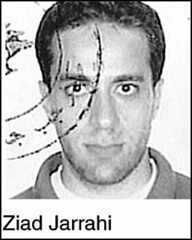 |
Jarrah's former fiancée described how he had changed after moving from provincial Greifswald
| "Ziad didn't want me to tell anyone that he was learning to fly." |
Motassedeq was sentenced in 2003 to fifteen years imprisonment for his role within the al-Qaeda group and for helping to plot the 3,000 murders of September 11, 2001. The verdict was quashed by an appeals court, which then directed a retrial.
Labels: al Qaeda, Al-Qa'idah, Al-Qaeda, Al-Qaida, Mounir al-Motassedeq, September 11, Ziad Jarrah
Thursday, November 18, 2004
Wolfowitz on the War in Iraq
| Radek Sikorski | Paul Wolfowitz | |
Why couldn't we have had Iraqis liberating Baghdad, winning credibility from defeating Saddam and then becoming the new Iraqi government? Why did we have to have US soldiers to do it for them? | Why was it necessary to have such a large US role? This is a point that is totally misunderstood and almost never explained. It allows people to say that I have held the same view on Iraq for the last 10 years. In fact, before 11th September, those of us who said that it was important to end the hypocrisy of saying "we want the liberation of Iraq but we won't do anything about it" were never advocates of invading Baghdad....But 11th September and the anthrax attacks which came immediately after changed the calculation. | |
| The US would have won more support in Europe if it had justified war on humanitarian grounds-Europe accepted war against Serbia on that basis. | But we would never have had 15 votes in the UN on that proposition. The UN was what forced us down the WMD path, which was a legitimate argument. When the president first went to the UN, he made three arguments. He talked about terrorism, he talked about WMD and he talked about abuse of the Iraqi people. Even with the UN resolution, we might have pushed harder on this issue. On the other hand, the Syrians weren't going to vote for a resolution that endorsed removing Saddam for the sake of the Iraqis. | |
| Conservatives are suspicious of projects to change human nature. They oppose social engineering in domestic policy. Yet here you are, full of ideological zeal, crafting a new form of government for people very different from us. Is this a contradiction? | If you put it that way, you create a contradiction. We're not trying to graft our system of government on to people who are different from us. We're trying to remove shackles that keep them from having what they want. And it's astonishing how many of them want something that's similar to what we in the west have. I was assistant secretary of state for east Asia when we first confronted Marcos under the Reagan administration. People said: "What are you doing? We'll end up with what Carter got in Iran." But we pressed Marcos very hard in the Philippines and I think the proof is in the outcome. The contradiction is to say that allowing people to choose their government freely is to impose our ideas on them. There was a wonderful moment at a conference here in Washington where someone said it's arrogant of us to impose our values on the Arab world, and an Arab got up and said it's arrogant of you to say these are your values because they are universal values. | |
| RS: With the benefit of hindsight and now that the election campaign is over, what would you say could have been done differently in Iraq? | People make a lot about the decision to dismiss the Iraqi army. But I don't think people are shooting at Americans and blowing up schools because we dismissed the Iraqi army. When people talk about why Iraq is as difficult as it is, they always start and finish with a list of American mistakes. Nobody ever talks about the enemy. It would be like saying why the battle of the bulge was tough without ever mentioning the German army. Saddam Hussein didn't stop fighting us, at least until he was captured in December last year. Al-Zarqawi didn't surrender when Baghdad fell. He stepped up his efforts. There are all these organisations that are unheard of in Europe and barely known in the US that people ought to know about. There was the M-14 division of the Iraqi intelligence service, its so-called "anti-terrorism" division, which specialised in hijackings and bombings, kidnappings and assassinations. There was the M-16 division, which perfected new bombing techniques. Many of these guys are out in Falluja and Ramadi in the western parts of Iraq today making bombs. |
Labels: American Enterprise Institute, Iraq, Paul Wolfowitz, Saddam Hussein, September 11, United Nations
Monday, October 11, 2004
Remembering Bali: October 12, 2002
Labels: al Qaeda, Al-Qa'idah, Al-Qaeda, Al-Qaida, Bali, Indonesia, Jema'ah Islamiyah, September 11
Abu Hafs: Al Qaeda's Top Man in Chechnya
 |
According to reports:
- Abu Hafs was born in Jordan, is believed to have Saudi citizenship and is about 40 years old.
- Abu Hafs has been associated with Al Qaeda for years and has known bin Laden personally.
- In 1994, following orders of bin Laden, Abu Hafs moved to Chechnya and became an instructor at Ibn al-Khattab's training camp near Serzhen-Yurt.
- In 1996, bin Laden ordered Abu Hafs into Georgia, where he became Al Qaeda's representative and was known as Amzhet.
- He lived in the village of Tsuniban, Pankisi Gorge, had a Wahhabi fundamentalist mosque built there, as well as a hospital for guerillas in Chechnya.
- On September 11, 2001, 15 minutes after a plane crashed into the Pentagon, Russian secret services detected a call from an Al Qaeda leader to Amzhet in Georgia. The caller told Amzhet that everything was going well, but that not all the targets were hit. The fourth hijacked plane crashed in Pennsylvania soon after the call.
- Russian secret services poisoned Khattab in 2002, and the position of representative of international terrorist organizations in Chechnya was passed to al-Walid.
- Abu al-Walid summoned Amzhet to return to Chechnya. Fearing he might be poisoned as well, Abu Hafs brought in his own cook from Jordan. He took second wife in Chechnya, the widow of Arab field commander Abu Jafar, killed in May 2001.
- Abu Haf's roles in operational planning and distribution of funds from sponsors in Chechnya was confirmed by Ramat Kamal Burahlja (a.k.a. Abu Mushab) of Algeria, recently arrested in Chechnya. Burahlja is an explosives expert who was trained in Pankisi Gorge by Amzhet himself and is personally familiar with Abu Hafs's role in planning operations.
- Russian secret services killed Abu al-Walid in April and Abu Hafs stepped into the vacancy.
- Abu Hafs is believed to have financed the terrorist attack in Beslan, North Ossetia and a similar operation that was thwarted in Dagestan.
Labels: Abu al-Walid, Abu Hafs, al Qaeda, Al-Qa'idah, Al-Qaeda, Al-Qaida, Chechnya, Osama bin Laden, September 11
Friday, October 08, 2004
Aussie Had Foreknowledge of 9-11,
Linked to 1993 WTC Bombing, Says U.S.
 |
- Habib admitted having prior knowledge of the September 11 attacks.
- He helped move chemical weapons within Afghanistan, near Kabul.
- Habib conducted surveillance of buildings, hospitals and schools.
- He was in telephone contact Ibrahim El-Gabrowny, convicted over the 1993 World Trade Center bombing. Additional connections between Habib and those convicted in the 1993 World Trade Center Bombing were reported in the Australian press last summer:
- In July, it was reported that Habib's lawyer, Steven Hopper, revealed that Habib had been a schoolfriend and neighbor in Egypt of Mahmud Abouhalima, also convicted in the 1993 bombing of the World Trade Center ("Habib, WTC bomber 'old schoolfriends'" Lincoln Wright, Canberra times, July 10, 2002).
- The Canberra Times also reported in July that Ibrahim El-Gabrowny telephoned Habib and asked for Habib's financial support for Sheikh Omar Abdel Rahman, the blind cleric who was convicted for the 1993 bombing of the World Trade Center.
- In the same July article in the Canberra Times, Habib was also reported to be a close associate of Ramzi Yousef, convicted of planning the 1993 WTC bombing.
- Habib stayed in an al-Qa'ida safe house in the months leading up to September 11.
- He planned to hijack a plane himself.
- Habib trained with al-Qa'ida, and its Kashmir-based offshoot Lashkar-e-Taiba.
- Sheik Mohammad Omran, of Melbourne, alleged earlier this year that Habib had assembled a war chest of $12,000 to send Islamic rebel fighters to Chechnya.
- Habib has claimed he was tortured by the Egyptian secret police before being transfered to Guantanamo Bay in 2003.
Labels: Afghanistan, al Qaeda, Al-Qa'idah, Al-Qaeda, Al-Qaida, Australia, Mamdouh Habib, Ramzi Yousef, September 11, Sheikh Omar Abdel Rahman, World Trade Center
Wednesday, October 06, 2004
Friends of Enemies Are Enemies
While the controversy over Bush's Doctrine continues, the legal response to terror continues in the world's courts. Yesterday, the results on this front were mixed.
In Boston, a federal grand jury unsealed a seven-count indictment charging Saajid Badat with attempted murder and other charges related to an alleged conspiracy with Richard Reid, the al-Qaida member who attempted to use a shoe bomb to blow up an American Airlines flight in December, 2001.
Badat allegedly got his "custom-made" shoe bombs in al-Qaida training camps in Afghanistan. The Boston Herald reports that Badat attended the North London mosque linked to Zacharias Moussaoui in Gloucester. Law enforcement officials are quoted as saying that small amounts of explosives were found in Badat's home and a stray hair of Badat's was found in Reid's shoe bomb.
Meanwhile, in Turin on Tuesday, a five-year sentence imposed on Ibraim Ellaban, an Egyptian national linked to al-Qaeda, has been set aside by an appeals court judge. Ellaban was arrested after Scotland Yard found references to him in the address book of a suspected terrorist. In Ellaban's trial, the prosecution read several letters, allegedly written by Osama Bin Laden, that called for members of his al-Qaida network to acquire weapons of mass destruction and urging them to "kill, fight, create traps and destroy" Americans. ("Bin Laden letters order US massacre," Philip Willan and Nick Hopkins, The Guardian, October 18, 2001).
In an April 16, 1998 letter, released during Ellaban's trial, Bin Laden is reported to say: "America carries out the worst international terrorism. Is it not terrible terrorism that America is carrying out in Iraq on children, women and the old, having condemned them to hunger?"
Interesting that Bin Laden should adopt the talking points of Saddam Hussein. Interesting too that the Ba'athist Iraqi regime would celebrate al-Qaeda's attacks on the twin towers in a mural on the Iraqi military headquarters of Nasiriyah.
Plainly, a purely legal response to terror will not protect the United States from the coalition of groups that are waging jihad against the West. Yet, the issue has not quite been joined in the election debates. The Kerry campaign professes support for a warlike response to terror while presuming a juridical test of legitimacy.
In the debate last night, Vice President Cheney opened with the case that Iraq was an ally of al-Qaeda:
It's important to look at all of our developments in Iraq within the broader context of the global war on terror. And, after 9/11, it became clear that we had to do several things to have a successful strategy to win the global war on terror, specifically that we had to go after the terrorists where ever we might find them, that we also had to go after state sponsors of terror, those who might provide sanctuary or safe harbor for terror.
...Concern about Iraq specifically focused on the fact that Saddam Hussein had been, for years, listed on the state sponsor of terror, that they he had established relationships with Abu Nidal, who operated out of Baghdad; he paid $25,000 to the families of suicide bombers; and he had an established relationship with Al Qaida. Specifically, look at George Tenet, the CIA director's testimony before the Committee on Foreign Relations two years ago when he talked about a 10-year relationship.
Senator Edwards shifted the focus from that broader context to the narrower legalistic question of whether Saddam Hussein was involved in the operational planning of the September 11 attacks. His sound-bite line was: "There is no connection between Saddam Hussein and the attacks of September 11th -- period."
If one agrees that the legitimate response to 9/11 is warlike, then it is important that one leave the question of prosecution of individual criminal acts to the courts and adopt a foreign policy that takes the broader view that those allied with the enemies of our country are our enemies also. A question for Senators Edwards and Kerry to ponder: after Pearl Harbor, would the United States have been justified in declaring war on Nazi Germany, Japan's ally, had Hitler not declared war on the U.S. first?
Labels: Afghanistan, al Qaeda, Al-Qa'idah, Al-Qaeda, Al-Qaida, Dick Cheney, George W. Bush, jihadists, John Edwards, John Kerry, Osama bin Laden, Richard Reid, September 11
Saturday, October 02, 2004
Cleric With Links to 9-11, Bin Laden and Madrid
Made Secret Deal with Saudi Regime
Osman Ahmed's Milan apartment was reportedly wiretapped by Italian anti-terrorism police. In one taped conversation he is reported to say that "The Madrid attack is my project." He is also recorded saying that al-Awdah is "everything, everything."
| "[Sheikh Salmon al-Awdah is] everything, everything..." "I worked for him in Spain." Rabei Osman Ahmed |
Al-Awdah was last heard from on Wednesday when he insisted on Saudi-owned Al-Arabiya television that he did not encourage violence by Muslims. Yet, Al-Awdah's biography paints a very different picture.
It is well known that many of the September 11 hijackers were Saudis. It is not well known that thirteen of the 19 suicide attackers on 9-11 came from villages in the southern part of the kingdom. Six family names were of particular interest to investigators: Al Shehri, Ahmed, Al Suquami, Al Ghamdi, Al Omari and Al Hanzi. All of these were from the Assir region and a part of two influential clans, the Hamedi and the Sharahni. These clans are breeding grounds for radical Wahhabite groups, part of the Salafiyya movement (from al-salaf al-salih, the "virtuous forefathers") in opposition to the monarchy because it did not practice a pure form of Islam. The two clans were the impetus behind the rise of the Islamic Resurgence Movement that was headed by two young ulamas (religious men), Safar al-Hawali, a teacher at the Oum Al Qora university in Mecca, and Salman al-Awdah, a cleric who was practicing in the town of Buraida.1
In the aftermath of the Gulf War, Al-Awdah and al-Hawali were signatories to two petitions critical of the monarchy and demanding reform. The first was sent in May 1991 to King Fahd and the second in September 1992 to the grand mufti of Saudi Arabia, Shaykh 'Abd al-'Azia bin-Baz. The petitions called on the ummah (Muslim community) to defend its holy places by itself, rather than relying on alliances with the West.2
| To avoid tarnishing the country's image even more, Bin Laden's friends agreed to keep a low profile and the regime promised to tolerate their presence. |
After a string of fiery sermons, and a public demonstration in Buraidah criticizing the presence of foreign troops in the kingdom, Sheik al-Awdah was jailed in September 1994, along with Sheikh Safar al-Hawali and Sheikh Naser al-Omar. They languished in jail for five years, without trial or conviction, but were released in June, 1999, because of the help of the new grand mufti, Abdulaziz Bin Abdullah al-Shaikh, who had succeeded to the position two days after the death of Abdulaziz Bin Baz on May 13.4
Le Monde reported in October 2001 that a tape recorded by Salman al-Awdah had been circulating underground in Europe and the United States
His "sermon on death" calls on the Saudi intellectual elite to prepare for sacrifice and martyrdom in order to attack the Westerners and the Saud regime, accused of serving the "crusaders."The text of this famous fatwa is particularly striking. Here is one excerpt: "The opposition must be brought to the forefront by a group of people from the elite, who would be willing to sacrifice everything for the cause. This small group of people must prepare itself to face arrest, torture, and even death. It must be solidly determined and must strike with precision so that the rest of the support will crumble."5
Soon after the attacks of September 11, 2001, Sheik al-Awdah sat down for an interview with the New York Times. He presented himself as a voice of moderation. His mission since September 11, he claimed, was "to prevent such things from happening again." He told the interviewer: "What they did in America was to attack people they had no problem with in the first place."6
There was an incongruity between this new moderate image and the radical connections between al-Awdah and al-Qaeda leader Osama bin Laden. Bin Laden had recorded a videotape thanking Salman al-Awdah and Safar bin Abdul Rahman al-Hawali for their support and for "enlightening" Muslim youth. The release of al-Awdah had been a key demand of the Muslim militants believed to have been behind the bombings in Saudi Arabia in 1995 and 1996 in which 24 U.S. servicemen were killed.7
An explanation for the disparity between al-Awdah's post-9-11 public image and his past was given by Intelligence Online in a revealing article in June, 2002:
The minutes of a meeting held in Riyadh on June 15 between senior officers from Mabahess Alamat, the Saudi general intelligence agency, points clearly to the confusion reigning within the country's secret services. The meeting, held in the office of deputy interior minister Ahmed Bin Abdel Aziz, centered primarily on current unrest in several cities and on planning swoops on Al Qaeda sympathizers. Two factors lie behind the difficulty encountered by security chiefs in handling the situation, even though they have received support from Al Mutuon, the religious police. One is the support that Al Qaeda commands in the religious elite, including at the Um Al Qora university in Mecca. Another is that since Sept. 11 an informal pact has governed relations between the ruling Saud family and sympathizers of Ben Laden. To avoid tarnishing the country's image even more, Bin Laden's friends agreed to keep a low profile and the regime promised to tolerate their presence. The agreement was reached between the boss of internal security, Nayef Bin Abdel Aziz (presently convalescing in Switzerland) and members of the Movement for Islamic Resurgence, a front for Al Qaeda in Saudi Arabia. Officials from the interior ministry feared - and rightly so - what would happen if the pact were broken. Under the accord, the two leading figures in the movement, Sfar Al Hawli and Salman Al Awdah, promised to abstain from any anti-American acts or rhetoric (which nonetheless continued in dozens of mosques after Sept. 11) in return for the government's leniency and eventual release of group members who were jailed some months ago.8
The article concludes by reporting that the American campaign in Afghanistan and the reorganization of Al Qaeda's leadership "put the skids" to the informal understanding. Demonstrations flared anew in Najrane and Assir, Mecca and Buraida. Cassettes calling for martyrdom against the West and the royal family began to circulate. Prince Nayef called on June 17, 2002 for a wave of arrests in religious circles. The operations "made clear Al Qaeda was still getting assistance from welfare organizations and import-export companies. The round-up also confirmed that dozens of Al Qaeda fighters in Afghanistan had managed to make their way back to the country after Sept. 11."8
| The agreement was reached between the boss of internal security, Nayef Bin Abdel Aziz members of the Movement for Islamic Resurgence, a front for Al Qaeda in Saudi Arabia. |
Al-Awdah surfaced again in the news in September 2003, when Al-Jazeera broadcast a video of Sa'id al-Ghamidi, one of the September 11 hijackers. The recording showed al-Ghamidi reading his last will on December 23, 2000. Al-Awdah received special attention:
They [the enemies of Islam] repressed the honest scholars and silenced the sincere preachers. They did this to our noble scholar Humud al-Uqlah al-Shu'aybi, Shaykh Abdallah Jibrin, Shaykh Safar al-Hawali, Shaykh Salman al-Awdah and Shaykh Nasir al-Umar, may God protect them, and many others.10
Al-Awdah again adopted a moderate tone in June of this year, when he signed, along with Safar bin Abdul Rahman al-Hawali and four other clerics, a condemnation of the attacks against Westerners Kenneth Scoggs and Paul Johnson in Saudi Arabia. The attacks were carried out by a group identifying itself as "al-Qaida in the Arabian peninsula." The clerics condemned the attacks as "a heinous crime," and even went so far as to adopt the monarchy's description of the attackers as "deviants."
"We condemn the criminal acts committed by the deviant group in a number of Saudi areas in which many innocent people were killed....The nation's theologians are in consensus that it is a sin to kill a life without a right, be it Muslim or non-Muslim."11The otherwise puzzling turnabouts make sense if there was indeed a secret agreement between Nayef Bin Abdel Aziz, Salman al-Awdah and other members of the Movement for Islamic Resurgence. If al-Awdah has never ceased supporting al-Qaeda, both philosophically and financially, if he surreptitiously supported the mastermind of the Madrid bombings, then would it not be likely that he has also been supporting those who are currently planning future terrorist attacks against the United States? Since Wednesday, Salman al-Awdah has not been available for comment12. Perhaps Riyadh might be.
NOTES
1"Saudi Regime's Underpinnings are Shaken," Intelligence Online, October 18, 2001.
2Mary-Jane Deeb, "Prepared Statement before the Senate Intelligence Committee," July 10, 1996.
3Douglas Jehl, "In Saudis' Heartland, Unrest Is Aimed at Rulers and U.S.," The New York Times, November 5, 1996.
4"Islamist leaders released," MEED Quarterly Report -- Saudi Arabia, August 1999.
5Ali Laïdi, "Terrorists Within the Regime's Opposition: The Saudi Connection" Le Monde, Oct. 4, 2001, reprinted in the January 2002 issue of World Press Review (VOL. 49, No. 1).
6Douglas Jehl,"A Nation Challenged: A Critic; After Prison, a Saudi Sheik Tempers His Words," New York Times, December 27, 2001.
7"Dissident cleric: Saudi releases four leading Islamic activists," The Associated Press, July 6, 1999.
8"Saudi Arabia Discovers its Fundamentalists," Intelligence Online, June 27, 2002.
9Stephen Grey, "Follow the Mullahs," The Atlantic Monthly, November 2004.
10"Al-Jazeera TV Broadcasts 'Last Will' of Alleged 11 September Hijacker," BBC Monitoring International Reports, September 13, 2003.
11Salah Nasrawi, "Saudi Clerics Condemn Attacks Against Westerners," Associated Press, June 15, 2004.
12The Associated Press, "Report Examines Madrid Bombing Funds; Report Says That Suspect in Madrid Train Bombing Was Bankrolled by Saudi Cleric, ABC News, September 30, 2004.
Labels: Madrid bombings, March 11, Osama bin Laden, Rabei Osman Ahmed, September 11, Sheikh al-Awdah, Spain, Wahhabis
Friday, September 24, 2004
Al-Zarqawi planning major attack in Europe or US
 |
Reportedly, the Iraqi intelligence agencies have prepared a report on Abu-Mus’ab al-Zarqawi, the commander of the Tawhid wa Jihad group.
The BBC Monitoring report states: “Al-Watan has learned from informed European diplomatic sources that a prominent European country concerned with the course of events in Iraq received this Iraqi intelligence service report about Jordanian Abu-Mus'ab al-Zarqawi (whose real name is Ahmad al-Khalayilah, age 38). This report contains the following basic information and elements”:
| The European sources disclosed that the security and intelligence services in a number of European countries have information that Al-Zarqawi is ‘determined’ to carry out an operation similar to that of 11 September either in the United States or in one of the European countries. |
- Al-Zarqawi's group bears the name Tawhid wa Jihad.
- Tawhid wa Jihad includes between 1000 and 1500 fighters from Iraq and from other Arab and Islamic countries.
- The group includes experts in explosives, projectiles, and various assault weapons.
- The inner group is composed of non-Iraqis that Al-Zarqawi has known for years.
- Some prominent members of Tawhid wa Jihad are:
- Abu-Ali, a rocket expert who worked in the military system under Saddam Hussein's regime;
- Abu-Muhammad, a former Lebanese soldier and an expert in the manufacture and use of explosives. Abu-Muhammad came to Iraq after the U.S. invasion. Prior to his arrival in Iraq, he had spent a few years in Denmark.
- The main headquarters of Tawhid wa Jihad is in the city of Al-Fallujah.
- The leadership of the group is composed of nine "commanders,” responsible for separate combat areas.
- The commander for Baghdad had been Umar Bazyani. has been apprehended and has revealed valuable information about the group. He has been replaced, but the identity of his successor was not revealed in the BBC report.
- The commander for the northern region is Husayn Salim.
- The commander for the Al-Anbar Province is Abdallah Abu-Azzam.
- The commander for Mosul is Abu-Tal’at.
- Al-Zarqawi’s deputy and chief aid is Abu-Mahdi al-Shami. It is believed he may be of Syrian nationality.
- The media department of Tawhid wa Jihad is supervised by Hasan Ibrahim.
- There are 500 fighters operating in Al-Fallujah, under the command of a soldier with the pseudonym of “Abu-Nawas al-Falluji.”
- There are 60 fighters operating in Al-Anbar, 50 in Baghdad, 50 in Samarra, 80 in Al-Diyali Province, and 150 fighters in Al-Qa’im near the Syrian borders.
- Al-Zarqawi’s movement possesses hiding places for weapons and explosives in several locations in Iraq.
- Tawhid wa Jihad wants to transform Iraq into a “hell” for Iraqis by keeping the war buringing and thereby preventing the establishment of a stable and legitimate government through elections. It also seeks to incite civil strife between the Sunnis and the Shi’is.
- According to European diplomatic sources, Abu-Mus’ab al-Zarqawi greatly admires the Al-Qa’idah leader, Usamah bin Ladin, but al-Zarqawi is not subordinate to him.
- Al-Zarqawi aspires instead to compete with Bin-Ladin for the leadership of “the hard-line jihadist Islamic movements.” Al-Zarqawi seeks to turn Iraq into a “new Afghanistan,” a theater for launching terrorist operations that can be exported globally.
- There is some dispute among the sources of the report over whether Al-Zarqawi was a connecting link between Saddam Hussein and Al-Qai’dah. Some believe the communications between Iraqi officials and Al-Qai’dah were direct and carried out without the intercession of Al-Zarqawi.
- ”The European sources disclosed that the security and intelligence services in a number of European countries have information that Al-Zarqawi is ‘determined’ to carry out an operation similar to that of 11 September either in the United States or in one of the European countries. This will be accomplished with the help of secret networks and cells that belong to him and are active and concentrated in some of the European countries and, perhaps, even in the American theatre.”
Labels: Abu Musab al-Zarqawi, al Qaeda, Al-Qa'idah, Al-Qaeda, Al-Qaida, Al-Tawhid wa al-Jihad Group, Iraq, Osama bin Laden, September 11, Umar Bazyani
Khalid Sheik Mohammed, 9-11 Mastermind,
Sought Entry to Oz
| "It happened, interestingly enough, before the 11th of September, 2001, and it does underline the fact that al-Qaeda had an interest in this country before the terrorist attack on New York and Washington and before the involvement of Australia in Iraq." Prime Minister John Howard |
Labor Leader Mark Latham responded by saying the incident showed the need to tighten Australian security. Prime Minister John Howard, drew a different moral, pointing out that the incident revealed al-Qaeda’s interest in Australia prior to the Australian involvement in the war in Iraq.
Labels: al Qaeda, Al-Qa'idah, Al-Qaeda, Al-Qaida, Australia, Khalid Sheik Mohammed, September 11
main page
most recent entries
- The sting of 'cling'
- Finding Iran's long-range missile site in Google E...
- Southern Iraqi Shiite tribal leader claims Iran be...
- Rice for the Vice?
- A stash of FARC's uranium found in Columbia
- Is Condi Rice signaling an interest in being McCai...
- Saddam Hussein's regime plotted with Gaza terroris...
- An unapologetic apologia for the Iraq war
- Romanian rendezvous; Terrorists and arms dealers i...
- Saddam's support for terror: the Pentagon report's...
archives
blogs
feeds




searches
statistics
buttons
Blogroll Me!


