Friday, April 11, 2008
Finding Iran's long-range missile site in Google Earth
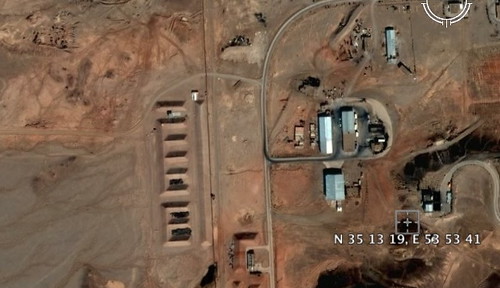
According to Jane's Intelligence Review, the photograph is said to reveal to a former Iraqi weapons inspector that Iran is using the site, about 230km southeast of Tehran, to develop a ballistic missile with a range of 6,000 km. Geoffrey Forden, research associate at Massachusetts Institute of Technology, is quoted as pointing out that a recently constructed building, 40 meters in length, is similar in shape and size to the North Korean long-range Taepodong missile assembly facility.
The new building is plainly visible in the lower left corner of the photograph accompanying the Times story (below), and is notably absent on the earlier Digital Globe image currently in use on Google Earth.

UPDATE: You can also see the Google Map imagery without leaving your browser at Flash Earth
UPDATE 2
The original story from Jane's can be found here: Iran Develops Long Range Missile Technology:
Analysis by Jane's has identified several developments at this site since the most recent open source imagery was taken in September 2004. Jane's has identified facilities at this site similar in size and form to the Taepodong assembly facility in North Korea. Measurement and Signatures Intelligence by Jane's shows features of the site are also similar to North Korean facility features that indicate this facility is the location of missile assembly.(Hat tip:TheZoo)
Jane's Proliferation Editor Avital Johanan commented: "This analysis suggests that Tehran is following the same path in its missile programme as North Korea and identifies a previously unidentified location as an important element in it. Bringing together Jane's analysis with exclusive satellite imagery provides a unique capability to offer near-real time intelligence."
Labels: DPRK, Google Earth, Iran, Jane's Intelligence Review, long-range ballistic missiles, North Korea, Taepodong-2 missile


Tuesday, April 08, 2008
Southern Iraqi Shiite tribal leader claims Iran behind Basra fighting (and al-Qaida!)
Sheikh Unayzan and Sheikh Sabah Muhsin al-Maliki, head of the Bani Malik tribes, were interviewed in Arabic, but an English account of the interview can be found on Radio Free Europe and on BBC Worldwide Monitoring (subscription).
Al-Maliki claims that it was the Arab tribes of southern Iraq that brokered a truce between the Al-Mahdi Army and the government:
Tribes in southern Iraq played a large role in extinguishing the fire of sedition. They mediated between the Al-Mahdi Army and government. The tribes reached a truce in some areas so that security could prevail. Praised be God, things went on normally there."More significantly, the tribal leaders remarked on the intervention of Iran in Iraq:
[Unayzan]"Iranian interference is no secret to anyone. America itself wants the Iranians to interfere in Iraq although it found Iranian explosive devices, Grad missiles, and Katyushas. The Iranians have agendas. Some political forces are now working for the Iranian intelligence and they receive funds from them. The Iranians are seriously thinking of creating an unbalanced Iraq that advocates a theory that is not pan-Arab. This means they want to keep Iraq away from its pan-Arab affiliation. These forces worked from Karbala and even Baghdad up to the farthest part of Iraq. Iran supports Al-Qa'idah, militias, and death squads. Iran buys the smuggled and stolen oil." He then says he "warned" the Arab countries that if Basra falls in Iranian hands, the Iranians will try to expand in the direction of the Gulf States, where "Iran has a large community estimated at 5 million people."The two southern Iraqi tribal leaders are currently on a tour of Arab countries to mobilize Arab support for the Southern Arab Tribal Council.On whether he is concerned about the Arab identity of Iraq, Al-Maliki says: "There is a large concern and this is the feeling of every patriotic citizen who wants security and all that is good for his country. We are all concerned because there are foreign interferences by Iran and its agents." Asked if the Arab tribes will establish a force to fight the militias, he says the tribes will not fight the "patriotic militias which have a genuine Arab history." He adds: "But there are militias which want to wreak havoc in Iraq, hand southern Iraq to another country, and destroy some leaders in Iraq. These should be fought. A force should be formed from the tribes to deter them."
Asked if a force similar to the Awakening Councils will be established, Unayzan says: "We will not establish Awakening Councils to serve the occupation. This is the first point. We will establish a force to strike at the militias collaborating with Iran. This is certain. The Iranians killed only in Basra 31 heads of tribes and clans, 37 doctors carrying the doctorate and master's degree including a professor, 400 women, and a large number of pilots and ordinary people who belonged to the Ba'th Party and the former security and intelligence services. We want to stop this."
...Asked what the tribal council will do if it participates in and wins in the local elections, Unayzan says: "We will first prevent the establishment of federalism, block the Oil Law, and prevent absolute subservience to Iran. We will demand protection for our areas in the south to prevent all neighbouring countries and not only Iran from infiltrating them."...On the reasons for "lack of security and poor services in Basra," Unayzan says "personal gains, ambitions, and Iran's blatant interference in Iraq are the reasons. He adds that the recent Basra fighting began and ended "with Iranian motives."
...On the way he views merger of religion with politics in Iraq, Unayzan says political Islam does not serve the interests of any country." Asked if Basra can be ruled by religious parties, he says: "There is no doubt that Basra is now ruled by the religious parties. Had it not been for the tribes, they would have made people suffer bitterly." He adds this is so although killings, abductions, and seizure of state resources continue, noting that the government's campaign in Basra was not successful because more than 900 people were killed in it.
Asked about national reconciliation...Unayzan says: "Reconciliation with whom? The Shi'is totally reject reconciliation with the Ba'thists. They want to uproot the Ba'th ideology and the Ba'th Party in general. There are more than 3 million Ba'thists in Iraq, and the Shi'is, including me, refuse to pardon the Ba'thists. But those whose hands were not stained with the blood of the Iraqis and who have good intentions should be accepted and rehabilitated." He then says reconciliation can be achieved when the Iraqi officials listen to the ordinary people and prevent foreign interference.
UPDATE: Those quick to pounce on John McCain's slip, in which he momentarily implied that al-Qaida in Iraq was a "Shiite sect" before correcting himself, would do well to consider that to keep track of the complex and shifting political coalitions in the Middle East one must not presume that such affiliations do not cut across Islamic sectarian lines. That point will be lost, however, to those who appear to think that one need only have the Sunni and Shiite teams on their Middle East scorecard. MSNBC wasted no time suggesting McCain had made another gaffe. Here is the exchange:
McCain: There are numerous threats to security in Iraq and the future of Iraq. Do you still view Al Qaeda in Iraq as a major threat?Meanwhile, Jason Linkins, on Huffington Post, praised Senator Evan Bayh's questioning as the "highlight of the hearing," but neglected to notice Bayh's own momentary lapse of taking Pakistan to be an Arab country, in this exchange with Ambassador Ryan Crocker:
Petraeus: It is still a major threat, though it is certainly not as major a threat as it was say 15 months ago.
McCain: Certainly not an obscure sect of the Shiites overall?
Petraeus: No, no sir.
McCain: Or Sunnis or anybody else then? Al Qaeda continues to try to assert themselves in Mosul, is that correct?
BAYH: The Afghanistan and Pakistan are subjects for another day but since this is all tied up in the global effort against extremism and terror, as you know, things have not been going as well as we would hope in Afghanistan. And it is true we're not going to have troops in Pakistan. Still, our resources are finite and they do have an impact. Some might look at this and say why are we devoting five times the amount of resources to a place that at this time is not the principal threat?CROCKER: In part, Senator, to be sure that it doesn't become that. I noted in my testimony that Osama bin Laden fairly recently referred to Iraq as the perfect base for al Qaeda and it is a reminder that for al Qaeda, having a safe base on Arab soil is extremely important today. They got close to that in '06.
BAYH: They apparently have one now in the tribal areas of Pakistan.
Labels: al Qaeda, Al-Qa'idah, Al-Qaeda, Al-Qaida, Basra, Iran, Iraq, Kazim Unayzan, Sabah Muhsin al-Maliki, Southern Arab Tribal Council
Friday, March 07, 2008
At behest of Iran and China, Chavez tests how far "lame duck" US can be pushed
Analysis of relative combat capabilities between Ecuador and Venezuela on the one hand, and Colombia on the other, may be premature, but it is clear from a range of sources that there has been coordination on the issue between Caracas and Tehran, and Caracas and Quito, in order to "test the waters" as to how far the US can be pushed to support its ally, Colombia, during this "lame duck" political year. It is also known that the People's Republic of China (PRC), which has significant relations with Venezuela, and has worked discreetly with Pres. Chavez to help further PRC interests elsewhere in the region -- particularly Panama -- is taking a keen interest in monitoring the US response to the tri-nation border crisis.
UPDATE: On second thought ... the crisis appears to be over, at least for now....Reuters: Colombia, Ecuador, Venezuela make peace
Labels: China, Columbia, Defense and Foreign Affairs Daily, Ecuador, Hugo Chávez, Iran, PRC, Venezuela
Wednesday, March 05, 2008
A missile shield to protect the Gulf from Iran
Winning the blessings of Congress last month, Lockheed Martin and Raytheon are to shortly finalize the sale of 288 Patriot Advanced Capability- 3 (PAC-3) missiles to the United Arab Emirates. Already equipped with PAC-2 weapons (the previous version), Kuwait is to acquire 88 PAC-3s. The already-sizeable contracts (USD 9 billion for the Emirates and EUR 1.4 billion for Kuwait) could shortly be followed by similar agreements with Qatar and even with Bahrain and Oman.The acquisition of Patriot by Kuwait and the UAE forms part of what is a still secret project to build an anti-missile shield against Iran that could be deployed throughout the Gulf....
REVISED with additional excerpting.
UPDATE: Also see: U.S. To Sell Patriot Missile defense Systems to UAE (Pat Dollard, Young Americans Documentary).
Labels: Gulf Cooperation Council, Iran, Kuwait, Lockheed Martin, Patriot missiles, Qatar, Raytheon, United Arab Emirates
Tuesday, March 04, 2008
Ahmadinejad seeks Iraqi backdoor to break sanctions and equip nuclear program
"The Iranian delegation accompanying Iranian President Ahmadinezhad has asked Iraqi officials to merge the Iraqi economy with the Iranian economy and ensure that they complement each other, particularly in the financial and industrial areas, with a view to breaking the sanctions imposed on Iran in the fields of banking and money transfers. The delegation also asked that Iraqi financial institutions and banks be used to fill the void created after several world banks stopped sending direct money transfers to Iran. Furthermore, the delegation asked that Iraqi industrial organizations be used as a cover for importing some equipment and materials that are used in military industries and that support the Iranian nuclear programme, which is facing difficulties in obtaining some raw materials and industrial equipment. The Iranian president and his delegation stressed the need to achieve financial, industrial, trade, and oil integration [between the two countries], noting that this tasking should be assigned to people who believe in strategic alliance with Iran."
Labels: Iran, Iraq, Mahmoud Ahmadinejad
Wednesday, February 20, 2008
Getting rich on enriched uranium
Adamov was first arrested in 2005 in Switzerland, at the request of the U.S. for defrauding the United States of $US 9 million of funds designated for helping Russia to improve security at its nuclear facilities. Adamov fought extradition to the U.S. to face charges filed in Pittsburgh. Federal prosecutors there said that Adamov and Mark Kaushansky, a former Westinghouse nuclear engineer and Ukrainian immigrant, formed two shell companies to funnel US Department of Energy funds to their bank accounts in Pittsburgh and Delaware during the late 1990s. Adamov was fired by Vladimir Putin in 2001.
How is it that Adamov wound up facing charges in Russia rather than in the United States when the Swiss authorities who arrested Adamov in 2005 did so at the behest of the US authorities? This makes for a rather curious story. After months in a Swiss jail, Adamov was the one who requested going back to Russia. Why? Russia's Defense and Security, citing informed sources, argues that what scared Adamov most of all was the
...prospect of the Americans finding out the details of how he sold Iran a package of documents about building a top-secret deuterium reactor. Such a reactor is capable of producing plutonium, and plutonium can be used to produce nuclear weapons.("Adamov's Persia File, Nadezhda Popova, source: Moskovskii Komsomolets, Defense and Security, October 12, 2005).Iran paid Adamov handsomely for this "gift." ...And in 1999, with the prosecutors already investigating, Adamov and his colleagues attempted to establish contacts with Iranian specialists outside their normal job duties. Then the Federal Security Service (FSB) got involved."
But it seems the FSB was a bit too late. "Dr. Adamov" had already sent off the blueprints for a heavy water reactor and received a fairly generous payment from Iran. One of his former deputies, who asked to remain anonymous, confirmed this in an interview with us.
"At first, Adamov wanted a barter deal," says the source. "In exchange for the heavy-water reactor blueprints, he asked the Iranians for marble. A lot of marble - since marble is fairly cheap over there. But Iran always pays cash, and Adamov allowed himself to be 'persuaded.'"
But how did Adamov manage to transfer classified documents to Iran and avoid the Prosecutor General's Office investigation concerning nuclear cooperation with Iran? What's more, at the hottest moment, when investigators were on his tail, he found himself in the position of nuclear energy minister! Mikhailov was dumbfounded when he found out who had replaced him in the minister's office on Ordynka Street.
Who helped Adamov?
"The minister's position was secondary for him", say sources at the Nuclear Energy Ministry, "Boris Berezovsky and Roman Abramovich pushed him into taking that job, assisted by the Kremlin officials, saying it was only 'for a while.' Then he was promised the office of prime minister."
What prevented him from taking it? Or who? Most people involved state, that it was Yuri Shekochikhin, a journalist, that contrived to hand in all the discreditable documents to the United States. An American journalist sent Shekochikhin's message to the FBI. President Putin was no doubt informed of the FBI's interest in the Adamov affair. Putin signed the documents on dismissal of Adamov in November 2001, and not by mere chance.
Helping Adamov fight extradition to the US, and defending him in the Federal Court in Pittsburgh, is Covington & Burling attorney Lanny A. Breuer, special White House counsel who represented former President Bill Clinton during his impeachment hearings.
The ties to the Clintons go further than simply sharing an attorney. It was during the Clinton presidency, the Megatons to Megawatts program was initiated. Russia sold the United States low-grade uranium fuel obtained from enriched weapons-grade uranium recovered from nuclear warheads. The American agent in these contracts, including the exchanges in which Adamov is alleged to have skimmed $9 million, was US Enrichment Corporation. The Clinton administration pushed to privatize the USEC in a 1998 public offering that yielded $1.9 billion. Outside consultants and investment bankers who handled the USEC deal pocketed $78 million from this deal. ("The art of the (raw) deal," Bruce B. Auster, US News & World Report, April 24, 2000). One of the Washington lobbyists most prominently pushing for privatization was Susan Thomases, close friend, private lawyer, and one-time chief scheduler to Hillary Clinton ("With friends like Hillary," Michael Isikoff, Newsweek, August 14, 1995).
The flow of US federal money to "Megatons to Megawatts" continues. Last July, Senator Hillary Clinton and Rep. Ellen Tauscher reintroduced legislation in both chambers of Congress they said would safeguard fissile materials and prevent nuclear terrorism. The Clinton-Tauscher bill would increase funding to several federal agencies, including the Department of Energy's "Megatons to Megawatts" initiative to aid Russia and other nations in "downblending" their highly enriched uranium.
Meanwhile, US prosecutors in Pittsburgh doubt that Yevgeny Adamov will ever face trial in the United States (Russian with Pittsburgh ties found guilty of fraud, Former Russian official guilty of stealing nuclear safety funds.
Labels: Hillary Clinton, Iran, Lanny A. Breuer, Mark Kaushansky, Megatons to Megawatts, Susan Thomases, US Enrichment Corporation, Yevgeny Adamov, Yuri Shekochikhin
Tuesday, February 19, 2008
Being cooked by intelligence
It was not uncommon, for example, to see false or exaggerated intelligence attributed to the Iraqi National Congress leader Ahmad Chalabi when it had actually come from Kurdish officials. This was never more clear than in a July 17, 2004, New York Times correction. The paper was retracting three stories which alleged a connection between Chalabi and an Iraqi source code-named Curveball, whose information later turned out to be bogus. The editors explained that their correspondent had "attribute[d] that account to American intelligence officials who spoke on condition of anonymity." They continued: "Those officials now say that there was no such established relationship." In other words, intelligence officials lied to a reporter to achieve a policy aim.Administration critics have long maintained that the White House has sought to politicize the intelligence community and cook the evidence to advance geopolitical aims. Rubin maintains that the direction of influence has been in the opposite direction. It is the CIA that has unabashedly sought to influence policy.Such behavior is not limited to debates over policies impacting countries thousands of miles away. W. Patrick Lang, a former Defense Intelligence Agency official, told the American Prospect in 2005 that his intelligence community colleagues used leaks to try to influence the 2004 presidential election. "Of course they were leaking. They told me about it at the time. They thought it was funny. They'd say things like, 'This last thing that came out, surely people will pay attention to that. They won't reelect this man.'"
Labels: CIA, George W. Bush, Iran, Iraq, Mahmoud Ahmadinejad, National Intelligence Estimate, NIE
Friday, February 15, 2008
Iran flexes its muscles in Iraq
- Iraqi officials announced that Iranian President Mahmoud Ahmadinejad will travel to Iraq on March 2 for a visit of two to three days to discuss bilateral relations.
- Iran postponed the fourth round of trilateral talks with the U.S. and Iraq to discuss ways to improve Iraq's security. Mirembe Nantongo, spokeswoman for the U.S. Embassy in Baghdad said:
"We are happy to sit down for the talks, but it is increasingly clear Iran is not. We've been ready to participate for weeks."
Iraqi government spokesman Ali al-Dabbagh said the Iranians did not provide a reason for the postponement. (See In a First, Ahmadinejad To Visit Iraq Next Month: Iran Postpones Fourth Round of Talks With U.S..) - Lieutenant-General Ray Odierno, the outgoing deputy to General David Petraeus and soon to be Army Vice-Chief of Staff expressed concern about Iranian influence on Iraq:
“I think Iran wants a weak Iraq....They want a weak government of Iraq. It is probably in their best interests.”
(See Surge general accuses Tehran of backing militias to weaken Iraq.) - The U.S. military linked the explosions in an open-air market in Sadr City to the Iranian-backed Special Groups. (See Special Groups behind Sadr City bombing.)
Yossef Bodansky's hypothesis -- discussed in this space yesterday -- that the U.S. and Iran had cut a deal signaled by the December release of the NIE report -- is looking increasingly far-fetched. Not so, alas, his fears of increased Iranian dominance in the Gulf.
Labels: David Petraeus, Iran, Iraq, Mahmoud Ahmadinejad, Ray Odierno, Yossef Bodansky
Thursday, February 14, 2008
Did the NIE signal a secret deal with Iran?
Here is a timeline, drawn primarily from the Bodansky report:
- Mid-July 2007: In Damascus, three insurgent groups – the 1920 Revolution Brigades, Ansar al-Sunna and Iraqi Hamas -- announced a united front of seven Sunni-led insurgent organizations fighting the U.S. occupation in Iraq were ready to “negotiate with the Americans in anticipation of an early U.S. withdrawal. Abd al-Rahman al-Zubeidy, political spokesman of Ansar al-Sunna announced opposition of his group to al-Qaida:
"Resistance isn’t just about killing Americans without aims or goals. Our people have come to hate Al-Qaida, which gives the impression to the outside world that the resistance in Iraq are terrorists."
Wayne Wright of Washington’s Middle East Institute and an expert adviser to the Iraq Study Group commented at the time:"This does reveal that despite the widening cooperation on the part of some Sunni Arab insurgent groups with US forces against al-Qaida in recent months, such cooperation could prove very shortlived if the US does not make clear that it has a credible exit strategy."
(Insurgents form political front to plan for U.S. pullout, Seumas Milne, The Guardian, July 19, 2007.) - August, 2007: Iraqi Prime Minister Nouri al-Maliki, Khamene’i, and Ahmadinejad agreed to an “experimental reduction” in anti-U.S. violence in order to expedite the U.S. withdrawal by “providing the Bush Administration with ‘success’ and no excuse to linger in Iraq.”
- Early September 2007: As they prepared for their report to Congress on the success of the surge in U.S. combat troops, Ambassador Ryan Crocker and General David Petraeus, commander of the Multi-National Force-Iraq (MNF-I), were apprised of Tehran’s proposal and decided “to give it a try.”
- Early November 2007: Mokhtar Lamani, Arab League Ambassador to Iraq, lamented the increasing Iranian power over Iraq:
Meanwhile, Iranian influence is becoming more and more palpable. Iraq has become a winning card in the hands of the theocratic regime of Tehran. As the French saying goes, “little by little the bird makes its nest.”
(My lost year in Baghdad, Mokhtar Lamani, Ottawa Citizen, November 1, 2007) - Mid-November 2007: Violence and U.S. losses came down to the level of February 2006, due in part to a significant reduction in Iranian-made road-side bombs, IEDs, and other Iran-origin weaponry.
- Mid-November, 2007: Iraqi spokesman Ali al-Dabbagh commended Iranian “restraint in sending people and weapons to destabilize Iraq.” Al Dabbagh claimed the turning point was the visit by Nouri al-Maliki to Iran in August. (see Teheran curtailing alleged support for insurgents, Associated Press, November 18, 2007.)
- Mid-November 2007: General James Simmons, Deputy Commanding General, Multinational Corps-Iraq, joined in the Iraqi government’s praise for Iran.
We believe that the commitments that the Iranians have made appear to be holding up,” Simmons said, adding that Iranian-made weaponry still found in Iraq appeared to have been smuggled in months ago.
(U.S. general: Iran sticking by pledge to stem flow of weapons, explosives to Iraq, Robert H. Reid, Associated Press, November 15, 2007)After the news conference, Simmons told The Associated Press that the Iranian move followed “a significant amount of negotiations.” He would not give details, however, saying he was not privy to the discussions.
- November 2007: Professor Karim Kamar of the Kurdish Salaheddin University in November 2007 remarks indicate that the Kurdish state in the north is de facto an independent state:
"It is simple, for my students Iraq does not exist …
(For Kurds, Iraq is a distant memory, Kurdish Media, November 17, 2007. See also: Iraq Kurds defy Baghdad on oil deals, Kurdish Media, November 26, 2007.)"To feel part of a country, its language should be spoken. However Arabic is no longer even taught. Or if it is, then as a foreign language—a little less even than English…
"For them Iraq is far away, and associated with bad memories. For the man in the street, it is a neighbour one must get along with because it could turn malicious. That’s all. Their country is here."
- Mid-November, 2007: Iraqi Islamic Council Chairman Abdul-Aziz al-Hakim is summoned to Tehran for “crucial discussions” with Khamene’i, Ahmadinejad and other senior officials
- November 24, 2007: Ryan C. Crocker, provided a sobering assessment of the prospects for political progress in Iraq:
“We are seeing encouraging signs of movement,” he said, but added, “This is going to be a long, hard slog.”
(U.S. Scales Back Political Goals for Iraqi Unity, Steven Lee Myers and Alissa J. Rubin, New York Times, November 25, 2007.) - November 25, 2007: Hakim, having returned from Tehran to Baghdad, challenged American claims that Iran was providing weapons used to kill Americans.
“These are only accusations raised by the multinational forces and I think these accusations need more proof,” the chairman of the Iraqi Supreme Islamic Council, Sayyid Abdul-Aziz al-Hakim, told reporters. Mr. Hakim, who has been undergoing treatment for lung cancer in Iran, said the Iranians have insisted in meetings with Iraqi officials that “their true will is to support the Iraqi government” and to promote stability. “They have a long history of standing by the Iraqi people and that is their official stance that is presented to the press without any hesitation,” he said.
(Iraqi Shiite Politician Defends Iran Against U.S. Accusations, Sameer N. Yacoub, Associated Press, November 26, 2007) - November 29-30, 2007: Hakim met with President Bush, Secretary of State Condoleezza Rice in Washington. Though the meeting did not receive media attention in the U.S., Bodansky claims that Hakim delivered Tehran’s olive branch of cover for an “honorable” withdrawal and a veiled ultimatum that the alternative would be a “cataclysmic regional war on Tehran’s terms.”
Some confirmation of Bodansky’s claims are provided by an Al-Arabiya television interview of Hakim on December 3, 2007 (translated by BBC Worldwide Monitoring, available through subscription). The interviewer, Pierre Ghanim remarks:
“following your meeting with US Secretary of State Condoleezza Rice two days ago, you said that Iran supports Iraq, while the United States accuses it of killing or helping kill US soldiers.”
Hakim responds:“The Americans do not deny that Iran has taken positive positions and backs the Iraqi Government. However, the United States accuses Iran of [interference] and Iran denies them. Iraqis have succeeded in getting the two countries to open a constructive dialogue in the interest of Iraq, its security, and its stability. During the dialogue, the two sides can determine whether or not Iran interferes in Iraqi affairs. The best way to settle this issue is for the two sides to resume the dialogue.”
Asked if he is mediating between Tehran and Washington, Hakim says:”I was among the first to call for a dialogue, and I am endeavouring to get the two sides to open productive, constructive, and useful dialogue in the interest of the Iraqi people and the Iraqi Government.”
Bodansky describes Hakim’s talks with Rice as:
”focused on Iraq’s security, national reconciliation, and Iraq’s reconstruction and issues related to neighboring countries”. Hakim said that he convinced official Washington that “Iran plays a positive role in establishing security in Iraq”. Hakim also disclosed that he had delivered to the Bush White House “documents proving that Iran has supported Iraq”. Meanwhile, Tehran accepted that the agreement, or understanding, with the Bush White House would be most secret. Nevertheless, Tehran now expected a clear signal from Washington that the threat of a US strike on Iran was over.
Bodansky claims that Washington’s signal was loud and clear: - December 3, 2007: release of the latest National Intelligence Estimate that completely reversed the US position on Iran. “We judge with high confidence that in Fall 2003, Tehran halted its nuclear weapons program.” Bodansky points out that the US intelligence community started drafting the NIE in August 2007, when Maliki brought the first Iranian offers.
- Early December 2007: [Not cited by Bodansky]Mohammad Kharroub, in Jordanian al-Ra'i (translated in "A Miserable Policy," Mideast Mirror, December 5, 2007, available through subscription) reports:
Ambiguity reins [sic] supreme; so much is certain. But to spread such a climate in the Middle East...only raises further questions about the aims that the Bush administration hopes to achieve. This is especially true since the [Iran intelligence] report opens the door wide open to numerous ‘compromises’ between Washington and Tehran in light of the stalemate over the various explosive files (Iraq, Lebanon, and Palestine) that have exhausted Washington.
Also in the Mideast Mirror, there is this report of [Israeli PM] Ehud Olmert's response to the NIE [also not reported by Bodansky]:After returning from Annapolis and a long meeting with Bush, he said in an interview with [the Israeli daily] Yedioth Aharanot: ‘Those in the know are not speaking. What happened in the great drama of which we are speaking, also applies to Iran. I prefer those who fight on the ground to those who speak in salons.’
- Early December, 2007: A key Sunni insurgent leader using the nom de guerre Dr Abdallah Suleiman Omary told the Guardian that the indigenous Sunni insurgency groups—now known as al-Sahwa (the Awakening) -- were taking money and weapons from the Americans in return for confronting al-Qaida militants.
”Al-Sahwa has made a deal with the US to take charge of their local areas and not hit US troops, while the resistance’s purpose is to drive the occupiers out of Iraq. We are waiting in al-Sahwa areas. We disagree with them but do not fight them. We have shifted our operations to other areas”.
(Iraqi insurgents regrouping, says Sunni resistance leader,Jonathan Steele, The Guardian, December 3, 2007) - December 3-5, 2007: Iranian President Mahmoud Ahmadinejad is an invited guest at the meeting of the Gulf Cooperation Council (GCC) in Doha, Qatar. Having Iranian representation at this meeting is unprecedented, inasmuch as the group was formed as a counterweight to Persian geopolitical influence in the gulf. Bodansky claims that Iranian opposition sources report that Ahmadinejad and Secretary of State Gates met secretly at this time. Bodansky claims a deal was reached in which the U.S. recognized Tehran's hegemony over areas surrounding Iran in return for a stable flow of oil and gas from these regions as well as a guarantee of an honorable withdrawal from Iraq. Bodansky claims that senior Gulf Arab officials confirm that senior U.S. and Iranian officials met in Doha and agreed on such a deal.
- December 8, 2007: Senior Iranian security official Ali Larijani claims on Iran's state-run television that Iran has helped improve security in Iraq:
"This time around, if the Americans pay attention to the fact that Iran has a prominent role in the Iraqi issue and can help -- because of its moral influence in Iraq and its political influence -- it can help the Iraqi government."
In the IPS News article reporting the above quote, there is also this additional piece of confirmation of high-level contacts between Iran and the U.S. and of the proposed December 18 meeting:Despite their mutual animosity, however, Iran and the U.S. have held three rounds of high-level talks on Iraqi security. On Sunday, Iran's foreign ministry announced that Iraqi officials have proposed holding the next round Dec. 18.
(Iran eases support to radical group – for now, Roxana Saberi, IPS News) - December 8, 2007: Not cited by Bodansky are the tough and at times sarcastic comments of Secretary of State Gates on Iran in his speech to a security conference in Manama, Bahrain: "Everywhere you turn, it is the policy of Iran to foment instability and chaos, no matter the strategic value or cost in the blood of innocents."
Iran aims 'To foment instability'Washington Post, December 8, 2007. - December 10, 2007: Iraqi Foreign Minister Hoshyar Zebari confirmed that the U.S., Iraq and Iran would meet on December 18, 2007 for high-level security talks. Zebari is quoted as saying: "As for the cooperation of Iran, we indeed have many indications to see that it has provided assistance…[Tehran is now convinced that] instability in Iraq will affect their interests sooner than later."
- Mid-December 2007: the U.S., Bodansky reports, got "cold feet" about a high-level tripartite meeting that would include senior officials of the IRGC [Iranian Revolutionary Guard Corps] and MOIS [Ministry of Intelligence and Security]. Instead, a secret "non-meeting" in Baghdad's Green Zone is held with a high-level delegation led by IRGC Commander Major-General Mohammed Ali Jafari
- December 18, 2007: The United Nations Security Council voted unanimously to extend the U.S.-led multinational force in Iraq for one year. The Iraqi prime minister Nouri al-Maliki promised this would be the nation's "final request" for help.
- December 23, 2007: David M. Satterfield, Iraq coordinator and senior adviser to Secretary of State Condoleezza Rice is quoted by the Washington Post as saying that Tehran has decided "at the most senior levels" to rein in the violent Shiite militias and that this decline "has to be attributed to an Iranian policy decision…. "We are confident that decisions involving the strategy pursued by the IRGC are made at the most senior levels of the Iranian government." (Iran Cited in Iraq's Decline in Violence, Karen DeYoung, Washington Post, December 23, 2007.
Bodansky concludes with a depressing set of prophecies, no less apocalyptic than that of the Mahdists in Iran:
For the elites of the Greater Middle East, left to be determined are only the modalities for the US withdrawal.Irrespective of the outcome of the 2008 elections in the United States, the US has committed to withdrawing from Iraq, and, as far as the Greater Middle East is concerned, from the entire region as well….
However, withdrawal from Iraq will entail a great strategic price for the United States, its friends and allies.
The post-US Greater Middle East will – in the view of this analyst – be characterized by the profound and at this stage largely irreversible weakening of the centralized states and their ruling elites. In their stead, the region will see the empowerment of religious-clannish elites, all beholden to Mahdist Tehran and dependent on the mullahs for their survival. The ascent of militant Shi'ism will affect the entire Greater Middle East, as well, for it will empower the Islamist-jihadist trend and elites also in the Sunni heartlands.
A major war for the "liberation" of Jerusalem and the ensuing destruction of Israel would consolidate the Islamist-jihadist hold over the Greater Middle East for centuries. Tehran is eager to escalate any grassroots reaction to the enduring US presence in Iraq into such an anti-Israel war. Even if such a war was to be averted by a speedy and smooth US withdrawal, this would only be postponement of the inevitable….
Adamant on saving his own political legacy, Pres. Bush made his Faustian deal with Mahdist Tehran. Thus, the Bush White House will be able to tout success; the US will be able to declare victory and withdraw safely. Left behind will be a tormented region now having to face on its own both the wake of the US adventure and the vacuum created by its withdrawal. Cognizant, all aspirant regional powers arre already posturing and surging in order to seize the historical opportunities virtually at all cost.
This cataclysmic struggle, which I believe will dwarf all regional wars to date, has barely begun.
There is no denying that the release of the NIE report last December was puzzling. David Kay, the veteran arms inspector who in 2003 could not find weapons of mass destruction in Iraq, comments on the NIE in an interview for the Council on Foreign Relations:
“I cannot believe that anyone who worked on nuclear proliferation for any period of time would make a statement like that.(Kay: Recent Iran NIE Recalls Erroneous 2003 Iraq Estimate)
It is dismaying to believe that the bureaucrats in the intelligence services were able to produce a flawed NIE report in order to preempt the administration from any possible military move against Iran in the remaining months of the Bush term. It is far more disheartening to think that the report signaled a secret deal with Iran that gives that fanatical regime hegemony over a large swath of the Middle East in exchange for a face-saving withdrawal of U.S. troops from Iraq. Yet, whether or not the Bush administration has entered into such a "Faustian" arrangement, the dire, even apocalyptic outcome Bodansky envisions may ensue anyway should Mr. Obama or Mrs. Clinton be in a position to carry out their promised hasty Iraqi retreat.
Labels: Abdul-Aziz al-Hakim, Ayatollah Ali Hoseini-Khamene'i, Condoleezza Rice, George W. Bush, Iran, Iraq, Mahmoud Ahmadinejad, National Intelligence Estimate, NIE, Nouri al-Maliki, Yossef Bodansky
Tuesday, January 22, 2008
Bolton: An Israeli strike may be last chance to prevent Iranian nukes
"We don't know for example exactly what the facility was – whether it was a clone of the Yongbyon reactor; whether it was a uranium enrichment facility; whether it was a storage location for North Korean plutonium or plutonium based weapons....Bolton suggested an explanation for why the U.S. might not want these questions answered:
"We don't know if it was North Korea in effect renting space in Syria to recreate the North Korean program. We don't know if it was a sale of technology or equipment from North Korea directly to Syria and we don't know whether it was a joint venture perhaps between Syria and North Korea working together.... Our governments, however, do know the answers to some of these questions."
"...this information is being withheld for fear that if it came out that North Korea once again, following its game plan, was engaged in nuclear proliferation contrary to its obligations."
[The Bush administration's preoccupation with keeping the February 2007 agreement with North Korea alive, despite Pyongyang's missing an end-of-the-year deadline to make a full disclosure of its nuclear activities, was made evident again this week. Jay Lefkowitz, the U.S. envoy on North Korean rights, said that the DPRK was not serious about nuclear disarmament and would probably "remain in its present status" when the next U.S. president assumes office in January 2009. That comment brought an angry rebuke from Condoleezza Rice, U.S. Secretary of State, who said that Lefkowitz "does not know what is going on in the six-party talks, and he certainly has no say on what American policy will be..."]
Bolton argued that the success of the Syrian raid had obvious consequences for Iran:
"Certainly in Teheran you can bet that they took careful notice of what the Israeli Defence Force did. Penetrating Russian supplied radars very similar to the air defenses that Teheran has; using techniques that could be very useful for a long range strike against Iran; this is the kind of operation that the Iranians need to continue to worry about. Because I think with the collapse of American policy, the Israeli strike against the Syrian / North Korea facility is the harbinger of what may be – absent regime change in Teheran – the last resort… Unless you are prepared to see Iran proceed unmolested toward a nuclear weapons capability, which this NIE has given them free rein to do in my judgment, you are coming very close to a decision point in this country of whether you will use military force to stop Iran."
Postscript: Apparently, the Syrians have now built a new structure at the site of the suspected reactor. Google earth still shows a pre-September photograph of the original structure at N 35 42 28, E 39 49 59. Here are the Digital Globe photographs for pre-September 2007, October 2007, and January 2008:


ArmsControlWonk links to the Institute for Science and International Security report here: ISIS
Labels: Condoleezza Rice, DPRK, Iran, Jay Lefkowitz, John Bolton, North Korea, Syria
Thursday, January 06, 2005
Increased Incursions into Iran Incite Insecurity
O'Sullivan and Horovitz note a report by the Iranian newspaper Aftab on Wednesday that U.S. warplanes, including F-16 mult-role fighters and F/A-18 attack jets, had flown into Iranian airspace in the past few days. The Iranians claimed the aircraft flew at a high altitude and appeared to be on a reconnaissance mission over Iranian nuclear sites, specifically those in the southwestern province of Khuzestan, or possibly to be a test of Iranian air defenses.
BBC Worldwide Monitoring on Monday related a report from the Iranian newspaper Etemaad website in Tehran, "American planes violate Iranian airspace over Khorasan and Khuzestan provinces." Here is the core of that report:
According to a report by the Iranian Labour News Agency (ILNA), the military sources, speaking to daily Al-Khalij, printed in the United Arab Emirates two days ago, said: An American military aircraft, flying at the height of one kilometre over Khorasan Province on Saturday was probably trying to take pictures of Musa Abad region south of the provincial capital, Mashhad.The flurry of activity in the air over Iran apparently has continued into this week. On Wednesday, BBC Worldwide Monitoring related a report from Baztab web site in Tehran of the landing of a spy aircraft:
The sources added: The said aircraft returned to its base in Afghanistan afterwards.
The American action took place at a time when other Iranian sources announced two days ago that three American aircraft, models F-16 and F-18 fighter jets, violated our country's airspace in the region of Shalamcheh southwestern border post in Khuzestan Province.
On the basis of this report, Commander Yahya Rahim-Safavi of Islamic Revolution Guards Corps had earlier issued orders to down any suspicious object that violated Iran's airspace.
An unidentified spy aircraft landed in the vicinity of Arak yesterday afternoon 4 January , a Baztab correspondent reported.The Jerusalem Post story also reports that the Iranian secret program to enrich uranium continues to "hum along." Ra'anan Gissin, a spokesman for Israeli Prime Minister Ariel Sharon, points to the "fuel-cycle" effort as the "critical element... the one factor that will determine when the program comes to fruition, when you can build a bomb."
The unidentified and pilotless spy aircraft landed with parachute 25 km west of Arak yesterday afternoon. The unidentified aircraft was gathering information in the area.
Related Story:
Labels: Iran
Tuesday, December 07, 2004
IAEA "Watchdog" Muffles His Own Bark
Reuters reported that Iran had purchased large quantities of the metal from a number of countries. Together with Polonium-230, an isotope Iran is known to have worked with, beryllium can initiate the chain reaction in a nuclear bomb.
El-Baradei angrily denied the accusation of collaboration with Iran. "We never show a report to any single member" of the International Atomic energy Agency (IAEA), "not the least of course an inspected country." El-Baradei is well-aware that the Bush Administration is opposed to his gaining a third term in 2005 as IAEA chief.
The IAEA conceded that the agency had removed any mention of beryllium purchase from its report, but claimed that the change was insignificant.
Meanwhile, on Monday, Defense & Foreign Affairs Daily ("US Belatedly Attempts to Stem Movement of US Strategic Technology Via PRC to Iran, Others" Gregory R. Copley, December 6, 2004) reported that Global Information System had amassed "strong circumstantial evidence" that El-Baradei was "centrally and personally responsible for an attempt to derail U.S. investigations of the Iraqi nuclear weapons research program and its links with the Libyan nuclear program by 'revealing' that documentation held by the U.S. on the shipment of uranium from Niger to Iraq was forged."
The GIS report continued: "There is strong, ongoing evidence that Dr. El-Baradei has attempted on numerous occasions to oppose whatever actions the U.S. has taken to uncover military-related nuclear research program undertaken by Iran, Iraq and Libya, and, with the deliberate manipulation of the issue of Niger-supplied yellowcake for the Iraqi nuclear research program which was being undertaken in Libya, took steps to attempt to impact the U.S. domestic political climate with the apparent purpose of helping to remove incumbent U.S. Pres. George W. Bush, who was then running for re-election."
El-Baradei failed to shorten Bush's term, but he appears to have successfully shortened his own.
Labels: Defense and Foreign Affairs Daily, IAEA, International Atomic Energy Agency, Iran, Mohamed El-Baradei, nuclear weapons
Monday, December 06, 2004
More of the Consequences of Perfidy
In today's Defense & Foreign Affairs Daily. Gregory R. Copley, an Editor of Global Information System, reports of a possible sale to Iran by China (PRC) of the new fighter aircraft built by China and Pakistan, the FC-1/JF-17 Thunder fighter. The fighter uses fly-by-wire systems that were transferred illegally to the PRC during the Clinton Administration.
Defense & Foreign Affairs Daily sees the sale as a likely consequence of a new accord between Iran and the PRC, formalized by the signing of a memorandum of understanding in Beijing on November 30, 2004. Under the agreement, the PRC will exchange expertise in the areas of satellites and aerospace technology.
The Bush administration responded to the memorandum of understanding by imposing additional sanctions on four organizations in the PRC and one in North Korea (DPRK). Though the Bush administration recognizes that the technology has already been lost to China and North Korea, it now sees the Iranian clerical Government as one of its most significant strategic concerns. The report claims that stolen technology, based upon a Global Positionining System, has already found its way into the guidance systems of Iranian Shabab 3D strategic ballistic missile systems that now target Israeli assets among others.
Labels: China, Defense and Foreign Affairs Daily, DPRK, FC-1/JF-17 Thunder fighter, Iran, North Korea, Pakistan, PRC
Wednesday, December 01, 2004
Jihad in the Caucasus
All sides agree that the hostage-takers were a multinational team. Russian intelligence claimed, soon after the attack, that the strike force was composed of 35 terrorists, including "Chechens, Insushes, Kazakhs, [ten] Arabs, Uzbeks and Slavs." Arab Islamist sources tend to agree with this original Russian claim of the large number of Arabs among the hostage-takers.
According to Bodansky, in mid-August 2003, Zawahiri and his aides were in Tehran to coordinate anti-American resistance in Iraq. "Then, on August 17 or 18, 2003, the eve of the first spectacular strikes in Baghdad, Ali Younessi, the chief of Iranian intelligence, personally instructed a special team of Iranian senior intelligence operatives to organize Zawahiri's clandestine trip back to Pakistan." The mullahs allegedly wanted Zawahiri to leave Iran because they did not want to be directly associated with a marked escalation in Islamist terrorism. Iranian intelligence gave Zawahiri the disguise and documents that helped him travel across the Turkish border, to stay in a safe house in eastern Turkey. Using a route upon which Islamists volunteers may travel to Chechnya, with the tacit approval of Ankara and Baku, Iranian intelligence escorted Zawahiri to al-Qaida's bases in the Pankisi Gorge in northern Georgia on the border of Russia. Zawahiri is then said to have traveled to the Fergana Valley, through northern Afghanistan, to Pakistan.
On the way to Pakistan, Zawahiri inspected command cells of jihadists that were under a command center of senior al-Qaida commanders in Tehran. Bodansky identifies the key members of this command group as: Saad bin Osama bin Laden (son of Osama bin Laden), Seif-al-Adl, Muhammad Shawqi al-Islambuli (a.k.a. Abu-Khalid) and the Mauritanian Mahfuz Ould Waleed (a.k.a. Abu-Hafts).
On the eve of his departure from Tehran, Zawahiri organized a new command cell for the Caucasus. Among the commanders of this cell were the Saudi, Muhammad Abu-Omar al-Seif, nominated by Zawahiri as "al-Qaida's emissary" in Chechnya and the northern Caucasus. Though he was deployed in summer 2003, he assumed the formal title "Commander of the Eastern Province and the Mujahedin and Al-Ansar in Chechnya" in September 2004. Bodansky mentions, but has no information about, another key commander in Chechnya, the Saudi Abu Hajr.
The first claim of responsibility for the strikes against Russia was issued via authoritative Islamist-jihadist channels that are associated with bin Laden's elite command. The claims were written in Arabic and explained that the anti-Russia jihad was an integral part of the global anti-Western jihad. The first such communique was issued from "Kataeb al-Islambuli" [The al-Islambuli Brigades] and claimed responsibility for the downing of the two aircraft. The Al-Islambuli Brigades are associated with the Iran-based Muhammad Shawqi al-Islambuli.
Next came a claim of responsibility for the Beslan massacre from "Ansar al-Zawahiri" [The Supporters/Devotees of al-Zawahiri] on September 5, 2004. The al-Zawahiri group tried to link their grievances against Russia with those they hold against all whom they regard as enemies of Islam.
The last communique in Arabic regarding the anti-Russian jihad and its connection to the global jihad was issued by "The Chechnya al-Khattab Group" on September 18, 2004. It declared:
"In consideration of the Russian and US parties exceeding the limits of their aggression against the honor and dignity of Islam and Muslims in Chechnya, Palestine, Iraq, Indonesia, Afghanistan, and other Muslim countries, within sight of the international community and without awakening the conscience of any Arab leader ... the commanders of the Chechen mujahedin and al-Ansar in Chechnya declare the beginning of simultaneous attacks against Russian and US interests."
Bodansky sardonically notes that the goal of an independent or Islamic Chechnya was not even mentioned in these statements. He also notes that the Chechen leader Shamil Basayev did not acknowledge responsibility for the strikes until after the Islamist-jihadist leadership had already done so. Basayev's first message was posted on September 19, 2004, though it was dated September 17. In an interview published on November 1, 2004, and prepared by the Kavkaz-Tsentr, Basayev acknowledge he had only "a degree of responsibility for the strikes" and did not think he was "guilty of that outcome." Yet his threats of future escalation became more bold, and he even gave a veiled warning of the use of weapons of mass destruction: "I would like to note," he said, "that the Russians had many times used chemical and bacteriological weapons against us as well as various poisons, and we feel free to retaliate."
Bodansky does not doubt any of these claims of responsibility. He sees a tight integration of the al-Qaeda high command with the Chechen resistance, not only operationally but ideologically. He cites the mentor of Basayev, Magomed [Muhammad] Tagayev, as calling for an anti-Russian jihad not in the context of an independent or even an Islamist Chechnya. According to Tagayev, "[The] Chechen state is ... the forward springboard for the liberation of the entire Caucasus."
Thus, the strikes against Russia in Autumn 2004 reveal how the international Islamist-jihad cause is closely integrated with the regional Islamist jihad in Chechnya.
Labels: Abu-Hafts, al Qaeda, Al-Qa'idah, Al-Qaeda, Al-Qaida, Ayman al-Zawahri, Beslan, Chechnya, Defense and Foreign Affairs Daily, Iran, Iraq, Russia, Saudi Arabia, Shamil Basayev, Yossef Bodansky
Monday, November 15, 2004
Iran: What's Next?
The game's participants, first determining that an Osirak-type preemptive strike would be too demanding for Israel, then focused on the military options available to the U.S. In the role of commander of CENTCOM, Sam Gardiner, a retired Air Force colonel in charge of running the simulated war game, presented a three-stage military option. The first level would be a punitive raid on key Iranian Revolutionary Guard units. At the second level, a 5-day pre-emptive air strike -- deemed a low-risk military option if the U.S were to do it -- could be launched against possible nuclear facilities. At the third level of involvement, a "regime change" invasion would be mounted.
The overall plan of attack was this: a "deception" effort from the south, to distract Iranian troops; a main-force assault across the long border with Iraq; airborne and Special Forces attacks from Afghanistan and Azerbaijan; and cruise missiles from ships at sea.The overall plan of attack was this: a "deception" effort from the south, to distract Iranian troops; a main-force assault across the long border with Iraq; airborne and Special Forces attacks from Afghanistan and Azerbaijan; and cruise missiles from ships at sea.All five of the game's participants voted to nix the regime-change plan as too risky.
The lessons of the game, according to Fallows? The United States cannot tolerate a radical regime like Iran getting its hands on nuclear weapons. Yet, it has no military option to stop Iran from getting those nuclear weapons. Nonetheless, diplomatic methods, absent a military threat, will not deter Iran from developing the weapons it seeks. So, a U.S. president can only bluff, pretending he has a military solution, when he does not, in the hope that Iran will be fooled.
Fallows wonders aloud whether this is a message that should be published as a cover story in a major periodical: "Is it therefore irresponsible to say in public, as our participants did and we do here, that the United States has no military solution to the Iran problem?" Fallows looks for assurance from Thomas Hammes, a Marine expert in counterinsurgency, who maintains that a government can never assume its enemy will not do something that is "unviable." "History shows," Hammes insists, "that countries make very serious mistakes."
To say that the only strategic option of the U.S. is a bluff is to misunderstand the possibility of mixed strategies in a sequential game of moves, in which the dynamics of play are similar to those that were present in the Cuban missile crisis. (See Steven J. Brams, Game theory and the Cuban missile crisis.) A policy of brinksmanship, ever maintaining a non-negligible probability of invasion, would plainly carry great risks, but may be more likely to produce a better outcome for the U.S. and the West than the unacceptable result of acquiescing to the emergence of Iran as a nuclear power.
Note: The Adventures of Chester promises another critique of the Atlantic's cover story on Tuesday evening.
Labels: Atlantic Monthly, CENTCOM, Iran, James Fallows, nuclear weapons, war games
Saturday, November 13, 2004
Iran Seeks to Coordinate Palestinian Terror After Arafat's Death
"Analysis: Iran Sends Terror-Group Supporters To Arafat's Funeral Procession," by Bill Samii, reports that one of Iran's delegates to Arafat's funeral is Hojatoleslam Ali-Akbar Mohtashami-Pur, founder of the Lebanese Hizballah while the Iranian ambassador to Damascus in the 1980s. In April 2001 and June 2002, Mohtashami-Pur organized "Support for the Palestinian Intifada" conferences, drawing representatives of Hizballah, Hamas, the Palestinian Islamic Jihad, the Popular Front for the Liberation of Palestine -- General Command, the Palestinian Authority, Al-Fatah, and Al-Fatah Uprising.
According to the Iran Labor News Agency (ILNA), "Mohtashami-Pur is expected to hold talks with representatives of a number of Palestinian movements while in Cairo."
Another of the representatives identified by ILNA, Hussein Sheikholeslam, was one of the "students" who held American diplomats and military personnel hostage from 1979 to 1981. Sheikholeslam was the coordinator of the Islamic Revolution Guards Corps participation in Hizballah operations during the 1980s and Mohtashami-Pur's Foreign Ministry contact in connection to the 1983 bombing of the U.S. Embassy in Beirut.
Iran's official message of condolences, on the occasion of Arafat's death, was provided on November 11 by Iran's Foreign Ministry spokesman Hamid Reza Assefi, and reported by the Islamic Republic News Agency. Tehran adopted a belligerent tone. "Israel, which only understands the language of force and violence," declared Assefi, "is incapable of confronting the intifada and the anger of Palestinians." Assefi then called for unity among the Palestinian groups: "What is important now is that the Palestinian people understand the current sensitive situation and, by maintaining unity, they defuse the plots of the Zionist regime."
The calls for unity and continued violence against Israel have obvious and ominous implications for the subject of the discussions now occurring in Cairo between the representatives of Tehran and radical Palestinian groups.
Labels: Al-Fatah, Hezbollah, Iran, Palestinians, Radio Free Europe, Yassir Arafat
Friday, November 12, 2004
AIDS Likely Cause of Arafat's Death; Successor Plots With HizbAllah
| "When the subject of Arafat's AIDS condition was raised with a number of Palestinian, French and other sources, the response invariably was that it was an 'open secret', but one now increasingly spoken of in loud whispers..." |
Here are the details of that report:
• The new Fatah Chairman is Faruq Qaddumi, who has the support of mobilized elements of Palestinean society.
• Qaddumi was in Beirut on November 11, for talks with Syrian and Iranian officials and leaders of HizbAllah and other terrorist and radical groups. He is strongly supported by Legislative Council Speaker and Interim Chairman Rawhi Fatouh.
• Fatah's strongly-active terrorist unit, the Al-Aqsa Martyrs' Brigade, changed its name on Thursday to Arafat Martyrs' Brigade.
• Extensive planning has been underway for some time before Arafat's death was announced to ensure that his funeral would occur on al-Quds (Jerusalem) day, November 12, 2004. This was a holiday created as a "gift" by the Ayatollah Ruhollah Khomeini of Iran after Arafat became the first Arab official to visit him after the 1979 revolution. Al-Quds Day is the last Friday in the month of Ramadan.
• Several Arab diplomats were told -- while officially Arafat was claimed to be alive -- to be ready and available on al-Quds Day, raising the suspicion that Arafat had been dead for some time before the announcement so that his body could be held for the symbolic day.
• Four separate diplomatic sources, three of them Arab, told GIS/Defense&Foreign Affairs that Arafat died of AIDS-related failures.
Labels: Al-Aqsa Martyrs' Brigade, Al-Fatah, Defense and Foreign Affairs Daily, Global Information System, Hezbollah, HIV/AIDS, Iran, Lebanon, Syria, Yassir Arafat
Monday, October 25, 2004
Ignorance is Blix
Meanwhile, the Iranians appear to agree with Blix that they have every right to pursue uranium enrichment, having turned down the European Union's offer of nuclear technology in exchange for an unlimited suspension of enrichment.
Blix warned against air attacks against Iran's nuclear facilities, saying there were no nuclear weapons being developed there.
Hans Blix offered no explanation for how he is able to determine what Iran is doing -- or not doing -- at its nuclear facilities. One wonders why John Kerry laments (e.g., in the second presidential debate) the President's unwillingness to let "Hans Blix do his job and thoroughly go through the inspections," when Hans Blix can find that there is nothing to find, without even looking.
Labels: Hans Blix, Iran, nuclear weapons, United Nations, uranium enrichment
Wednesday, October 13, 2004
"Spectacular" Pre-Election Terrorist Attacks on U.S. Reportedly Being Debated in Tehran, Damascus and Islamabad
| "Damascus and Tehran, and [Islamist leaders in] Islamabad are in on the debate and are having major input." |
Though the debate is formulated in theological language, the GIS sources describe it as "extremely pragmatic." The utilitarian calculation involves an estimation of the probable reaction of the US electorate to pre-election attacks, described as a new mass-casualty "spectacular," and the danger of retaliation directed toward the sponsoring states. There is also some discussion of how the Muslim world will respond to the extreme violence and bloodshed being proposed.
Sources have stressed that the sponsoring states have the power to prevent the attacks on their own, "in more than one way," should they choose to do so.
This is not the first report of plans for a major attack against the West. A leaked Iraqi intelligence report, published in the Iraqi daily al-Watan on September 22, 2004 (and discussed by headland on September 24 in Al-Zarqawi planning major attack in Europe or US." 2), alleged that Abu Musab al-Zarqawi was preparing cells for a big attack, "along the lines of 11 September," in Western Europe or the United States.
GIS sources characterized these reports as somewhat misleading, inasmuch as Zarqawi has no direct control over significant assets in Western Europe. Nonetheless, some of the non-Iraqi Islamist fighters who have fought in Iraq under Zarqawi's command and in association with his Jamaat al-Tawhid wa'l-Jihad (Unity and Jihad Group) have returned to Islamist units in their home countries. These operatives are under commanders in Western Europe and await the directions of the high strategic operational command led by Dr. Ayman al-Zawahiri and his associated state sponsors.
TO BE CONTINUED.
NOTES
1 Jason Fuchs (Global Information System UN Correspondent), "Intense Debate by Islamist movements and Sponsoring States on New Terrorist Attacks on the West," Defense & Foreign Affairs Daily, October 12, 2004.
2 The headland report, Al-Zarqawi planning major attack in Europe or US.", was based on a BBC Worldwide Monitoring translation of the al-Watan report, published on www.al-watan.com in Arabic.
Labels: Abu Musab al-Zarqawi, Ayman al-Zawahri, Defense and Foreign Affairs Daily, Global Information System, Iran, Iraq, Jamaat al-Tawhid wa'l-Jihad, Jason Fuchs, Syria
Sunday, October 10, 2004
BOSNIAN ORPHANS FIGHTING FOR AL-QAIDA (PART 2)
The man in Vienna supplying the main control and direction of Kvadrat is businessman Mohammed Porca, a Bosnian Muslim. Porca is also linked to other Islamist organizations in Austria and Germany. The financing sources for Kvadrat in the international Muslim community has come in part from Al-Haramain, but also through donors cultivated by Mr. Porca.
The location of Kvadrat's offices, in Bosnia but now also in the southern Serbian region of Raska, adjacent to Bosnia's Gorazde Corridor, suggests that Kvadrat may now be getting some of its funding through narco-trafficking. The logistical line of narcotics from Afghanistan is through Iran, Azerbaijan and Turkey, into Albania, and then through Kosovo and Raska areas of Serbia, into Bosnia and finally into Western Europe.
GIS sources identify the main activist radicals of Kvadrat to be: Softic Samir, susa Samir, Kolsic Nisvet, and Dzafic Emir.
Members of the Steering Committee of Kvadrat since 1999 include: Mezit Nermin ("Nerko"), (Sarajevo), Seknic Sendad (Mostar), Sinanovic Kermal, (Sarajevo), Tahic Berin (Sarajevo), Tahic Berin (Sarajevo), Alic Galib (Sarajevo), Motoruga Elvir (Sarajevo), Hodzic Emir (Sarajevo), Zukic Sabahudin (Sarajevo), Cengic Faruk (Sarajevo), Hasanovic Aliya (Sarajevo), Ahmetovic Amir (Kaknja), Nuhanovic Sanel (Bihac), Ortas Emire (Sarajevo). In 2004, the Steering Committee was enlarged. Known to have joined the group are: Cardakovic Seco, Dedovic Edin, Gusic Elmedin ("Melo"), and Skrijelj Admir.
Northern Cyprus, occupied by Turkey, is being used by Kvadrat as a safe haven for its fighters. Kvadrat is also said to be building a base in Northern Cyprus, to proselytize the Muslim community in the Cypriot society.
The Office of the High Representative, the internationally appointed governor of Bosnia-Herzegovina, has continued to deny that terrorist organizations are operating in Bosnia. Instead, Paddy Ashdown, the OHR and a former MI6 (British Intelligence) official, has only pursued alleged war criminals from the Serbian side of the civil war.
Al-Haramain foundation (AHF), the Saudi charity that supported Kvadrat had two U.S. branches through 2004: in Ashland, Oregon and Springfield Missouri. The organization's U.S. attorney was Al-Buthe and documents that provided him with broad legal authority were signed by Aqeel Abdul Aziz Al-Aqil, the former director of AFH. Since March 2002, the United States and Saudi Arabia have designated eleven branches of AHF as providing logistical support to the al-Qaida network. These branches were: Afghanistan, Albania, Bangladesh, Bosnia, Ethiopia, Indonesia, Kenya, the Netherlands, Pakistan, Somalia, and Tanzania. These branches, as well as the former director of AHF, Aqeel Abdul Aziz Al-Aqil, are named by the UN's 1267 Committee's consolidated list of terrorists associated with al-Qaida and Osama bin Laden.
The US website FrontPage Magazine (September 16, 2003) details the AHF connection to al-Qaida:
"In September 2002, Indonesian al-Qaida informant Omar al-Faruq told the CIA that Al-Haramain was used to remit funds to him from bin Laden. Al-Haramain's website used to have a direct link to qoqaz.net, which is a website that is part of the al-Qaida propaganda network. The website is owned by Azzam Publications, bin Laden's propaganda vehicle, and operated from Houston Texas. Al-Haramain is also involved with the Al Baraka banking empire, which was also named in the 9/11 lawsuit. AL-Baraka finances the activities of bin Laden and al-Qaida. In his Senate testimony in July 2003, terrorism expert Steve Emerson said that although initially Saudi Arabia denied allegations that Al-Haramain were involved in terrorist activities, in June (2003) they stated that al-Haramain was not acting according to its charter and announced that all foreign offices were to be closed. Emerson did remark that the Ashland office was still in operation. Al-Haramain has another location in the United States. According to the 9/11 complaint, Al-Haramain owns a building in Springfield, Missouri that is home of the Islamic Center of Springfield, which is a mosque."The Saudis announced in June, 2004, that they would dissolve AHF and fold all charities operating abroad into a new entity, the Saudi National Commission for Relief and Charity Work Abroad.
Yet, Al-Haramain Foundation has yet to be dissolved. According to the BBC Monitoring Report, ("Saudi Arabia Announces 'Dissolution' of Controversial Charity", October 6, 2004), Dr. Tawfiq al-Sudayri, the undersecretary of the Ministry of Awqaf and Religious Affairs in Saudi Arabia, was reported by the London-based newspaper Al-Sharq al-Awsat to say by telephone on October 5: "A decision was issued today [October 5, 2004] to dissolve the Al-Haramayn Charity Foundation and all its branches." The Associated Press report of October 5 points out that AHF has until October 15 to dissolve all of its operations, so this Saudi "charity," the one that bankrolled the training of Bosnian orphans to become terrorists in Chechnya, is not yet dead.
Labels: al Qaeda, Al-Haramain Foundation, Al-Qa'idah, Al-Qaeda, Al-Qaida, Bosnia, Bosnia-Hercegovina, Chechnya, Cyprus, Defense and Foreign Affairs Daily, Iran, Kvadrat, Osama bin Laden, VEVAK, Wahabbi
main page
most recent entries
- The sting of 'cling'
- Finding Iran's long-range missile site in Google E...
- Southern Iraqi Shiite tribal leader claims Iran be...
- Rice for the Vice?
- A stash of FARC's uranium found in Columbia
- Is Condi Rice signaling an interest in being McCai...
- Saddam Hussein's regime plotted with Gaza terroris...
- An unapologetic apologia for the Iraq war
- Romanian rendezvous; Terrorists and arms dealers i...
- Saddam's support for terror: the Pentagon report's...
archives
blogs
feeds




searches
statistics
buttons
Blogroll Me!


