Friday, March 07, 2008
At behest of Iran and China, Chavez tests how far "lame duck" US can be pushed
The border crisis between Venezuela and Columbia is the result of close coordination between Caracas and Tehran, according to a special report in Defense & Foreign Affairs (March 4, subscription only).
Analysis of relative combat capabilities between Ecuador and Venezuela on the one hand, and Colombia on the other, may be premature, but it is clear from a range of sources that there has been coordination on the issue between Caracas and Tehran, and Caracas and Quito, in order to "test the waters" as to how far the US can be pushed to support its ally, Colombia, during this "lame duck" political year. It is also known that the People's Republic of China (PRC), which has significant relations with Venezuela, and has worked discreetly with Pres. Chavez to help further PRC interests elsewhere in the region -- particularly Panama -- is taking a keen interest in monitoring the US response to the tri-nation border crisis.
UPDATE: On second thought ... the crisis appears to be over, at least for now....Reuters: Colombia, Ecuador, Venezuela make peace
Labels: China, Columbia, Defense and Foreign Affairs Daily, Ecuador, Hugo Chávez, Iran, PRC, Venezuela


Monday, December 06, 2004
More of the Consequences of Perfidy
In "The Consequences of Perfidy," Headland reported on a Defense & Foreign Affairs Daily report that China and Pakistan had achieved performance levels on their fighter aircraft approaching those of the U.S. F-16A, thanks to the use of sensitive technologies transferred to China during the Clinton administration.
In today's Defense & Foreign Affairs Daily. Gregory R. Copley, an Editor of Global Information System, reports of a possible sale to Iran by China (PRC) of the new fighter aircraft built by China and Pakistan, the FC-1/JF-17 Thunder fighter. The fighter uses fly-by-wire systems that were transferred illegally to the PRC during the Clinton Administration.
Defense & Foreign Affairs Daily sees the sale as a likely consequence of a new accord between Iran and the PRC, formalized by the signing of a memorandum of understanding in Beijing on November 30, 2004. Under the agreement, the PRC will exchange expertise in the areas of satellites and aerospace technology.
The Bush administration responded to the memorandum of understanding by imposing additional sanctions on four organizations in the PRC and one in North Korea (DPRK). Though the Bush administration recognizes that the technology has already been lost to China and North Korea, it now sees the Iranian clerical Government as one of its most significant strategic concerns. The report claims that stolen technology, based upon a Global Positionining System, has already found its way into the guidance systems of Iranian Shabab 3D strategic ballistic missile systems that now target Israeli assets among others.
In today's Defense & Foreign Affairs Daily. Gregory R. Copley, an Editor of Global Information System, reports of a possible sale to Iran by China (PRC) of the new fighter aircraft built by China and Pakistan, the FC-1/JF-17 Thunder fighter. The fighter uses fly-by-wire systems that were transferred illegally to the PRC during the Clinton Administration.
Defense & Foreign Affairs Daily sees the sale as a likely consequence of a new accord between Iran and the PRC, formalized by the signing of a memorandum of understanding in Beijing on November 30, 2004. Under the agreement, the PRC will exchange expertise in the areas of satellites and aerospace technology.
The Bush administration responded to the memorandum of understanding by imposing additional sanctions on four organizations in the PRC and one in North Korea (DPRK). Though the Bush administration recognizes that the technology has already been lost to China and North Korea, it now sees the Iranian clerical Government as one of its most significant strategic concerns. The report claims that stolen technology, based upon a Global Positionining System, has already found its way into the guidance systems of Iranian Shabab 3D strategic ballistic missile systems that now target Israeli assets among others.
Labels: China, Defense and Foreign Affairs Daily, DPRK, FC-1/JF-17 Thunder fighter, Iran, North Korea, Pakistan, PRC
Monday, November 08, 2004
The Consequences of Perfidy
Fighter aircraft being produced in China and Pakistan have achieved performance approaching that of the U.S. Lockheed Martin F-16A Block 15 fighter, thanks to the use of sensitive U.S. technologies transferred to China during the Clinton administration. That is the conclusion of a special report published in today's Defense & Foreign Affairs Daily ("Advanced Chinese and Pakistani Fighter Utilizes Illegally -- or Accidentally -- Transferred Sensitive U.S. Technology," November 8, 2004).
The aircraft is the CF-1/JF-17 Thunder fighter [sic -- see Defense Talk and Global Security for more information on the FC-1 "Chao Qi" / JF-17 Thunder] that is being made at Chengdu Aircraft Industry Corporation in the PRC and Pakistan Aeronautical Complex in Kamra. China expects to deploy 200 of the fighters by 2006; Pakistan plans to deploy 150 beginning in 2005-6.
The details emerged in a just concluded Aerospace exhibition in Zhuhai. The restricted technology in the fighter is the quadruple-redundant fly-by-wire technology and the single-crystal jet engine fan blade technology. Global Information Service recognized the fly-by-wire system as the system produced by Honeywell. This technology was approved by the Clinton administration, but only for civil use. The single-crystal jet engine fan blade technology is unique to the U.S., and had been prohibited for export, though the finished product is used on exported U.S. jet engines.
The report concludes that these fighters highlight the extent that sensitive technology was transferred from the United States to China during the Clinton administration, thereby confirming the concerns voiced in the 1999 official report of the U.S. Congress's Cox Commission.
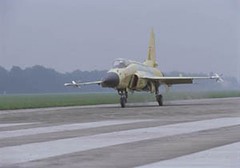 |
The aircraft is the CF-1/JF-17 Thunder fighter [sic -- see Defense Talk and Global Security for more information on the FC-1 "Chao Qi" / JF-17 Thunder] that is being made at Chengdu Aircraft Industry Corporation in the PRC and Pakistan Aeronautical Complex in Kamra. China expects to deploy 200 of the fighters by 2006; Pakistan plans to deploy 150 beginning in 2005-6.
The details emerged in a just concluded Aerospace exhibition in Zhuhai. The restricted technology in the fighter is the quadruple-redundant fly-by-wire technology and the single-crystal jet engine fan blade technology. Global Information Service recognized the fly-by-wire system as the system produced by Honeywell. This technology was approved by the Clinton administration, but only for civil use. The single-crystal jet engine fan blade technology is unique to the U.S., and had been prohibited for export, though the finished product is used on exported U.S. jet engines.
The report concludes that these fighters highlight the extent that sensitive technology was transferred from the United States to China during the Clinton administration, thereby confirming the concerns voiced in the 1999 official report of the U.S. Congress's Cox Commission.
Labels: Bill Clinton, Chao Qi, China, Defense and Foreign Affairs Daily, F-16A Block 15 fighter, FC-1/JF-17 Thunder fighter, Pakistan, PRC
main page
most recent entries
- The sting of 'cling'
- Finding Iran's long-range missile site in Google E...
- Southern Iraqi Shiite tribal leader claims Iran be...
- Rice for the Vice?
- A stash of FARC's uranium found in Columbia
- Is Condi Rice signaling an interest in being McCai...
- Saddam Hussein's regime plotted with Gaza terroris...
- An unapologetic apologia for the Iraq war
- Romanian rendezvous; Terrorists and arms dealers i...
- Saddam's support for terror: the Pentagon report's...
archives
blogs
feeds




searches
statistics
buttons
Blogroll Me!


