Friday, April 11, 2008
Finding Iran's long-range missile site in Google Earth
According to Jane's Intelligence Review, the photograph is said to reveal to a former Iraqi weapons inspector that Iran is using the site, about 230km southeast of Tehran, to develop a ballistic missile with a range of 6,000 km. Geoffrey Forden, research associate at Massachusetts Institute of Technology, is quoted as pointing out that a recently constructed building, 40 meters in length, is similar in shape and size to the North Korean long-range Taepodong missile assembly facility.
The new building is plainly visible in the lower left corner of the photograph accompanying the Times story (below), and is notably absent on the earlier Digital Globe image currently in use on Google Earth.

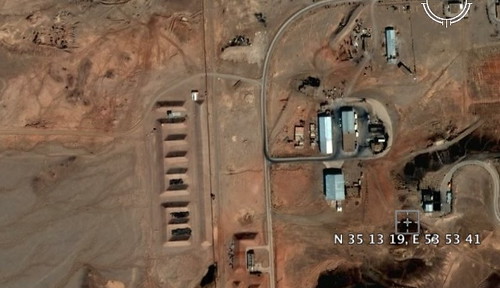
UPDATE: You can also see the Google Map imagery without leaving your browser at Flash Earth
UPDATE 2
The original story from Jane's can be found here: Iran Develops Long Range Missile Technology:
Analysis by Jane's has identified several developments at this site since the most recent open source imagery was taken in September 2004. Jane's has identified facilities at this site similar in size and form to the Taepodong assembly facility in North Korea. Measurement and Signatures Intelligence by Jane's shows features of the site are also similar to North Korean facility features that indicate this facility is the location of missile assembly.(Hat tip:TheZoo)
Jane's Proliferation Editor Avital Johanan commented: "This analysis suggests that Tehran is following the same path in its missile programme as North Korea and identifies a previously unidentified location as an important element in it. Bringing together Jane's analysis with exclusive satellite imagery provides a unique capability to offer near-real time intelligence."
Labels: DPRK, Google Earth, Iran, Jane's Intelligence Review, long-range ballistic missiles, North Korea, Taepodong-2 missile


Tuesday, February 05, 2008
A. Q. Khan to be released?
The next day, according to Pak Tribune, S.M. Zafar, Khan’s former lawyer and a Pakistan Muslim League-Quaid senator, reported that President Pervez Musharraf has lifted some restrictions on Khan, who is now permitted to meet with some close friends and colleagues.
In his memoir In the Line of the Fire and in subsequent interviews, Musharraf alleged that Khan provided nearly two dozen prototype centrifuges suitable for uranium enrichment to North Korea. The alleged existence of a secret DPRK weapons-grade uranium-enrichment program has been a key argument of former U. N. ambassador John Bolton against the denuclearization agreement reached nearly one year ago with Pyongyang.
North Korea’s U.N. representative Kim Myong Gil’s response to these allegations was reported (in "What A. Q. Khan Knows", Washington Post, January 31, 2008) to be: "Why don’t you invite A. Q. Khan to join the negotiations?" If Musharaff’s purpose for Khan's house arrest was to shield him from foreign interrogation, it is imperative, as Khan's restrictions are loosened, that the U.S. press Islamabad for more access to the man. Answers from A. Q. Khan, however unlikely, are long overdue.
Labels: A. Q. Khan, DPRK, North Korea, nuclear weapons, Pakistan, Pervez Musharraf
Tuesday, January 22, 2008
Bolton: An Israeli strike may be last chance to prevent Iranian nukes
"We don't know for example exactly what the facility was – whether it was a clone of the Yongbyon reactor; whether it was a uranium enrichment facility; whether it was a storage location for North Korean plutonium or plutonium based weapons....Bolton suggested an explanation for why the U.S. might not want these questions answered:
"We don't know if it was North Korea in effect renting space in Syria to recreate the North Korean program. We don't know if it was a sale of technology or equipment from North Korea directly to Syria and we don't know whether it was a joint venture perhaps between Syria and North Korea working together.... Our governments, however, do know the answers to some of these questions."
"...this information is being withheld for fear that if it came out that North Korea once again, following its game plan, was engaged in nuclear proliferation contrary to its obligations."
[The Bush administration's preoccupation with keeping the February 2007 agreement with North Korea alive, despite Pyongyang's missing an end-of-the-year deadline to make a full disclosure of its nuclear activities, was made evident again this week. Jay Lefkowitz, the U.S. envoy on North Korean rights, said that the DPRK was not serious about nuclear disarmament and would probably "remain in its present status" when the next U.S. president assumes office in January 2009. That comment brought an angry rebuke from Condoleezza Rice, U.S. Secretary of State, who said that Lefkowitz "does not know what is going on in the six-party talks, and he certainly has no say on what American policy will be..."]
Bolton argued that the success of the Syrian raid had obvious consequences for Iran:
"Certainly in Teheran you can bet that they took careful notice of what the Israeli Defence Force did. Penetrating Russian supplied radars very similar to the air defenses that Teheran has; using techniques that could be very useful for a long range strike against Iran; this is the kind of operation that the Iranians need to continue to worry about. Because I think with the collapse of American policy, the Israeli strike against the Syrian / North Korea facility is the harbinger of what may be – absent regime change in Teheran – the last resort… Unless you are prepared to see Iran proceed unmolested toward a nuclear weapons capability, which this NIE has given them free rein to do in my judgment, you are coming very close to a decision point in this country of whether you will use military force to stop Iran."
Postscript: Apparently, the Syrians have now built a new structure at the site of the suspected reactor. Google earth still shows a pre-September photograph of the original structure at N 35 42 28, E 39 49 59. Here are the Digital Globe photographs for pre-September 2007, October 2007, and January 2008:


ArmsControlWonk links to the Institute for Science and International Security report here: ISIS
Labels: Condoleezza Rice, DPRK, Iran, Jay Lefkowitz, John Bolton, North Korea, Syria
Monday, December 13, 2004
The Case Against North Korea Understated, Not Overstated
Harrison claimed that the Bush Administration had presented a worst-case scenario as a certainty and distorted its intelligence to exaggerate the danger that Pyongyang is secretly making uranium-based nuclear weapons. Harrison also stated that there was no evidence to support the CIA's claim in 2002 that the DPRK had acquired large quantities of fissile materials.
GIS/Defense & Foreign Affairs points to the exercises the DPRK ran in September 2004 to test its national command authority capabilities and claims they demonstrate that the regime has more nuclear weapons than the minimum required for a first-strike capability. The exercises showed that the DPRK was preparing for an ongoing nuclear conflict by testing its national-level command and control system under operational conditions.
In previous operations, the DPRK's approach was to test a launch that would be an absolute first-strike, using all available systems at the initiation of a conflict. Such an exercise only requires a coordinated launch order. Now, the command and control being exercised involves dispersed elements of strategic missile battalions, each battalion equipped with 12 mobile launchers, and each launcher supported by a reload vehicle with two additional No-Dong missiles. This exercise showed that the DPRK was preparing for a second-strike and follow-on strike operations, and had the capability of carry out a coordinated and extended operation from random launch sites. The evidence of irregular activity was noted at 10 bases, each of which could support launches from nearby positions, thereby evading preemptive enemy destruction of the bases and thwarting the prevention of the launch.
By GIS estimates, the DPRK now probably has as many as 18 deployed or deployable warhead for its No-Dong strategic missiles and its Taepo-Dong longer-range series of ballistic missiles. This means that the DPRK has at least one fully-operational, nuclear equipped No-Dong battalion ready for operations against South Korea and Japan, and at least half a battalion of nuclear equipped Taepo-Dong missiles that can reach U.S. targets in Guam, Hawaii and Alaska.
Labels: Defense and Foreign Affairs Daily, DPRK, No-Dong missiles, North Korea, nuclear weapons, Pyongyang
Monday, December 06, 2004
More of the Consequences of Perfidy
In today's Defense & Foreign Affairs Daily. Gregory R. Copley, an Editor of Global Information System, reports of a possible sale to Iran by China (PRC) of the new fighter aircraft built by China and Pakistan, the FC-1/JF-17 Thunder fighter. The fighter uses fly-by-wire systems that were transferred illegally to the PRC during the Clinton Administration.
Defense & Foreign Affairs Daily sees the sale as a likely consequence of a new accord between Iran and the PRC, formalized by the signing of a memorandum of understanding in Beijing on November 30, 2004. Under the agreement, the PRC will exchange expertise in the areas of satellites and aerospace technology.
The Bush administration responded to the memorandum of understanding by imposing additional sanctions on four organizations in the PRC and one in North Korea (DPRK). Though the Bush administration recognizes that the technology has already been lost to China and North Korea, it now sees the Iranian clerical Government as one of its most significant strategic concerns. The report claims that stolen technology, based upon a Global Positionining System, has already found its way into the guidance systems of Iranian Shabab 3D strategic ballistic missile systems that now target Israeli assets among others.
Labels: China, Defense and Foreign Affairs Daily, DPRK, FC-1/JF-17 Thunder fighter, Iran, North Korea, Pakistan, PRC
Wednesday, November 17, 2004
Kerry's Defeat, Kim's Disappearance, Leave North Korea in a State of Worry
| "The loss of this woman was a blow, but John Kerry's loss in the U.S. election was a harder one. These are now very worried men." |
One recent indication of Kim's official absence was the fact that he did not even sign North Korea's official message of condolence to the Palestinians, following the death last week of Yasser Arafat. That duty was left to Kim Yong-nam, head of the Supreme People's Assembly
Diplomats in Pyongyang have noted that some of the North Korean members of their embassy staff have been reassigned, and those remaining have become even more uneasy than is the norm about discussing current affairs. Tighter restrictions have been imposed on the movements of foreigners, and the secret police have assumed control of the mobile phone service.
Some of Sheridan's sources see the security clampdown as caused by the outcome of the U.S. election. The DPRK regime is said to view the victory of George W. Bush with alarm, inasmuch as they see the re-elected administration as determined to break their will and disarm them of nuclear weapons.
"The loss of this woman was a blow," a foreign diplomat is quoted as saying, "but John Kerry's loss in the U.S. election was a harder one. These are now very worried men."
Today's edition of Defense & Foreign Affairs Daily reports that Russian political and intelligence sources have informed Global Information System about the removal, in just the past few days, of large portraits of Kim Jong-Il from key public areas. Their sources did not attribute the changes in security procedures to the defeat of John Kerry, or to the death of Kohn Young-Hee, but instead believed the clampdown to be the result of an acute leadership crisis.
Global Information System concludes that the death or removal of Kim Jong-Il could have a profound effect along several geopolitical fronts. First, a change in leadership could disrupt the strategic alliance between the DPRK and Iran, an alliance that has resulted in both states pursuing an aggressive game of brinksmanship by the rapid development of their respective nuclear programs. Second, GIS sees a potential impact on the support by the DPRK, through their facilities in Myanmar, for South Asian terrorist and insurgency movements. "Of principal concern in this regard," claims the special report, "would be the impact such a change would have on support for the Liberation Tigers of Tamil Eelam (LTTE), in Sri Lanka, as well as on DPRK support for some non-Muslim Indian separatists." Finally, a regime change would have a probable impact on North Korea's weapons sales to Syria, Sudan, Libya and others.
Labels: Defense and Foreign Affairs Daily, DPRK, Kim Jong-il, Liberation Tigers of Tamil Eelam, North Korea, Pyongyang, Sri Lanka
Sunday, September 26, 2004
Syria Trying to Send Iraqi Nuclear Scientists to Iraq
Asad is said by Western intelligence officials to be desperate to rid his country of the scientists because of fears that Syria may be the next target of Washington's War on Terror.
The report claims that the Iraqi scientists brought to Syria CDs crammed with research data on Saddam's nuclear program. Damascus gave them new identities, including Syrian citizenship papers and falsified birth, education and health certificates. Hidden away at a secret Syrian military installation, the scientists are said to be conducting research on behalf of their new hosts.
American intelligence has other reasons to be concerned about Syrian research into WMDs. Damascus has allegedly acquired, possibly from North Korea, several gas centrifuges, necessary for enriching uranium to make a nuclear weapon.
The terms of the deal offered to the Iranians involve the transfer of the Iraqi scientists to Teheran in exchange for the Iranians agreeing to share the results of their weapons research with Damascus.
In another frightening development, Teheran announced it was pressing ahead with plans to enrich 37 tons of uranium. Experts estimate that when the process is complete that the Iranians will have enough fissile material for five nuclear bombs.
Labels: Bashir al-Assad, DPRK, Iran, North Korea, Syria, uranium enrichment
Saturday, September 25, 2004
Powell: North Korea Might Soon Test Missile
According to Japanese officials, intelligence indicates active movements of missile units around several North Korean Rodong missile launch sites. Hours after that announcement, North Korea warned it could turn Japan into a "nuclear sea of fire."
Labels: DPRK, North Korea
Chemical used in nerve gas shipped to North Korea
The South Korean Commerce Ministry is also looking into a separate allegation that 40 tons of sodium cyanide were shipped to the North by a Malaysian company. The confirmation of illegal exports came after denials on Monday that North Korea had imported sodium cyanide from Thailand, though the North Koreans had attempted to get 70 tons of the chemical from Thailand just last May.
Since 2002, South Korea has exported 146,000 tons of sodium cyanide to ten countries, including China, Thailand, Russia and Indonesia. The largest shipment of 42,300 tons was sent to China.
SOURCE: Yonhap news agency, Seoul, in English 0224 gmt 24 Sep 04
Labels: chemical weapons, DPRK, North Korea, South Korea
Thursday, September 23, 2004
North Korea About to Conduct Another Missile Test?
The Defense Ministry of South Korea has sought to calm fears. Military spokesman Brig. General Nam Dae-youn suggested that the movements were a part of annual military exercises, but acknowledged that the possibility of a test-firing could not be ignored.
Japan has deployed an Aegis-guided destroyer and some intelligence planes, including the EP-3 to the East Sea between Japan and the Korean peninsula to monitor the situation. North Korea shocked Japan in 1998 by test-firing a missile across Japan and into the Pacific Ocean.
U.S. intelligence is particularly concerned about the possibility of a test of the Taepodong-2 missile. The Taepodong-2 is believed to be capable of striking targets within a range of 3700 miles, thus representing a potential threat to Alaska and Hawaii.
Labels: DPRK, Japan, North Korea, South Korea, Taepodong-2 missile
Sunday, September 12, 2004
Ryanggang
 | |
South Korean officials deny that the explosion was caused by a nuclear test, and this opinion was reaffirmed this morning by Secretary of State Colin Powell:
"We have seen reports of this explosion, but based on all the information that we have, it was not any type of nuclear event," he said. "We are trying to find out more about it, and what exactly it was, if anything, but it does not appear to be a nuclear event." ( VOA News)
There were hints of the possibility of sabotage in the Chosun Ilbo story, which noted that the blast in the vicinity of the missile base occurred on a national holiday, September 9, North Korea’s foundation day.
| “When I activated a huge switching gear in the mountainside, the ground split open, and a missile appeared.” |
The Rodong missiles based in Yongjo-ri and elsewhere carry a smaller payload than the larger Taepodong, but the Rodong can be carried on a mobile transporter-erector from tunnels, where they can be hidden from U.S. satellites. The Daily Yomiuri suggests an explanation for the location of the Yongjo-ri tunnels: its proximity to the Sino border makes it difficult for U.S. forces to attack the facilities, since cruise missiles or bombers would have to fly over Chinese air space.
The Daily Yomiuri quotes a North Korean defector:
”When I activated a huge switching gear in the mountainside, the ground split open, and a missile appeared.”
Recent success in wooing North Korean defectors was reported last May in The Weekend Australia to be the result of a highly secret plan nicknamed “Operation Weasel.”
Another [defector] is a military officer, Park Young-soo. His debriefing notes are marked "then I asked through intermediary to elaborate on his involvement in the nuclear/missile part on his initial request".
The [debriefing notes prepared on the preliminary interrogations of the four defecting senior military officers] say Park's response was: "Worked for the unit No583 under the Military Construction Bureau to build a missile launch base in Woltan-ri, Kimhyungjik-gun Ryanggando. Also for the unit No740, 4th corp as a special instructor in military martial arts."
The four men have all been targeted as part of a plan codenamed Operation Weasel, a smuggling plot ostensibly run by private citizens from 11 countries but with inspirations that stem from one of the Pentagon's most secretive and self-contained units.
"What you have in the US, more than ever before, is a factional Government.... You have the State Department that does one thing and you have the Pentagon that does the other."
The existence of Operation Weasel, revealed by Inquirer last month, was denied by the US State Department. However, no component of the operation fell under the State Department's ambit. "What you have in the US, more than ever before, is a factional Government," says a source intimately involved with the plan.
"You have the State Department that does one thing and you have the Pentagon that does the other."
In Washington this week, the leader of a key South Korea-based humanitarian organisation, Norbert Vollersten, sat down for lunch at the Mayflower Hotel with two of the biggest fish in the Bush administration, Vice-President Dick Cheney and Defence Secretary Donald Rumsfeld.
What was discussed is not known but what is clear is that an advocate for North Korean refugees with a track record for helping defectors is considered important enough to join their table.
“North's 'weasels' go West”, Martin Chulov, Inquirer Feature Column, The Weekend Australian, May 17, 2003, Pg. 23.
Alas, no one from the Pentagon appeared on the Sunday talk shows this morning.
Labels: Colin Powell, DPRK, North Korea, nuclear weapons, Rodong missiles, South Korea
main page
most recent entries
- The sting of 'cling'
- Finding Iran's long-range missile site in Google E...
- Southern Iraqi Shiite tribal leader claims Iran be...
- Rice for the Vice?
- A stash of FARC's uranium found in Columbia
- Is Condi Rice signaling an interest in being McCai...
- Saddam Hussein's regime plotted with Gaza terroris...
- An unapologetic apologia for the Iraq war
- Romanian rendezvous; Terrorists and arms dealers i...
- Saddam's support for terror: the Pentagon report's...
archives
blogs
feeds




searches
statistics
buttons
Blogroll Me!


